
Have Questions? Talk to Expert (Binod)
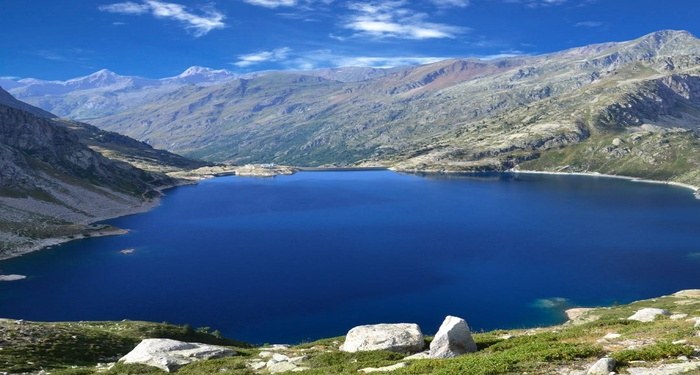
Rara Lake Trekking is one of Nepal’s most rewarding off-the-beaten-path adventures, taking travelers deep into the remote landscapes of the Karnali region. At an elevation of approximately 2,990 meters (9,810 feet) and covering about 10.8 square kilometers, Rara is Nepal’s largest lake and one of the country’s most spectacular natural attractions. The deep blue water, forested hills, surrounding mountains, peaceful villages, and extraordinary sense of isolation make Rara very different from the busy trekking routes of Everest and Annapurna.
Unlike Nepal’s more commercialized trekking destinations, Rara offers a quieter experience. The journey combines scenic domestic flights, remote mountain trails, traditional villages, historic Sinja Valley, alpine forests, high passes, and several days of walking through the spectacular landscapes of western Nepal.
For travelers who want to experience nature, wilderness, local culture, wildlife, and authentic rural Nepal away from the crowds, Rara Lake is an excellent choice.
Himalayan Adventure Intl Treks organizes Rara Lake trekking, jeep tours, customized private trips, guide and porter services, and helicopter tours. This guide explains the route, itinerary, best seasons, permits, transportation, accommodation, food, guide and porter costs, flights, jeep tours, helicopter tours, and an estimated overall budget.
Important: Prices in remote Nepal can change according to season, fuel costs, airline schedules, road conditions, group size, and availability. The costs below are therefore useful planning estimates for Trekkers, rather than a fixed quotation. Himalayan Adventure Intl Treks can provide a final quotation according to your travel dates, group size, nationality, and preferred comfort level.
Rara Lake sits inside Rara National Park, in the Karnali region of western Nepal. The Nepal Tourism Board currently lists Rara National Park at 106 sq. km and identifies activities including trekking, birdwatching, horse riding, boating, and mountain biking. The Board also describes access by air to Nepalgunj and onward to Talcha Airport, or a longer trekking approach through Jumla.
The lake is surrounded by forests dominated by blue pine, while rhododendron, juniper, spruce, oak, and cypress are also found around the lake and higher elevations. The park supports wildlife including musk deer, Himalayan black bear, leopard, Himalayan tahr and the endangered red panda.
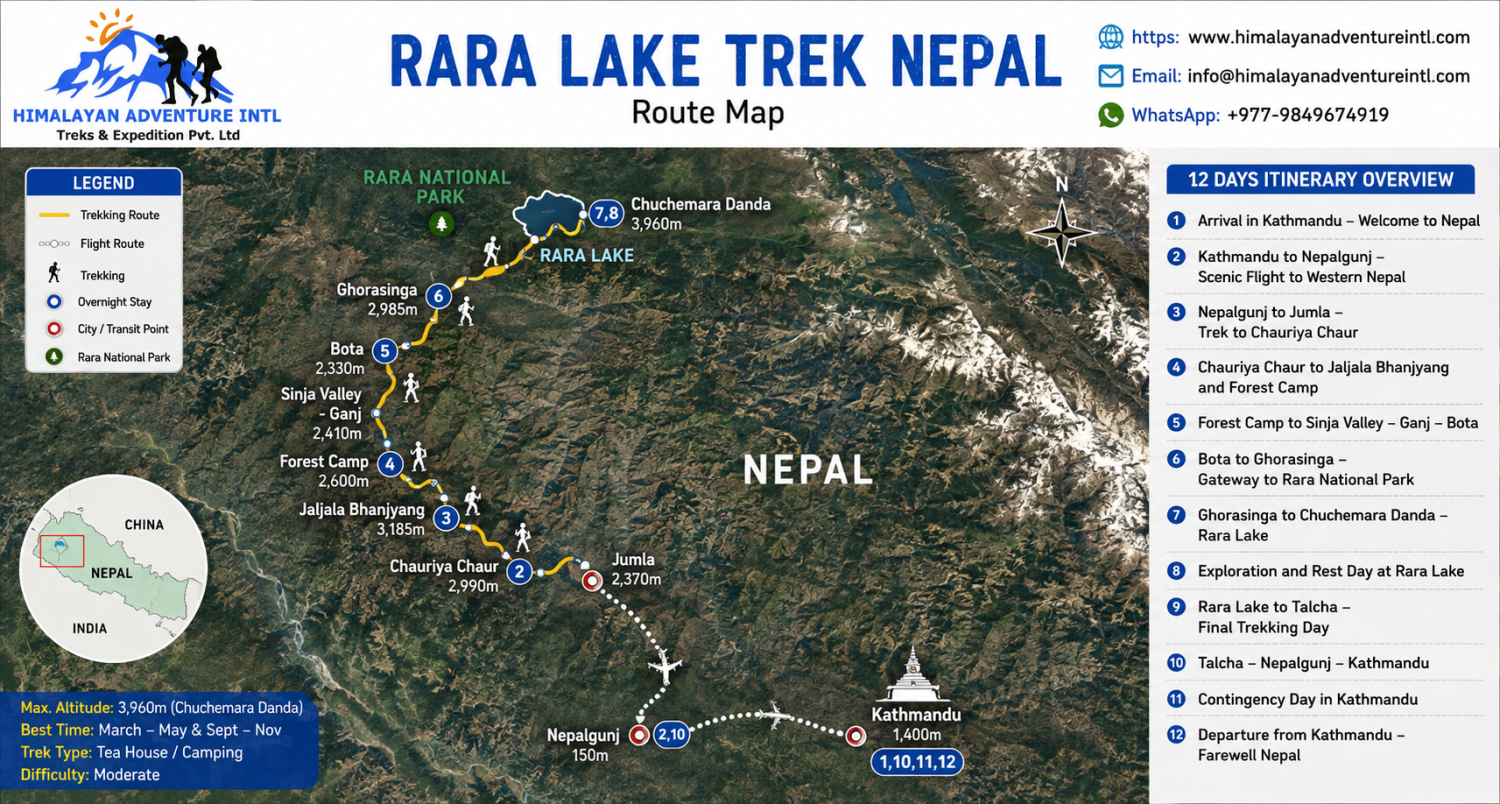
The trekking route described in the source itinerary passes through Jumla, Chere Chaur, Chalachaur, Sinja Valley, Ghorosingha, Rara Lake, Pina, Bumra and back to Jumla.
Rara is not simply another lake trek. It is an opportunity to explore one of Nepal’s least-developed trekking regions and experience landscapes that remain relatively untouched by mass tourism.
The journey begins in Kathmandu and normally continues by air to Nepalgunj and then to Jumla for the classic trekking approach. The flight itself is part of the adventure, taking you from the Kathmandu Valley through the lowlands and into the remote mountain environment of Karnali.
Once the trek begins, the landscape changes dramatically. Green agricultural fields, traditional settlements, forests, high ridges, river valleys and mountain viewpoints gradually lead toward the brilliant blue waters of Rara Lake.
One of the major attractions is Sinja Valley, historically associated with the medieval Khasa Malla kingdom. The valley adds an important cultural and historical dimension to the trek.
The route is also considerably quieter than Everest Base Camp, Annapurna Circuit or Annapurna Base Camp. That makes Rara especially attractive to photographers, nature lovers, birdwatchers, families looking for a private adventure, and experienced trekkers searching for a less crowded destination.
The source itinerary also highlights the cultural experience of Jumla, the Sinja Valley, Rara National Park, distant Himalayan views and the forests encountered along the route.
The classic Rara Lake trek from Jumla takes travelers through several remote settlements before reaching the lake.
A typical route is:
Kathmandu → Nepalgunj → Jumla → Chere Chaur → Chalachaur → Sinja Valley → Ghorosingha → Rara Lake → Pina → Bumra → Jumla → Nepalgunj → Kathmandu
The source itinerary uses a 15-day overall program, including Kathmandu sightseeing, flights, trekking, a full exploration day at Rara Lake and return travel.
The actual trekking portion is approximately one week, although the complete journey is longer because of flights, acclimatization, Kathmandu and Nepalgunj stays.
Your Rara Lake adventure begins after arrival at Tribhuvan International Airport.
A Himalayan Adventure Intl Treks representative can meet you at the airport and transfer you to your hotel in Kathmandu.
After check-in, you can rest and recover from your international journey. Later, our trekking team can provide a trip briefing covering the route, accommodation, flights, packing requirements, safety and trekking arrangements.
Altitude: Approximately 1,300 m
Accommodation: Hotel
After breakfast, enjoy a half-day cultural sightseeing tour of Kathmandu.
Depending on the schedule, you can visit major heritage attractions such as Pashupatinath, Boudhanath, Swayambhunath and Kathmandu Durbar Square.
The rest of the day is available for shopping and final preparation.
You can purchase or rent trekking equipment in Kathmandu, organize your backpack and meet your guide.
Accommodation: Hotel
The supplied itinerary similarly includes a half-day Kathmandu sightseeing program before departure toward western Nepal.
Take a domestic flight from Kathmandu to Nepalgunj.
The flight takes approximately one hour, although schedules and actual flight times can vary.
Nepalgunj is located in the Terai and is one of the principal gateways to western and far-western Nepal.
After arrival, check into your hotel and prepare for the following day’s flight toward Jumla.
Accommodation: Hotel
The source itinerary describes the Kathmandu–Nepalgunj flight as approximately one hour and recommends an overnight stay in Nepalgunj.
The next morning, take a flight toward Jumla.
Jumla lies at approximately 2,540 meters and provides a dramatic transition from Nepal’s lowland environment to the high hills of Karnali.
After arrival, spend time exploring Jumla and acclimatizing.
Because flights to remote mountain airports are weather-dependent, it is wise to maintain some flexibility in your itinerary.
Accommodation: Tea house
The supplied itinerary places Jumla at approximately 2,540 meters and includes an acclimatization day after arrival.
Today the trek officially begins.
From Jumla, the trail gradually climbs through local settlements, farmland and forest toward Chere Chaur at approximately 3,055 meters.
Walk slowly and maintain a comfortable pace because you are beginning to gain altitude.
Walking: Approximately 5–6 hours
Accommodation: Tea house
The trail continues through beautiful forest toward Jaljala Pass.
You walk through pine, birch and rhododendron landscapes before reaching higher ground. The route offers beautiful views of the surrounding mountains and eventually joins the Rara Circuit.
The destination is Chalachaur, approximately 2,980 meters.
Walking: Approximately 5–6 hours
Accommodation: Tea house
The source itinerary specifically describes the Jaljala Pass at approximately 3,580 meters and the walk through forest and grazing areas before reaching Chalachaur.
Today you descend toward historic Sinja Valley.
The trail follows the Jaljala River and passes through small settlements and traditional countryside.
Sinja is particularly important for travelers interested in Nepalese history and culture. It was an important center of the medieval Malla/Khasa kingdom.
Walking: Approximately 4–5 hours
Altitude: Approximately 2,490 m
Accommodation: Tea house
The supplied itinerary identifies Sinja Valley as a historical center associated with the Malla Dynasty and notes its ancient temples and sites.
After breakfast, continue toward Ghorosingha.
The trail follows the river upstream before climbing through small settlements and forest.
The final approach becomes steeper before reaching Ghorosingha at approximately 3,050 meters.
Walking: Approximately 5–6 hours
Accommodation: Tea house
This is one of the most exciting days of the trek.
You climb toward Chucharmare Danda and eventually reach viewpoints where the magnificent blue waters of Rara Lake begin to appear.
The first sight of Rara is often one of the most memorable moments of the entire journey.
Continue through forest and toward Chhapri village and the headquarters of Rara National Park before reaching the lake.
Walking: Approximately 6–7 hours
Accommodation: Tea house
The source itinerary describes the approach through Chucharmare Danda, forest trails and Chhapri before reaching Rara Lake.
This is your dedicated exploration day.
You can walk along the lakeshore, photograph the scenery, explore surrounding forests and simply enjoy the extraordinary peacefulness of Rara.
For stronger trekkers, an excursion toward Murma Top can provide a spectacular elevated view of the lake.
Boating may also be possible depending on local conditions and operating arrangements.
Swimming should not be considered part of the itinerary because protecting the lake environment is important.
The source itinerary also recommends spending the day around Rara Lake and mentions Murma Top, boating on suitable days and observing the changing colors of the lake.
Leave the lake behind and descend toward Pina.
The route passes toward Gamgadhi and continues through forest and local settlements before reaching Pina.
Walking: Approximately 4–5 hours
Altitude: Approximately 2,440 m
Accommodation: Tea house
Today the route continues toward Bumra.
You cross Ghurchi Langna Pass at approximately 3,480 meters and then descend through the surrounding landscape.
The route provides excellent views of the Karnali region.
Walking: Approximately 5–6 hours
Accommodation: Tea house
This is the final trekking day.
The route crosses suspension bridges and continues through mountain villages before reaching a hot spring where you can relax.
The trail then crosses Danphe Lagna Pass and eventually reconnects with the earlier route toward Jumla.
Walking: Approximately 5–6 hours
Accommodation: Tea house
The supplied itinerary includes the hot spring, Danphe Lagna Pass at approximately 3,691 meters and the return to Jumla.
Take the flight from Jumla to Nepalgunj.
Depending on the airline schedule, connect onward to Kathmandu.
After reaching Kathmandu, transfer to your hotel and enjoy a final evening in Thamel.
Accommodation: Hotel
Depending on your international flight schedule, Himalayan Adventure Intl Treks can arrange your airport transfer.
We recommend arriving at Tribhuvan International Airport approximately three hours before an international departure.
The total price depends heavily on:
For this reason, Himalayan Adventure Intl Treks normally prepares a customized quotation rather than publishing one universal price.
A comfortable guided trekking package can commonly be budgeted around USD 1,200–1,700 per person for a small international group when flights, guide, porter sharing, accommodation, meals and permits are included. Premium private arrangements can cost more.
Hiring a licensed local trekking guide is strongly recommended for the classic Jumla–Rara route.
For Himalayan Adventure Intl Treks, a useful planning rate is approximately:
This planning rate covers the guide's daily service, food and accommodation arrangements. Additional expenses such as insurance, transportation and special language requirements may be budgeted separately depending on the package.
A guide is especially valuable in Rara because the route is remote and infrastructure is more limited than on popular trekking routes.
A professional guide can assist with:
For a 12-day operational period, guide service at USD 30 per day would represent approximately USD 360 before any separate transportation, insurance or special-service costs.
A porter makes the trek substantially easier, especially because the route includes multiple passes and long walking days.
One porter normally carries the combined luggage of two trekkers, subject to a reasonable weight limit.
For example, if two travelers share one porter, the approximate porter cost can be around USD 10 per person per day.
A porter can carry your main duffel while you carry a small daypack containing:
For a remote trek such as Rara, we recommend using a porter rather than carrying all your equipment yourself unless you are an experienced backpacker.
Budget travelers sometimes prefer a porter-guide, who can provide basic guiding assistance while carrying luggage.
A useful planning figure is approximately:
However, a porter-guide is not equivalent to a fully licensed professional trekking guide in terms of experience, leadership and responsibilities.
For first-time trekkers or private international groups, Himalayan Adventure Intl Treks recommends a licensed guide plus porter arrangement.
One important advantage of Rara is that the main protected-area fee is straightforward.
The Nepal Tourism Board currently lists Rara National Park entry at:
These are current figures published by the Nepal Tourism Board.
The Nepal Tourism Board also confirms that park entry fees can be paid through authorized tourism channels or at designated entry points.
Trekking documentation and TIMS requirements can change according to current government rules and route classification. Therefore, Himalayan Adventure Intl Treks checks the applicable requirements when confirming your trip rather than asking travelers to rely on outdated permit information.
The supplied itinerary lists Rara National Park entry, necessary trekking permits and TIMS among its included arrangements.
Food is one of the most important budget considerations on a remote trek.
Typical tea-house meals include:
A realistic planning budget for food and accommodation combined is approximately:
Remote areas can be more expensive than Kathmandu because food must be transported long distances.
Drinking water, hot drinks, snacks, chocolate and bottled beverages are generally additional.
Accommodation on the classic route is generally in basic local tea houses or lodges.
Rooms are usually simple, with beds, mattresses and blankets. Bathroom facilities may be shared.
USD 10–20 per person per night
However, the room itself can sometimes be inexpensive while food and drinks make up a larger part of the daily bill.
In the supplied itinerary, tea-house accommodation is used throughout the trekking section, with hotel accommodation in Kathmandu and Nepalgunj.
Because Rara is remote, trekkers should not expect the same facilities available at popular Everest or Annapurna tea houses.
Transportation depends on the route.
This is the classic trekking approach.
Current airline information confirms regular Kathmandu–Nepalgunj service, while Nepal Airlines lists Nepalgunj–Jumla and Jumla–Nepalgunj services.
As a planning estimate, international visitors should budget approximately:
Kathmandu–Nepalgunj: USD 90–180 one way
Nepalgunj–Jumla: approximately USD 100–180 one way
Actual fares vary according to airline, booking date, season, nationality, fare class and availability.
A current CAAN fuel-surcharge document lists Nepalgunj–Jumla and Nepalgunj–Talcha sectors among Nepal's domestic routes, illustrating why fares can change with fuel surcharges.
For a round trip through Jumla, therefore, it is sensible to reserve roughly USD 400–700 per person for domestic flights when building a preliminary international-traveler budget.
If your objective is simply to visit Rara Lake rather than complete the classic Jumla trek, you can consider flying from Nepalgunj to Talcha Airport, the nearest airport to Rara.
The Nepal Tourism Board describes the Talcha option as approximately a two-hour trek to Rara Lake, compared with approximately 2.5 days by trekking via Jumla.
This is an excellent option for travelers with limited time.
A jeep tour is one of the easiest ways to reach Rara without completing a long trekking itinerary.
Road conditions in Karnali can be challenging, and travel times are highly dependent on weather, road construction and monsoon conditions.
A current 2026/27 market example advertises Rara jeep packages from approximately USD 499 per foreign traveler from Kathmandu, while its Nepalgunj package starts around USD 385.
Another current 2026/27 Rara jeep package is advertised at approximately USD 1,600 per person for a longer seven-day Kathmandu round trip, illustrating how dramatically package costs can differ according to inclusions and service level.
For Himalayan Adventure Intl Treks, we recommend quoting private jeep trips based on:
A private jeep is particularly suitable for families, senior travelers and groups that want to avoid long trekking days.
For travelers with very limited time, a helicopter tour is the fastest and most comfortable option.
A helicopter journey can connect Kathmandu, Nepalgunj and Rara depending on the charter plan and weather.
Helicopter prices are substantially higher than trekking or jeep travel because the aircraft is normally chartered.
Current 2026/27 market examples show:
Therefore, Himalayan Adventure Intl Treks recommends budgeting approximately USD 2,000–4,500 per person for a shared/premium helicopter experience, with private charter pricing quoted separately.
Helicopter prices depend on:
Helicopter tours remain weather-dependent, and a confirmed booking does not eliminate operational restrictions caused by poor visibility or unsafe flying conditions.
A helicopter trip is ideal for:
It provides an extraordinary aerial perspective of the Karnali landscape and allows you to experience Rara without spending a week trekking.
The best seasons are generally spring and autumn.
The Nepal Tourism Board currently identifies February–April and October–November as the best season for Rara National Park.
Spring brings pleasant daytime conditions, clearer mountain views and flowering vegetation.
March and April are particularly attractive for travelers interested in forests, flowers and photography.
Temperatures can still be cold at night, particularly at higher elevations.
Autumn is arguably the most reliable season.
After the monsoon, the air is generally clearer, mountain visibility improves and the surrounding landscapes are fresh and green.
October and November are excellent for trekking, photography and cultural exploration.
Rara can become very cold in winter.
Snow may cover surrounding ridges and high passes. Some facilities and transportation services can also be affected by winter conditions.
Experienced trekkers who are properly equipped may enjoy the winter landscape, but it requires additional preparation.
June to September is the least predictable period.
Heavy rain can create muddy and difficult roads, landslides and flight disruptions.
However, monsoon can produce very green landscapes, and adventurous travelers may still consider Rara with adequate flexibility.
The Rara Lake trek is generally considered moderate to adventurous.
It is not technically a mountaineering expedition, but trekkers should be prepared for:
The route's highest points vary according to the itinerary and optional viewpoints. The supplied itinerary includes passes such as Jaljala and Danphe Lagna and reaches elevations above 3,500 meters.
Good cardiovascular fitness and previous hiking experience are helpful but not mandatory for a fit traveler.
For a comfortable trek, bring:
Travel insurance is strongly recommended.
Your policy should cover:
Do not assume that a standard holiday insurance policy covers trekking in remote Nepal.
Before departure, check the maximum altitude covered by your insurance and whether helicopter rescue is included.
For the Jumla–Rara route, we strongly recommend hiring a guide.
Rara is much less developed than the major trekking destinations, and the availability of accommodation, transportation and communication can be limited.
A guide also supports the local economy and helps you interact with communities respectfully.
Himalayan Adventure Intl Treks can arrange:
Rara can be suitable for active families, particularly when using a private itinerary.
For families with children or older travelers, a jeep-based Rara tour can be easier than the full Jumla trekking route.
For active families, the classic trek can be customized with shorter walking days and additional rest days.
Rara is a fantastic destination for photography.
The combination of blue water, forests, mountains, villages, clouds and changing light creates excellent opportunities throughout the day.
Photographers should allow extra time rather than rushing from one village to another.
Early morning is particularly valuable because the lake can be calm and mountain reflections may be visible.
Murma Top is another excellent viewpoint for panoramic compositions.
Rara National Park is home to rich biodiversity.
The Nepal Tourism Board lists wildlife such as red panda, musk deer, Himalayan black bear, leopard and Himalayan tahr, while the park's forests support numerous bird species.
Wildlife sightings cannot be guaranteed. The forest environment is large and animals are naturally cautious.
A guide familiar with the local environment can improve your chances of identifying tracks, birds and other wildlife.
| Expense | Estimated Cost |
|---|---|
| Licensed trekking guide | USD 30/day |
| Porter | USD 20/day |
| Porter-guide | USD 25/day |
| Trek food + accommodation | USD 35–45/day |
| Rara National Park – foreigner | NPR 3,000 |
| Rara National Park – SAARC | NPR 1,500 |
| Kathmandu–Nepalgunj flight | Approx. USD 90–180 one way |
| Nepalgunj–Jumla flight | Approx. USD 100–180 one way |
| Jeep tour | Approx. USD 385–1,600+, depending on package |
| Shared helicopter tour | Approx. USD 1,800–4,500+ |
| Private helicopter charter | Can exceed USD 9,000 |
| International airfare | Depends entirely on origin/date/airline |
These are planning figures, not guaranteed quotations. Current park fees are based on Nepal Tourism Board information, while flight and helicopter figures reflect current published airline/operator information and can change.
A comprehensive package can include:
The supplied source itinerary similarly lists airport transfers, Kathmandu accommodation, sightseeing, flights, licensed guide, porter, trekking meals and accommodation, permits, equipment, staff insurance and government taxes among package inclusions.
Unless specifically requested, a package normally excludes:
The supplied itinerary also identifies international airfare, visa, personal expenses, drinks, tips, rescue/evacuation and special accommodation as exclusions.
Himalayan Adventure Intl Treks specializes in customized trekking and adventure holidays throughout Nepal.
For Rara, our team can arrange the complete journey from Kathmandu, including flights, accommodation, guides, porters, permits and transportation.
We can customize the trip according to:
Our objective is to make a remote Himalayan journey easier and safer while preserving the authentic character of the destination.
Absolutely.
Rara Lake is one of Nepal's most beautiful destinations for travelers who want something different from the country's famous trekking routes.
The journey is not simply about reaching a lake. It is about experiencing the remote Karnali region, flying into Jumla, walking through traditional villages, exploring historic Sinja Valley, crossing forested mountain passes, meeting local communities and finally seeing the extraordinary blue waters of Rara.
For travelers with enough time and reasonable fitness, the Jumla–Rara Lake trek provides the most rewarding experience.
For travelers with limited time, the Talcha flight or jeep tour provides a faster alternative.
For travelers seeking maximum comfort and minimum travel time, a helicopter tour offers a spectacular premium experience.
With the right planning, guide, permits, transportation and weather flexibility, Rara Lake can become one of the most memorable journeys of your Nepal adventure.
Himalayan Adventure Intl Treks can organize Rara Lake trekking, private jeep tours, group departures, guide and porter services, domestic flights and helicopter tours from Kathmandu, Nepalgunj or other locations in Nepal. Contact us for a customized itinerary and current quotation based on your group size and travel dates.
Elevation: Kathmandu – 1,350 m
Trekking: No trekking
Walking: Approximately 1–2 hours around the hotel if desired
Accommodation: Hotel in Kathmandu
Meals: Welcome dinner
Welcome to Nepal! Upon your arrival at Tribhuvan International Airport in Kathmandu, our representative and trekking guide will meet you outside the arrival terminal. After completing the airport formalities, you will have a short and comfortable transfer to your hotel in central Kathmandu.
Once you check in, take some time to rest after your international journey. Kathmandu is a fascinating city where ancient temples, traditional courtyards, historic monuments and modern urban life exist side by side. Your trekking guide will meet you at the hotel and provide a comprehensive briefing about your upcoming Rara Lake Trek.
The briefing covers the trekking route, accommodation, meals, transportation, weather, packing requirements, safety procedures and the role of the guide, porter and support crew. You will also have an opportunity to check your trekking equipment and make any final preparations.
In the evening, join your trekking team for a traditional Nepali welcome dinner at a typical local restaurant. Enjoy authentic Nepalese dishes while experiencing traditional music and cultural folk performances.
This first evening provides a wonderful introduction to Nepalese hospitality and gives the group an opportunity to get acquainted before heading toward the remote western Himalaya.
Elevation: Kathmandu 1,350 m | Nepalgunj approximately 150 m
Trekking: No trekking
Flight: Approximately 50 minutes
Accommodation: Hotel in Nepalgunj
Meals: Breakfast
Enjoy a relaxed morning in Kathmandu before beginning the next stage of your Rara Lake adventure. The morning is intentionally kept free so that you can rest, organize your backpack and complete any final trekking preparations.
After breakfast, you can spend some time checking your equipment and packing your belongings for the remote mountain journey ahead. Your guide will help ensure that your trekking bags are properly organized before departure.
In the afternoon, transfer to Kathmandu's domestic airport for your flight to Nepalgunj, a major gateway to the remote Karnali and far-western regions of Nepal.
The flight takes around 50 minutes. On clear days, the aircraft offers wonderful aerial views of the Himalayan range, middle hills, valleys and changing landscapes as you travel from the Kathmandu Valley toward the warmer lowlands.
Nepalgunj lies in the southwestern part of Nepal near the Indian border and has a considerably warmer, subtropical climate compared with Kathmandu and the mountain regions. After landing, meet the local representative and transfer to your hotel.
Depending on your arrival time, you can take a short walk around the city, explore the local streets and markets or simply relax at your hotel.
Elevation: Jumla approximately 2,540 m | Chauriya Chaur approximately 2,600–2,800 m
Trekking: Approximately 4–5 hours
Flight: Approximately 35–45 minutes
Accommodation: Camping
Meals: Breakfast, lunch and dinner
Rise early for the exciting flight from Nepalgunj to Jumla, one of the most important gateways to western Nepal's remote mountain districts.
After breakfast, transfer to Nepalgunj Airport and board a small mountain aircraft. The flight itself is an adventure, passing over rolling green hills, deep valleys, terraced farmland and rugged mountain landscapes before landing at Jumla's small airstrip.
Jumla is the administrative center of Jumla District and is known for its distinctive highland farming traditions, fertile valleys and remote mountain culture. The region is considerably different from the busy trekking corridors around Everest and Annapurna.
After meeting the trekking crew, organize the baggage and begin walking. Today's trail starts with a gradual climb through traditional farming settlements. You will pass cultivated fields, stone houses and local villages where people continue traditional agricultural practices.
As the trail moves away from the settlements, the surroundings become quieter and more natural. The walking pace is deliberately moderate because this is your first trekking day.
After several hours of walking, reach Chauriya Chaur, a peaceful farming settlement where your camp will be prepared. Enjoy dinner with the trekking crew and spend your first night under the western Himalayan sky.
Elevation: Jaljala Bhanjyang approximately 3,500–3,600 m
Trekking: Approximately 6–7 hours
Accommodation: Camping
Meals: Breakfast, lunch and dinner
Today the Rara Lake adventure moves deeper into the remote wilderness. After an early breakfast, leave Chauriya Chaur and gradually head north along the mountain trail.
The route initially passes through rural landscapes before entering beautiful forested terrain. Pine and birch trees dominate the hillsides, creating a peaceful atmosphere as the trail climbs higher. The sound of birds, mountain streams and wind moving through the forest accompanies you throughout the walk.
The main objective of today's trek is Jaljala Bhanjyang, a scenic mountain pass and one of the important high points along the route. The climb is gradual but can feel demanding because of the increasing elevation.
Once you reach the pass, take time to rest and enjoy the spectacular mountain panorama. In clear weather, the surrounding Himalayan wilderness opens up dramatically, with views toward Kanjibroba Himal and other distant peaks.
After enjoying the viewpoint, begin descending on the opposite side of the ridge. The trail gradually loses elevation as it passes through changing vegetation and open mountain terrain.
After several hours of descent, reach a suitable grassy area where the trekking crew establishes camp. Enjoy a warm meal and relax beside the campsite after a rewarding day in the mountains.
Elevation: Sinja approximately 2,500–2,600 m
Trekking: Approximately 6–7 hours
Accommodation: Camping near Bota
Meals: Breakfast, lunch and dinner
Today's walk combines spectacular natural scenery with the fascinating history of western Nepal. After breakfast, begin descending along a winding mountain trail.
The route follows the Jaljala Khola, passing through dense pine forest and gradually entering more cultivated landscapes. As the trail descends, the environment changes from forested mountain slopes to terraced farmland and traditional settlements.
Eventually, you reach the historic Sinja Valley, one of the most culturally significant areas along the Rara Lake route. Sinja was an important center of the ancient Khasa/Malla Kingdom and is associated with the development of the Khas language and culture.
As you explore the area, you may see remnants of ancient temples, carved stones, monuments and archaeological remains. Many of these historic structures are weathered and partly covered with moss, giving the valley a fascinating atmosphere.
After exploring Sinja, continue upstream toward the small village of Ganj. This is a suitable place to take a lunch break and refresh before continuing.
The afternoon trail becomes more rugged as it enters an interesting gorge. Continue through the valley toward Bota, where camp is established for the night.
Elevation: Ghorasinga approximately 3,000 m
Trekking: Approximately 5–6 hours
Accommodation: Camping
Meals: Breakfast, lunch and dinner
The journey toward Rara Lake continues today as you leave Bota and head north through increasingly beautiful mountain scenery.
After breakfast, begin walking along a pleasant trail following the valleys of Sinja Khola and Ghatte Khola. The route passes through forests, open areas and traditional farmland while gradually gaining elevation.
The scenery becomes increasingly wild as you approach Rara National Park, Nepal's smallest national park by area but one of its most beautiful protected landscapes.
The forest provides habitat for a variety of Himalayan wildlife and birds. Depending on the season and conditions, you may see colorful birds and other wildlife along the trail. Your guide will help identify interesting plants, birds and natural features.
The walk continues toward Ghorasinga, situated close to the entrance and rim of Rara National Park. The settlement is small and peaceful, with a local police post serving the surrounding region.
The campsite is established in or around the village. As evening approaches, the atmosphere becomes especially peaceful, with mountain scenery surrounding the settlement.
Rest well tonight because tomorrow is one of the most spectacular days of the entire trek—you will cross Chuchemara Danda and finally reach Rara Lake.
Elevation: Chuchemara Danda 4,260 m | Rara Lake approximately 2,990 m
Trekking: Approximately 7–8 hours
Accommodation: Lodge/camp near Rara Lakeside
Meals: Breakfast, lunch and dinner
Today is the main highlight of the Rara Lake Trek.
Wake early and prepare for a challenging but extremely rewarding day. After breakfast, begin the steady uphill climb toward Chuchemara Danda, the highest point reached during the trek at approximately 4,260 meters.
The climb takes you through changing vegetation and increasingly open mountain terrain. As you gain altitude, the views become broader and more spectacular.
Reaching the summit of Chuchemara Danda is a major achievement. From the ridge, enjoy an extraordinary panorama across the Rara region. On clear days, you can see Rara Lake below, surrounded by forested hills, rolling green landscapes and distant snow-covered Himalayan peaks.
After taking photographs and enjoying the mountain panorama, begin the long descent toward Rara Lake.
The trail passes through forests containing birch and bamboo, creating a beautiful contrast with the open ridge above. Continue downhill until reaching the Khatyar Khola. Cross the stream and continue along the trail toward the lake.
Eventually, the blue waters of Rara Lake appear through the forest—a truly memorable moment after several days of trekking.
Arrive at the lakeshore and settle into a simple lodge or campsite. Enjoy a warm dinner while surrounded by the peaceful landscape of Nepal's largest lake.
Elevation: Rara Lake approximately 2,990 m
Trekking: Approximately 3–5 hours of optional walking
Accommodation: Rara Lakeside lodge/camp
Meals: Breakfast, lunch and dinner
After several consecutive days of trekking, today is dedicated to rest, exploration and enjoying Rara Lake.
There is no need to rush in the morning. Wake up beside the lake and enjoy breakfast while taking in the peaceful scenery. Rara Lake is famous for its deep blue and turquoise waters, surrounded by forest-covered hills and distant mountain peaks.
Take a leisurely walk along the lakeshore, photograph the changing colors of the water and explore the surrounding forest trails. You may also hike to a nearby viewpoint or observation tower for a broader panoramic perspective.
From higher ground, the beauty of Rara Lake becomes even more impressive. The lake stretches through the valley like a giant blue jewel, while green hills rise around it and snow-capped mountains appear in the distance when visibility is good.
You can spend the afternoon relaxing by the lakeshore, reading, taking photographs or enjoying conversations with your trekking companions and guide.
This rest day is also useful for allowing your body to recover after crossing Chuchemara Danda. The quieter schedule gives you time to fully appreciate the wilderness rather than simply passing through it.
Elevation: Rara Lake approximately 2,990 m | Talcha approximately 2,700–2,800 m
Trekking: Approximately 4–5 hours
Accommodation: Local lodge in Talcha
Meals: Breakfast, lunch and dinner
After enjoying your final breakfast beside Rara Lake, begin the return journey toward Talcha, where the region's small mountain airstrip provides an important connection with Nepalgunj.
Today's walk is comparatively shorter, allowing you to enjoy a final opportunity to experience the forests and hills surrounding Rara National Park.
The trail follows an alternative route away from the lake and gradually descends toward Talcha. Along the way, enjoy views of forested ridges, traditional settlements and the remote landscape of the Mugu region.
As you approach Talcha, the environment becomes more familiar with signs of the small local settlement and airfield appearing ahead.
After arriving at Talcha, check into a simple local lodge and relax. This is also an emotional evening because the trekking portion of your adventure is coming to an end.
Take time to thank your porters, guide, cooks and camping crew who supported the journey through this remote region. Enjoy a final evening together before leaving the Rara area.
Your flight schedule will depend heavily on local weather and operational conditions, so your guide will confirm the departure arrangements for the following morning.
Elevation: Talcha approximately 2,700–2,800 m | Nepalgunj approximately 150 m | Kathmandu 1,350 m
Trekking: Approximately 1–2 hours walking/airport transfer
Flight: Talcha–Nepalgunj and Nepalgunj–Kathmandu
Accommodation: Hotel in Kathmandu
Meals: Breakfast
Wake early at Talcha and have breakfast before making your way toward the small airfield.
The flight from Talcha to Nepalgunj is one of the most exciting parts of the return journey. Weather permitting, the aircraft provides aerial views of the rugged western Nepal landscape, including deep valleys, forested hills and remote mountain settlements.
After landing in Nepalgunj, you will have time to rest, refresh and have something to eat before connecting with your flight to Kathmandu.
Continue your journey by air to the capital. After arriving in Kathmandu, our representative will meet you and transfer you back to your hotel.
The afternoon is free for relaxation. You may want to enjoy a comfortable shower, rest after the long journey or explore nearby restaurants and shops.
You can also use this time to purchase souvenirs or local handicrafts as a reminder of your journey through western Nepal.
Elevation: Kathmandu – 1,350 m
Trekking: No trekking
Accommodation: Hotel in Kathmandu
Meals: Breakfast
Today is deliberately reserved as a contingency or spare day for the Rara Lake Trek.
Flights to remote mountain airports such as Jumla and Talcha are highly dependent on weather and visibility. Mountain clouds, strong winds, rain, fog or other operational factors can sometimes cause delays or cancellations. Keeping an additional day in the itinerary provides valuable flexibility and helps protect your international departure schedule.
If your journey has proceeded exactly according to plan and you have already returned to Kathmandu, this becomes a free day.
You can use the day to explore some of Kathmandu's cultural attractions, visit historic temples and courtyards, shop for souvenirs or simply relax at your hotel.
For travelers interested in Nepalese culture, Kathmandu offers plenty of opportunities to discover traditional architecture, local markets, handicrafts and historic neighborhoods.
Alternatively, simply enjoy a relaxed final day after your remote Himalayan adventure. Look back through your photographs, share stories with fellow trekkers and enjoy a final dinner in Kathmandu.
Elevation: Kathmandu – 1,400 m
Trekking: No trekking
Meals: Breakfast
Today marks the conclusion of your unforgettable Rara Lake Trek.
Depending on your international flight departure time, enjoy your final breakfast at the hotel and complete your check-out. Our representative and guide will meet you and arrange your private transfer to Tribhuvan International Airport.
The airport transfer is scheduled according to your international flight time, allowing sufficient time for check-in, security procedures and immigration formalities.
As you leave Nepal, you will carry memories of a remarkable journey through one of the country's least-visited and most beautiful regions. From the traditional villages around Jumla and the historic remains of Sinja Valley to the forests of Rara National Park, the high viewpoint of Chuchemara Danda and the tranquil shores of Rara Lake, this trek offers an extraordinary combination of nature, culture and adventure.
Rara Lake is particularly special because of its remote setting and peaceful atmosphere. Unlike Nepal's busier trekking routes, the Rara region offers a genuine wilderness experience where traditional lifestyles and pristine landscapes remain central to the journey.
We hope your Rara Lake adventure has been filled with unforgettable scenery, warm hospitality and meaningful experiences.
Safe travels and farewell from Nepal!
| Particular | Details |
|---|---|
| Trek Duration | Approximately 12 days |
| Trekking Region | Jumla – Sinja – Rara Lake – Talcha |
| Highest Point | Chuchemara Danda – 4,260 m |
| Rara Lake Elevation | Approximately 2,990 m |
| Daily Trekking | Approximately 4–8 hours |
| Starting Point | Jumla |
| Ending Point | Talcha |
| Main Attraction | Rara Lake |
| National Park | Rara National Park |
| Historic Site | Sinja Valley |
| Main Mountain Viewpoint | Chuchemara Danda |
| Accommodation | Hotels, camping and simple local lodges |
| Main Flights | Kathmandu–Nepalgunj–Jumla and Talcha–Nepalgunj–Kathmandu |
| Contingency | 1 additional day recommended |
| Trek Difficulty | Moderate to challenging |
| Best Feature | Remote wilderness, culture, forests and spectacular Rara Lake |
Note: Flight schedules, trekking hours, campsites and exact elevations can change because of weather, trail conditions and local logistics. The guide will make the final day-to-day decisions to ensure the safest and most comfortable journey possible.
The Rara Lake Trek is one of Nepal’s most rewarding off-the-beaten-path adventures, designed for travelers who want to experience pristine nature, remote mountain communities, peaceful trails, and the remarkable beauty of western Nepal. Organized by Himalayan Adventure Intl Treks, this journey takes you away from Nepal’s busier trekking corridors and into the tranquil landscapes surrounding Rara Lake, Nepal’s largest lake.
Rara Lake lies at approximately 2,990 meters above sea level in Mugu District within Rara National Park. Often called the “Queen of Lakes,” Rara is famous for its deep blue and exceptionally clear water, forested shoreline, alpine surroundings, and spectacular reflections of the surrounding mountains.
Unlike the Everest, Annapurna, or Langtang regions, the Rara area receives comparatively fewer international trekkers. This makes the journey particularly appealing to travelers looking for solitude and a more authentic encounter with rural Nepal. The trek combines scenic flights, remote mountain trails, traditional villages, dense forests, alpine landscapes, wildlife, and time beside the beautiful lake itself.
The classic Rara Lake Trek generally takes around 15 days, although the exact duration can be adjusted according to transportation schedules, weather, trail conditions, and the interests of the trekking group. Himalayan Adventure Intl Treks carefully arranges transportation, accommodation, permits, guides, porters, meals, and other essential services so that travelers can concentrate on enjoying the journey.
| Category | Details |
|---|---|
| Destination | Rara Lake, Mugu, Western Nepal |
| Approx. Lake Elevation | 2,990 m |
| Trek Duration | Around 15 days |
| Trek Style | Tea house / lodge trekking |
| Difficulty | Moderate |
| Highest Major Point | Around 3,450 m at Ghurchi Lagna Pass |
| Starting Point | Jumla |
| Major Access | Kathmandu – Nepalgunj – Jumla |
| Main Attraction | Rara Lake |
| Protected Area | Rara National Park |
| Best Seasons | Spring and Autumn |
| Trekking Hours | Approximately 4–7 hours per day |
| Suitable For | Fit beginners and experienced trekkers |
| Main Features | Lake, forests, mountains, villages, wildlife and culture |
Rara Lake offers a very different experience from Nepal’s famous high-altitude trekking routes. There are no enormous crowds, busy teahouse settlements, or heavily commercialized trekking corridors. Instead, the trail leads through quiet forests, traditional villages, open ridges, farmland, and remote landscapes.
The journey is ideal for travelers who want to explore a less-developed part of Nepal while still enjoying an organized trekking experience.
The most attractive aspects of the trek include:
For travelers who have already explored the popular trekking areas of Nepal and want something different, Rara is an excellent choice.
A typical 15-day itinerary can be arranged as follows. The exact program may be adjusted depending on flight schedules, weather, road conditions, and local circumstances.
Your Rara Lake adventure begins with your arrival at Tribhuvan International Airport in Kathmandu. A representative from Himalayan Adventure Intl Treks will welcome you at the airport and transfer you to your hotel.
After check-in, you can rest and recover from your journey. If your arrival time allows, there may also be an opportunity to explore parts of Kathmandu or meet your trekking guide for a briefing.
Overnight in a 3-star hotel in Kathmandu.
Before heading toward western Nepal, you can spend time exploring Kathmandu's cultural heritage. Depending on your schedule, visits can be arranged to important historical and religious landmarks.
This day is also useful for final trek preparation. Your guide will check your equipment, explain the trekking route, discuss safety procedures, and answer questions about the journey.
Overnight in Kathmandu.
Today you take a domestic flight from Kathmandu to Nepalgunj in southwestern Nepal.
The flight provides an excellent introduction to the changing geography of Nepal. As the aircraft leaves Kathmandu, the landscape gradually changes from the central hills toward the warmer plains and western region.
Upon arrival in Nepalgunj, you will be transferred to your hotel.
Overnight in Nepalgunj.
After breakfast, you take a flight from Nepalgunj to Jumla, an important gateway to the Rara region.
Jumla has a distinctive landscape and culture, and the surrounding area is known for traditional agriculture and high-altitude settlements.
After arriving in Jumla and completing preparations, the trekking portion of your adventure begins.
Overnight at a local lodge or teahouse.
Over the following days, the trail gradually crosses forests, ridges, villages, farmland, and mountain terrain.
You will encounter traditional settlements where everyday life remains closely connected to agriculture, livestock, forests, and seasonal mountain conditions.
The trail includes gradual climbs as well as steeper sections. Your guide will maintain a comfortable pace and arrange appropriate rest stops.
The crossing of Ghurchi Lagna Pass, around 3,450 meters, is one of the notable sections of the journey.
The most anticipated day of the trek arrives as you approach Rara Lake.
After walking through the surrounding forest and landscape, the first view of the lake can be an unforgettable moment. The blue water, forested hills, open sky, and mountain surroundings create a spectacular natural setting.
You will have time to enjoy the shoreline, take photographs, walk around the lake area, and simply appreciate the peaceful environment.
Overnight near Rara Lake.
Today is dedicated to enjoying the Rara Lake area.
You can explore different viewpoints, walk along sections of the lakeshore, photograph the landscape, and observe the surrounding forests and birdlife.
The changing light throughout the day can produce different shades of blue and green across the lake.
This is also an excellent opportunity to slow down after several days of trekking.
Overnight near Rara Lake.
After spending time at Rara Lake, the return journey begins.
The route follows trails through forests, villages, and mountain landscapes. Although you have already walked through some of these areas, the scenery can look completely different when viewed from the opposite direction.
Overnight at a local teahouse.
After completing the remaining section of the trek, you return toward Jumla and continue the journey according to the available flight schedule.
Depending on local conditions and flight availability, your overnight location may vary.
You return to Kathmandu and connect with your international departure flight according to your schedule.
Himalayan Adventure Intl Treks provides airport transfer assistance, helping you reach the airport comfortably and on time.
At Himalayan Adventure Intl Treks, we understand that arriving in a new country can sometimes be confusing, particularly after a long international flight.
For this reason, we provide complimentary airport pickup and drop-off service for our Rara Lake Trek clients arriving in Kathmandu.
Upon arrival at Tribhuvan International Airport, one of our representatives will meet you and transfer you safely to your designated hotel in Kathmandu Valley.
Our representative will assist you with the transfer and help make your first moments in Nepal simple and comfortable.
The same service is available when your trip comes to an end. We arrange your airport transfer according to your international flight schedule so you do not have to worry about finding transportation at the last minute.
The complimentary airport service includes:
This service is intended to provide convenience, safety, and peace of mind from the beginning to the end of your Nepal adventure.
Accommodation on the Rara Lake Trek is considerably more basic than in Kathmandu, Nepalgunj, or major tourist centers.
In Kathmandu and Nepalgunj, Himalayan Adventure Intl Treks generally arranges comfortable 3-star hotel accommodation, while during the trekking section, accommodation is primarily provided by local teahouses and lodges.
The teahouses provide basic but practical facilities for trekkers. Rooms are generally simple, with beds and mattresses, while bathroom facilities may be shared depending on the location.
Because Rara is a remote trekking destination, travelers should not expect the same level of facilities found on more developed routes.
As you travel deeper into the mountains, services become increasingly limited. Electricity, hot showers, internet access, charging facilities, and food choices may not always be available in the same way they are in Kathmandu.
We select accommodation based on:
Where advance reservations are possible, we arrange accommodation ahead of time to reduce unnecessary difficulty during the trek.
Food is an important part of trekking, particularly when walking several hours each day.
During the Rara Lake Trek, meals are generally prepared by local teahouses using ingredients available in the region.
A typical trekking package includes breakfast, lunch, and dinner.
Popular meals may include:
Dal Bhat, consisting of rice, lentil soup, vegetables, and accompanying dishes, is particularly popular among trekkers because it provides a substantial source of energy.
We also encourage travelers to try local cuisine whenever possible. Food in remote communities is more than simply nourishment; it is an opportunity to experience local culture.
As the trek moves into increasingly remote areas, food choices can become limited. Therefore, flexibility is important.
Staying hydrated is essential during the Rara Lake Trek.
You can obtain drinking water from local teahouses and settlements, but travelers should use appropriate purification methods such as:
Bottled mineral water may be available in some locations, but plastic waste is a growing environmental concern. We encourage responsible trekkers to carry reusable bottles and minimize single-use plastic.
Because this is a remote trek, appropriate packing is particularly important.
At the same time, avoid carrying unnecessary items. A heavy backpack can make several days of mountain walking considerably more difficult.
Bring comfortable, well-broken-in trekking boots with good ankle support and reliable grip.
Water-resistant or waterproof boots are highly recommended because trails can become wet during rainfall.
A warm sleeping bag is recommended, particularly during spring, autumn, and winter.
Even when accommodation provides blankets, having your own sleeping bag gives you additional warmth and comfort.
Trekking poles are useful for both uphill and downhill sections.
They can help reduce pressure on the knees and improve balance on uneven terrain.
A waterproof and windproof outer shell is essential.
Weather can change quickly in mountain environments, so your jacket should protect you from rain, wind, and cold.
Choose comfortable, lightweight, quick-drying trekking trousers.
Avoid heavy cotton clothing because it dries slowly when wet.
A moisture-wicking base layer helps keep your body dry and comfortable.
You should carry both warm and lightweight layers so you can adjust your clothing according to changing temperatures.
Depending on the season, pack:
Good-quality sunglasses with UV protection are recommended.
A headlamp is useful for early-morning starts, evening walks, and power interruptions.
Carry spare batteries or a rechargeable power bank.
Pack:
UV exposure can be strong at higher elevations even when temperatures feel cool.
Carry lightweight toiletries such as:
A personal first-aid kit should contain basic supplies such as:
Consult your doctor regarding any prescription or altitude-related medication before traveling.
Rara Lake can technically be visited during different seasons, but spring and autumn are generally the most favorable periods.
Weather, trail conditions, flight schedules, and local conditions can change from year to year, so flexibility is important.
Autumn is one of the best seasons for the Rara Lake Trek.
Following the monsoon, the atmosphere is often clearer and the landscape looks fresh and vibrant.
Advantages include:
September can still experience occasional rainfall, particularly early in the month, while October and November are generally more stable.
Spring is another excellent season.
The forests become colorful as rhododendrons and other flowers bloom. The combination of green forest, colorful flowers, blue sky, and mountain scenery makes spring particularly attractive for photographers.
March can still be cold, while April and May generally provide increasingly warmer conditions.
The monsoon season brings substantial rainfall to many parts of Nepal.
The Rara region can become more challenging because of:
Experienced trekkers can still visit during this period, but the itinerary requires greater flexibility.
Winter brings cold temperatures and possible snowfall.
Higher sections of the route can become covered in snow, and accommodation and transportation can be affected by winter conditions.
For experienced trekkers who enjoy snowy landscapes and solitude, winter can provide a spectacular experience. However, proper winter equipment and preparation are essential.
The Rara Lake Trek passes through Rara National Park, so trekkers need the appropriate national park entry permit.
The permit helps regulate access to the protected area and contributes toward conservation, environmental management, and protection of the region's biodiversity.
Permit requirements and fees can change, so Himalayan Adventure Intl Treks confirms the current regulations and applicable fees before your departure.
For planning purposes, travelers should budget for the applicable Rara National Park entry permit in addition to other trekking documentation and service costs.
The Trekkers' Information Management System (TIMS) is used to maintain trekking information and improve the safety and monitoring of trekkers.
Where TIMS is applicable to your itinerary, Himalayan Adventure Intl Treks handles the necessary arrangements through the appropriate registered trekking channels.
The exact TIMS requirements and fee structure can change according to government and tourism authority regulations. We therefore recommend confirming the current rate at the time of booking rather than relying on older published prices.
It is important to distinguish between Rara National Park and Nepal's officially designated restricted trekking areas.
Rara Lake is located inside a protected national park, but the entire Rara Lake trekking route should not simply be described as a restricted-area trek in the same way as Upper Mustang or the Manaslu restricted area.
The region is remote and close to Nepal's northern frontier in parts of Mugu, so certain locations can have additional administrative or security considerations. Permit requirements should therefore be checked according to the exact route planned.
Himalayan Adventure Intl Treks takes care of the applicable permits and documentation so travelers can focus on the trek.
Rara Lake remains less visited than Nepal's most famous trekking destinations for several reasons.
Rara lies in the remote western part of Nepal, far from Kathmandu and the country's major tourism centers.
Reaching the trailhead involves domestic air travel and a trekking journey through relatively isolated terrain.
The region has fewer hotels, restaurants, transportation options, charging facilities, and other tourist services than the Everest and Annapurna regions.
This limited infrastructure is part of the attraction but also means travelers must be prepared.
The comparatively low number of visitors creates a peaceful atmosphere.
You can walk for long periods without encountering large groups of trekkers.
The journey generally requires transportation through Nepalgunj and Jumla before reaching the trekking trails.
Domestic flights can also be affected by weather, so some flexibility should be built into the itinerary.
Because tourism has not transformed the region to the same extent as Everest or Annapurna, visitors can experience a more traditional rural environment.
Rara National Park protects an important ecosystem surrounding the lake and surrounding forests.
The region is known for a variety of birds and wildlife.
Depending on season, location, and luck, trekkers may encounter or observe signs of animals such as:
Wildlife sightings are never guaranteed. Trekkers should maintain a respectful distance from animals and never attempt to feed or approach wildlife.
Birdwatchers and nature photographers will find the region especially rewarding.
One of the greatest attractions of the Rara Lake Trek is the changing landscape.
The trail moves through:
Views toward Kanjiroba Himal and surrounding Himalayan terrain can add to the beauty of the trek when visibility is good.
Rara Lake itself is the centerpiece of the journey. The appearance of the lake changes according to sunlight, clouds, wind, and time of day.
The Rara Lake Trek is generally considered a moderate trek.
You do not need mountaineering skills or technical climbing experience. However, the trek should not be underestimated.
You should be prepared to walk approximately 4–7 hours on trekking days, depending on the itinerary.
The major challenges include:
A reasonable level of cardiovascular fitness will make the trek much more enjoyable.
Regular walking, hiking, stair climbing, cycling, and endurance training before departure can help prepare your body.
Although Rara Lake itself is not at extreme Himalayan altitude, parts of the journey reach higher elevations.
The itinerary should therefore allow the body to adapt gradually.
Common symptoms associated with altitude can include:
Tell your guide immediately if you feel unwell.
The most important precautions include gradual ascent, adequate hydration, sufficient rest, proper nutrition, and avoiding excessive alcohol.
Your guide will monitor your condition throughout the journey.
Traveling with a licensed local guide is strongly recommended for the Rara Lake Trek.
The region is remote, and trails can be less clearly defined than on Nepal's major commercial trekking routes.
A professional guide provides:
At Himalayan Adventure Intl Treks, our guides are selected for their experience, professionalism, local knowledge, and understanding of mountain safety.
Hiring a porter can make the trek considerably more comfortable.
Instead of carrying a large backpack throughout the trek, you can carry only your daypack containing essential items such as water, camera equipment, snacks, rain gear, and personal belongings.
A porter generally carries the majority of your trekking luggage within the applicable weight limits.
Porter service is particularly useful for travelers who want to enjoy the landscape without being burdened by a heavy pack.
Transportation is an important part of planning because Rara is located far from Kathmandu.
The classic route involves:
Kathmandu → Nepalgunj → Jumla → Rara Lake → return toward Jumla/Nepalgunj → Kathmandu
The first major flight is from Kathmandu to Nepalgunj.
The second flight connects Nepalgunj with Jumla, subject to operational conditions and seasonal schedules.
Domestic flights in Nepal are weather-dependent. Delays and cancellations can occasionally occur, especially during monsoon and winter.
For this reason, we recommend allowing some flexibility in your international flight schedule after returning from the trek.
The total cost of the Rara Lake Trek depends on the group size, season, transportation arrangements, accommodation category, guide and porter services, permits, domestic flights, and optional services.
A professional package can include:
Depending on your package, additional expenses may include:
Himalayan Adventure Intl Treks can provide a customized quotation according to your preferred group size, travel dates, accommodation standard, and transportation requirements.
Yes, reasonably fit beginners can undertake the trek with proper preparation.
You do not need previous mountaineering experience or technical climbing skills.
However, you should be comfortable walking for several hours over uneven mountain terrain.
If you are new to trekking, preparation should begin several weeks before departure.
A simple training program can include:
The goal is not speed. Consistent endurance is much more important.
Yes, it is possible, but monsoon is not generally the preferred season.
Rain can make trails slippery and transportation less predictable. Domestic flights can also be affected by cloud and weather conditions.
However, the landscape can be exceptionally green during the rainy season.
Travelers considering a monsoon trek should be prepared with waterproof clothing, waterproof backpack protection, suitable footwear, and flexible travel arrangements.
Mobile connectivity is limited and inconsistent in the Rara region.
You should not expect reliable high-speed internet throughout the trek.
Some villages may have mobile coverage, while other sections can have little or no signal.
This is one of the reasons Rara is attractive to travelers seeking a break from busy digital environments.
Download important documents, maps, entertainment, and communication information before leaving Kathmandu.
A power bank is also highly recommended.
Rara is a fragile natural environment, and responsible tourism is essential.
We encourage every traveler to:
The beauty of Rara depends on maintaining its natural and cultural integrity.
Himalayan Adventure Intl Treks focuses on providing reliable, responsible, and personalized trekking experiences in Nepal.
For the Rara Lake Trek, our team can assist with:
Our objective is to combine professional organization with the warmth of local Himalayan hospitality.
The Rara Lake Trek is an off-the-beaten-path trekking adventure in western Nepal that leads to Rara Lake inside Rara National Park. It combines remote mountain trails, traditional villages, forests, wildlife, and spectacular lake scenery.
Rara Lake is situated at approximately 2,990 meters above sea level.
It is generally a moderate trek. Previous trekking experience is helpful but not essential. Good physical fitness and the ability to walk several hours per day are recommended.
A classic Rara Lake adventure takes around 15 days, including Kathmandu, Nepalgunj, Jumla, trekking days, exploration around the lake, and return travel.
A guide is strongly recommended because the region is remote and some trails are less developed than those in the Everest and Annapurna regions.
Yes. Fit beginners can undertake the trek with proper preparation, a sensible itinerary, and an experienced guide.
Kathmandu and Nepalgunj generally offer comfortable hotel accommodation, while the trekking route primarily uses basic local teahouses and lodges.
Dal Bhat, noodles, momo, thukpa, fried rice, potatoes, vegetables, eggs, soup, and other local and basic international dishes may be available depending on the location.
Water is available from local sources and teahouses, but it should be properly treated before drinking. Reusable bottles and purification systems are recommended.
Altitude-related problems are possible, particularly as you climb higher. Gradual ascent, hydration, rest, and monitoring your health are important.
Rara National Park is a protected area, but Rara Lake should not automatically be classified as a restricted trekking area in the same way as Upper Mustang or the Manaslu restricted area. Permit requirements depend on the exact itinerary and current regulations.
October and November are among the most favorable months, while April and May are also excellent for trekking and blooming forests.
Yes, but winter conditions can be cold and snowy. Appropriate winter clothing and flexible planning are essential.
Yes, but rain, slippery trails, landslides, and flight disruptions can make the journey more difficult.
Rara offers a quieter, more remote experience focused on a spectacular lake, forests, wildlife, and rural culture rather than high-altitude mountain villages and an iconic base camp.
Internet access is limited. Do not depend on continuous Wi-Fi or mobile data throughout the trek.
Charging may be available in some lodges, but electricity is not guaranteed everywhere. Carry a power bank.
Emergency helicopter evacuation may be possible depending on weather, location, aircraft availability, insurance authorization, and the nature of the emergency. Comprehensive travel insurance covering trekking and emergency evacuation is strongly recommended.
Yes. Travel insurance covering trekking, medical treatment, emergency evacuation, trip interruption, and relevant altitude levels is highly recommended.
Yes. The Rara Lake Trek can be customized according to your travel dates, group size, fitness level, preferred accommodation, transportation arrangements, and available time.
The Rara Lake Trek is an excellent choice for travelers who want to discover a quieter and less commercial side of Nepal. From the moment you leave Kathmandu and fly toward western Nepal, the journey becomes an exploration of landscapes and communities that remain relatively untouched by mass tourism.
The trek is not simply about reaching a lake. It is about the entire experience: flying over Nepal's changing landscapes, walking through remote forests, crossing mountain ridges, meeting local people, experiencing traditional village life, observing wildlife, and finally standing beside the extraordinary blue waters of Rara Lake.
The peaceful environment around the lake provides a welcome contrast to Nepal's busier trekking routes. At sunrise and sunset, the surrounding forests and mountains create an especially memorable atmosphere, while clear days can provide excellent opportunities for photography.
Although the Rara region has fewer facilities than Everest or Annapurna, this is part of what makes the adventure special. Travelers should arrive prepared for basic accommodation, limited connectivity, changing weather, and a slower style of travel.
With Himalayan Adventure Intl Treks, your journey can be organized from the moment you arrive in Kathmandu. Our team can coordinate airport pickup and drop-off, hotels, domestic flights, permits, guides, porters, accommodation, meals, transportation, and trekking logistics.
If you are looking for an authentic off-the-beaten-path trekking experience in Nepal, Rara Lake deserves a place at the top of your list.
Book your Rara Lake Trek with Himalayan Adventure Intl Treks and discover the peaceful beauty of Nepal's Queen of Lakes.