
Have Questions? Talk to Expert (Binod)
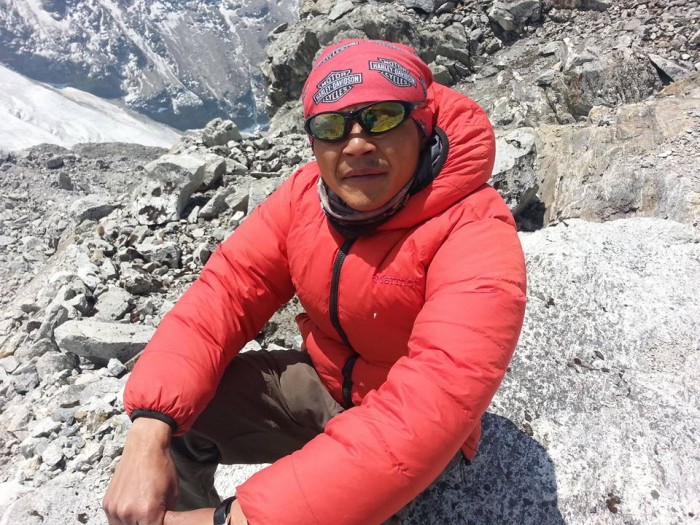
Damodar Kunda Trek is one of the most remote, spiritual, and adventurous trekking journeys in Nepal. Located in the spectacular Mustang region north of the Annapurna range, Damodar Kunda is a group of high-altitude sacred lakes revered by both Hindus and Buddhists. At approximately 4,890 meters above sea level, the lakes lie in an extraordinary Himalayan landscape of barren valleys, high mountain passes, snow-covered peaks, ancient settlements, and Tibetan-influenced Buddhist culture.
For pilgrims, Damodar Kunda is a sacred destination associated with purification, devotion, and spiritual liberation. For trekkers, it is an opportunity to venture deep into one of Nepal's least-visited Himalayan landscapes. The journey combines the spiritual importance of Damodar Kunda and Muktinath with the extraordinary cultural heritage of Upper Mustang, often described as the Ancient Kingdom of Lo in the Himalayas.
The trek begins around Kagbeni, the historic gateway to Upper Mustang, and takes you through the dramatic landscapes of Lo, including Chele, Syanbochen, Ghami, Charang, and Lo Manthang, the former walled capital of the Kingdom of Mustang. From Lo Manthang, the route becomes increasingly remote as it heads toward Yara, high mountain passes, isolated valleys, and finally the sacred Damodar Kunda lakes.
The return journey takes you through remote Himalayan terrain toward Tangye, Tetang, and Muktinath, another major pilgrimage destination revered by Hindus and Buddhists. The trek eventually concludes at Jomsom before flying back to Pokhara and traveling onward to Kathmandu.
With Himalayan Adventure Intl Treks, the Damodar Kunda Trek is carefully organized with experienced guides, permits, transportation, accommodation, meals, trekking support, and the necessary camping arrangements for the more remote sections of the route.
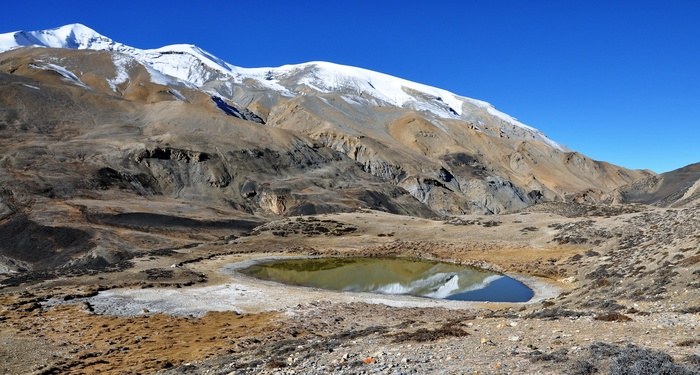
Damodar Kunda is a group of sacred alpine lakes situated in the remote northern part of Nepal's Mustang region. The lakes are surrounded by the stark and beautiful mountains of the Damodar Himal and lie in an isolated high-altitude landscape north of the Annapurna range.
The main lake is situated at around 4,890 meters, where the environment is cold, dry, windy, and extremely rugged. The combination of high mountains, blue skies, barren hills, and sacred waters creates an atmosphere unlike almost anywhere else in Nepal.
Traditionally, three lakes are associated with Damodar Kunda:
Among these, Chakra Kunda is regarded as particularly significant by pilgrims.
Damodar Kunda holds a special position in Hindu religious tradition. The name Damodar is associated with Lord Krishna, and the lakes are mentioned in Hindu religious literature. Devotees believe that bathing or praying at the sacred lake can help purify the soul and remove accumulated sins.
For Buddhist devotees, the region is also part of a broader sacred Himalayan landscape where mountains, lakes, caves, monasteries, and remote valleys are closely connected with religious traditions.
Consequently, the Damodar Kunda Trek is much more than an ordinary Himalayan hiking route. It is a journey into a landscape where nature, mythology, religion, and centuries-old Himalayan culture meet.
For Hindu pilgrims, Damodar Kunda is regarded as a place of extraordinary spiritual importance. Traditional beliefs associate the sacred lake with purification and liberation. Devotees travel considerable distances to reach the remote lakes, despite the difficult terrain and high altitude.
According to Hindu mythology, Damodar is one of the names associated with Lord Krishna. Religious traditions and stories connected with the Puranas give the area a deep spiritual identity.
One popular tradition connects the sacred waters with the story of Nalakubera, the son of Kubera. Mythological accounts describe a curse and subsequent liberation, with the sacred waters representing purification and redemption.
Whether approached from a religious or cultural perspective, these stories provide an important understanding of why pilgrims have been drawn toward the remote Mustang mountains for generations.
The spiritual significance of Damodar Kunda is also enhanced by its geographical setting. The lakes are surrounded by vast mountains and open Himalayan landscapes. There are no large settlements nearby, and the silence of the high mountains creates an atmosphere ideal for prayer, reflection, and meditation.
For many travelers, reaching the lakes after days of walking through Upper Mustang becomes a deeply personal experience.
The Kali Gandaki region is famous among Hindus for Shaligram, naturally occurring fossil stones traditionally regarded as manifestations of Lord Vishnu.
These dark, rounded fossilized stones are associated with ammonites and are found along the Kali Gandaki River and its tributaries. Religious tradition considers Shaligram highly sacred, and many Hindu households keep them for worship.
The broader Damodar and Kali Gandaki region is therefore important not only because of its lakes but also because of its connection with the sacred stones.
The landscape makes the geological and spiritual relationship particularly fascinating. Millions of years ago, the Himalayan region was connected to ancient marine environments, while today the mountains stand thousands of meters above sea level.
For pilgrims, however, Shaligram represents much more than geology. It is a symbol of Lord Vishnu and an important part of Hindu religious practice.
Damodar Kunda is located in the Mustang region of north-central Nepal, in the remote high-altitude area north of the Annapurna range and within the broader Upper Mustang landscape.
The trek passes through areas associated with the ancient Kingdom of Mustang, whose cultural center is Lo Manthang.
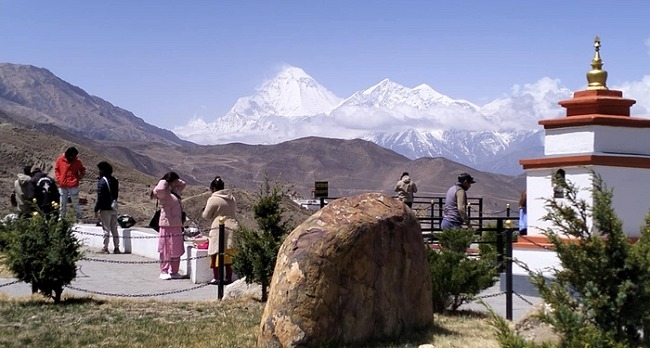
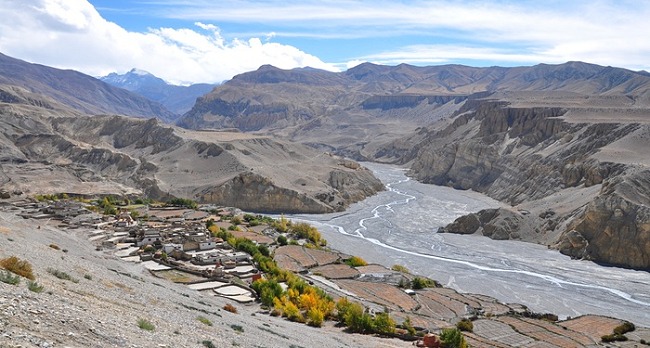
Upper Mustang lies within the Himalayan rain shadow. As a result, the landscape is dramatically different from the lush forests commonly associated with trekking elsewhere in Nepal.
Instead of dense green vegetation, trekkers encounter:
The contrast between the dry landscape and snow-covered mountains is one of the defining characteristics of the Damodar Kunda Trek.
One of the major attractions of the Damodar Kunda Trek is the opportunity to experience the cultural heritage of Upper Mustang, often referred to as the Ancient Kingdom of Lo in the Himalayas.
Lo Manthang served as the historic capital of the Kingdom of Mustang. Its traditional architecture, monasteries, palace, narrow lanes, whitewashed buildings, and surrounding walls preserve the distinctive cultural identity of the region.
For centuries, Mustang maintained strong cultural and commercial connections with Tibet. Tibetan Buddhism remains an important part of local life, and many villages preserve ancient religious traditions.
During the trek, you can encounter:
The combination of cultural heritage and remote geography makes Upper Mustang one of Nepal's most fascinating destinations.
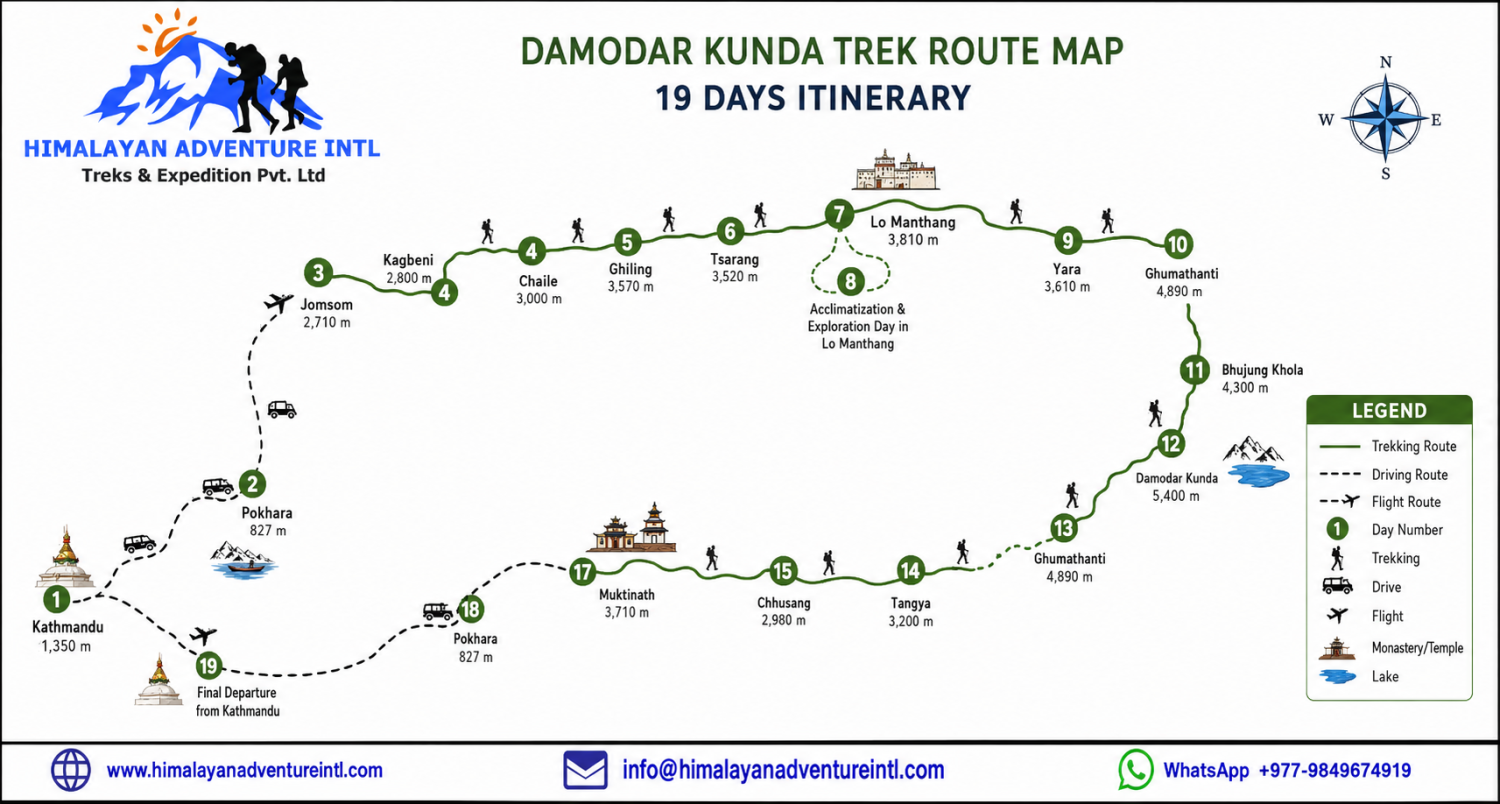
The 20-day Damodar Kunda Trek begins with your arrival in Kathmandu and continues through Pokhara and Jomsom before entering the Upper Mustang region.
The major route is:
Kathmandu → Pokhara → Jomsom → Kagbeni → Chele → Syanbochen → Charang → Lo Manthang → Yara/Ghara → Ghumathanti→ Bhujung Khola → Damodar Kunda → Bhujung Khola → Tangye → Tetang → Muktinath → Jomsom → Pokhara → Kathmandu
Each section offers a different experience.
The lower Mustang villages introduce trekkers to the traditional culture of the Kali Gandaki valley. As the route climbs toward Upper Mustang and Damodar Kunda, the landscape becomes progressively more isolated and demanding.
The highest section is particularly challenging because of altitude, cold temperatures, wind, and limited facilities.
The ideal trekking season for Damodar Kunda is generally April through September.
Spring offers pleasant trekking conditions, relatively stable weather, and beautiful Himalayan scenery.
Although Upper Mustang is considerably drier than many other trekking areas, spring provides excellent visibility and comfortable daytime temperatures.
Upper Mustang lies in the Himalayan rain shadow, which makes it particularly attractive during Nepal's monsoon season.
While many parts of Nepal receive heavy rainfall, Mustang remains comparatively dry.
August is especially significant because the annual full-moon Purnima festival attracts Hindu and Buddhist pilgrims to the sacred region. If your schedule allows, planning the trek around the festival can add a memorable cultural dimension to the journey.
September can provide excellent visibility and pleasant trekking conditions.
The landscape is crisp, dry, and dramatic, with excellent opportunities for mountain photography.
For travelers seeking the combination of favorable weather and fewer crowds, April–September is a particularly attractive period.
One of the most fascinating times to visit Damodar Kunda is around the full moon in August.
The annual Purnima celebration brings Hindu and Buddhist pilgrims toward the sacred lakes. The gathering creates an atmosphere of prayer, religious devotion, cultural exchange, and celebration.
If your travel dates coincide with the festival, you may witness pilgrims performing religious rituals and visiting the sacred waters.
Because Damodar Kunda is extremely remote, the experience is very different from visiting a major urban festival. The combination of the full moon, sacred lakes, high mountains, and hundreds or thousands of pilgrims can create an unforgettable Himalayan experience.
Travelers interested in attending should plan well in advance because accommodation, transportation, permits, camping logistics, and guide availability can become more demanding around festival dates.
The Damodar Kunda Trek is considered a challenging to strenuous high-altitude trek.
Unlike relatively easy Himalayan routes, this expedition reaches elevations above 5,000 meters and crosses remote terrain with limited infrastructure.
Trekkers should be prepared for:
Previous trekking experience is highly recommended.
Good physical preparation is essential, but physical fitness alone does not eliminate altitude-related risks. Proper acclimatization, hydration, pacing, nutrition, and careful monitoring by the trekking team are important.
Altitude is one of the most important considerations on the Damodar Kunda Trek.
The journey begins at relatively low altitude before gradually climbing through Mustang. The itinerary includes an acclimatization day at Lo Manthang before entering the higher and more remote section.
Our guides monitor trekkers throughout the journey and encourage a sensible walking pace.
If symptoms of altitude illness occur, the trekking team takes them seriously. Depending on the circumstances, descending to a lower elevation may be necessary.
Travelers should not underestimate the combination of high altitude, cold, wind, long walking days, and remote terrain.
Accommodation varies according to the section of the trek.
In Kathmandu and Pokhara, you will stay in comfortable hotels.
During the lower and more developed sections of Mustang, accommodation is generally available in local lodges or teahouses.
At higher elevations and during the most remote portions toward Damodar Kunda, camping becomes necessary or may be used depending on the final itinerary and local conditions.
Accommodation at high altitude is basic. Trekkers should expect simple rooms, limited facilities, and shared services.
Himalayan Adventure Intl Treks arranges the required camping equipment, staff, and logistics for remote sections of the route.
In Kathmandu, breakfast is generally included with your hotel stay.
During the trekking journey, breakfast, lunch, and dinner are provided.
Meals in Mustang commonly include locally available foods such as:
Food becomes simpler as you travel into increasingly remote areas.
Potatoes are particularly useful at high altitude because they provide carbohydrates and energy needed for long walking days.
We recommend informing Himalayan Adventure Intl Treks about dietary requirements in advance so that appropriate arrangements can be made wherever possible.
Transportation is an important part of the Damodar Kunda expedition.
The standard itinerary includes:
Jomsom flights are highly dependent on weather conditions. Mountain weather can change rapidly, so some flexibility should be maintained in the itinerary.
Because Damodar Kunda lies in the remote Upper Mustang region, trekkers require special authorization.
The trek generally requires:
The region is restricted, and independent trekking is not permitted in the same way as ordinary trekking routes.
A licensed trekking guide is required, and Himalayan Adventure Intl Treks manages the necessary permit and guide arrangements for our guests.
Permit regulations and fees can change, so the final permit requirements and costs will be confirmed when your trip is booked.
The current package price provided for the 20-day Damodar Kunda Trek is USD 2,350 per person for a group of 2–4 people.
| Group Size | Price Per Person |
|---|---|
| 2–4 people | USD 2,350 |
| 5–7 people | USD 2,182 |
| 8–10 people | USD 2,143 |
| 11+ people | USD 2,000 |
The final cost depends on the exact services selected, group size, travel dates, permits, transportation conditions, and any additional services requested.
Our Damodar Kunda package can be arranged to include the major services required for a safe and comfortable expedition, including:
A detailed inclusion and exclusion list will be provided before booking.
Because this is a high-altitude and remote trek, appropriate equipment is essential.
Himalayan Adventure Intl Treks can provide certain trekking equipment such as a duffle bag and sleeping bag, subject to availability and return after the trek.
Your trekking boots should be properly broken in before arriving in Nepal.
Your trekking guide will carry a basic first-aid kit and commonly required emergency supplies.
You should nevertheless bring your own personal medication and a small personal first-aid kit.
Useful items include:
Medication such as acetazolamide (Diamox) should only be used according to appropriate medical advice.
Because the Damodar Kunda route is remote, travelers should discuss altitude trekking and personal medication requirements with a qualified medical professional before departure.
Remember to bring:
Keep copies of important travel documents separately from the originals.
Damodar Kunda is not a beginner-level trek.
You should prepare your body several weeks or months before departure.
Recommended preparation includes:
The goal is to develop endurance rather than simply speed.
You may walk approximately 5–8 hours on many trekking days, and some sections involve steep climbs at high altitude.
The better prepared you are, the more enjoyable the journey becomes.
The Damodar Kunda Trek requires much more than simply following a trail. It involves restricted-area permits, remote logistics, high-altitude planning, transportation coordination, camping arrangements, and experienced trekking staff.
At Himalayan Adventure Intl Treks, we focus on organizing the journey carefully from arrival in Kathmandu to your final departure.
Our team can assist with:
We understand that every traveler has different requirements. Private groups, couples, families with suitable experience, small groups, large groups, photography groups, pilgrimage travelers, and cultural explorers can all request customized arrangements.
Nepal offers several remote Himalayan adventures. Damodar Kunda, Upper Mustang, and Upper Dolpo are among the most fascinating.
| Feature | Damodar Kunda Trek | Upper Mustang Trek | Upper Dolpo Trek |
|---|---|---|---|
| Region | Mustang / Annapurna | Upper Mustang | Dolpo |
| Duration | 20 Days | Around 16+ Days | Around 21–28 Days |
| Difficulty | High | Moderate to Challenging | Very High |
| Maximum Terrain | Above 5,500 m | Around 4,000+ m | Around 5,000+ m |
| Main Attraction | Sacred lakes and high passes | Lo Manthang and Tibetan culture | Phoksundo, Shey and remote valleys |
| Landscape | High-altitude desert and sacred mountains | Himalayan desert | Remote Himalayan wilderness |
| Culture | Hindu and Buddhist | Tibetan Buddhist | Tibetan Buddhist |
| Crowds | Very Low | Low to Moderate | Extremely Low |
| Special Feature | Damodar Kunda pilgrimage | Ancient Kingdom of Lo | Shey Phoksundo and remote Dolpo |
Damodar Kunda is particularly suitable for travelers seeking a combination of spiritual pilgrimage and extreme Himalayan adventure.
This expedition is ideal for:
Because of the high altitude and remote terrain, trekkers should have appropriate physical preparation and a realistic understanding of the challenges.
The Damodar Kunda Trek is difficult to compare with ordinary trekking routes in Nepal.
It is a journey through a landscape where the mountains seem almost untouched, where villages remain isolated, where ancient religious traditions continue, and where the boundary between adventure and pilgrimage becomes increasingly difficult to separate.
You begin among the busy streets of Kathmandu, travel through the beautiful city of Pokhara, fly into the dramatic Kali Gandaki valley, and then gradually enter the dry Himalayan world of Mustang.
The trail takes you through historic settlements and toward Lo Manthang before leading farther into an increasingly remote landscape.
Finally, after crossing high mountain terrain, Damodar Kunda appears.
The sight of the sacred blue waters surrounded by barren mountains and snow-covered Himalayan peaks is the reward for the long journey.
The 20-day Damodar Kunda Trek is an extraordinary combination of high-altitude adventure, Himalayan scenery, ancient culture, and spiritual discovery.
From the historic village of Kagbeni to the walled city of Lo Manthang, from remote high passes to the sacred waters of Damodar Kunda, and from the ancient landscapes of Upper Mustang to the holy temple of Muktinath, every stage of the journey offers something different.
The trek is particularly special for travelers who want to experience a side of Nepal far beyond the country's better-known trekking trails.
If your travel schedule allows, consider planning your expedition around the August full-moon Purnima festival. For Hindu and Buddhist pilgrims, this can add an especially meaningful dimension to an already remarkable journey.
The recommended trekking period is April through September, with conditions varying according to altitude and weather.
Let Himalayan Adventure Intl Treks arrange your permits, transportation, accommodation, meals, guide, porters, camping support, and other essential logistics so you can concentrate on experiencing the mountains.
Damodar Kunda is not simply a destination. It is a pilgrimage, an expedition, and a journey into the spiritual heart of the Mustang Himalayas.
Book your Damodar Kunda Trek with Himalayan Adventure Intl Treks and discover one of the most remote and sacred Himalayan landscapes of Nepal.
Welcome to Nepal and the beginning of an extraordinary Himalayan adventure with Himalayan Adventure Intl Treks. Upon your arrival at Tribhuvan International Airport in Kathmandu, one of our friendly representatives will be waiting to greet you. Look for the Himalayan Adventure Intl Treks representative holding a company sign outside the arrival area. You will then be welcomed and transferred comfortably to your hotel in Kathmandu, which generally takes around 20–25 minutes, depending on traffic.
Kathmandu, situated at approximately 1,350 meters above sea level, is Nepal’s vibrant capital and a fascinating introduction to the country’s diverse culture, history, architecture, and mountain traditions. After checking into your hotel, you can take some time to relax after your journey. If your arrival is early enough and you feel comfortable, you may explore the nearby streets, visit a local café, or simply enjoy the atmosphere of the city.
Later in the day, your trekking team will organize a detailed briefing about the upcoming Upper Mustang and Damodar Kunda adventure. Your guide will explain the itinerary, trekking conditions, altitude considerations, transportation arrangements, accommodation, meals, permits, and safety procedures. This is also an excellent opportunity to meet other members of your trekking team and ask any final questions.
Our staff will check your trekking equipment and help identify anything you may need before leaving Kathmandu. If necessary, essential trekking equipment can be arranged through Himalayan Adventure Intl Treks.
The evening is free for you to enjoy Kathmandu at your own pace. You may experience a traditional Nepali dinner and sample some local cuisine before beginning your journey toward the remote Himalayan landscapes.
Overnight at a hotel in Kathmandu.
After breakfast, your Himalayan adventure continues with a scenic overland journey from Kathmandu to Pokhara. The drive covers approximately seven hours, although the actual duration can vary according to road conditions, traffic, weather, and scheduled breaks.
The route follows Nepal’s dramatic river valleys and rolling hills, gradually taking you away from the busy Kathmandu Valley and toward the beautiful lakeside city of Pokhara. Along the journey, you will see traditional villages, terraced agricultural fields, forests, rivers, suspension bridges, and changing landscapes. The drive provides an excellent opportunity to observe everyday life in rural Nepal.
Your guide and driver will ensure that the journey is comfortable and well organized. We normally make appropriate stops along the way for breakfast, lunch, refreshments, photographs, and short breaks. The road follows sections of the Prithvi Highway and provides beautiful views of the surrounding hills and river systems.
As you approach Pokhara, the scenery becomes increasingly attractive. Pokhara is famous for its peaceful atmosphere, Phewa Lake, green hills, and magnificent Himalayan views. On clear days, the distant peaks of the Annapurna and Dhaulagiri ranges may become visible.
After arriving in Pokhara, you will check into your hotel and have time to relax. Depending on your arrival time and energy level, you can take an easy walk around the Lakeside area. The lakeshore is filled with restaurants, cafés, shops, and pleasant viewpoints where you can enjoy the relaxed atmosphere.
This overnight stay also allows you to prepare for the flight into the Kali Gandaki region the following morning. Your guide will reconfirm the next day's schedule and help ensure that your trekking bags are properly organized.
Pokhara is an important gateway to the Annapurna and Mustang regions, and tonight marks the transition from Nepal’s urban environment to the remote mountain wilderness.
Overnight at a hotel in Pokhara.
Today marks the true beginning of your Himalayan trekking adventure. After an early breakfast, you will head to Pokhara Airport for the short but spectacular flight to Jomsom, located at approximately 2,710 meters in the Kali Gandaki Valley.
The flight to Jomsom is an unforgettable experience. As the aircraft travels northward, you can enjoy incredible views of the Himalayan landscape, including dramatic mountain valleys and snow-covered peaks. Weather conditions can affect flights in the mountain region, so your trekking team will coordinate closely with the airline and make any necessary adjustments.
After landing in Jomsom, you will meet your local trekking crew and begin walking toward Kagbeni. The trail follows the Kali Gandaki River through a landscape that gradually changes from green mountain scenery to the dry, rugged terrain characteristic of Mustang.
The approximately three-hour trek is relatively gentle and serves as an introduction to walking at higher altitude. You will notice the increasing presence of Tibetan-influenced architecture, prayer flags, mani walls, chortens, and traditional stone houses.
Kagbeni is a historic village situated near the junction of the Kali Gandaki and Jhong Rivers. The settlement has long been an important trading and cultural point between the lower Mustang region and the Tibetan plateau. Its narrow lanes, old monasteries, mud-brick homes, and traditional courtyards provide a fascinating glimpse into the region’s distinctive heritage.
Upon reaching Kagbeni, you will check into your local teahouse or lodge. Your guide will provide information about the following days and discuss the importance of gradual acclimatization as you move into the higher and more remote parts of Mustang.
You can spend the afternoon exploring the village, photographing the surrounding cliffs and mountains, or resting at the lodge.
Overnight in Kagbeni.
After breakfast, you leave Kagbeni and officially enter the restricted Upper Mustang region. The trail today leads deeper into the remote Trans-Himalayan landscape, where the scenery becomes increasingly dry, rugged, and distinctly Tibetan in character.
The trek begins by following the Kali Gandaki River before gradually moving through dramatic valleys and traditional settlements. You will encounter a landscape shaped by wind, erosion, and centuries of Himalayan geology. The contrast between the barren mountains and occasional patches of cultivated land makes this section particularly fascinating.
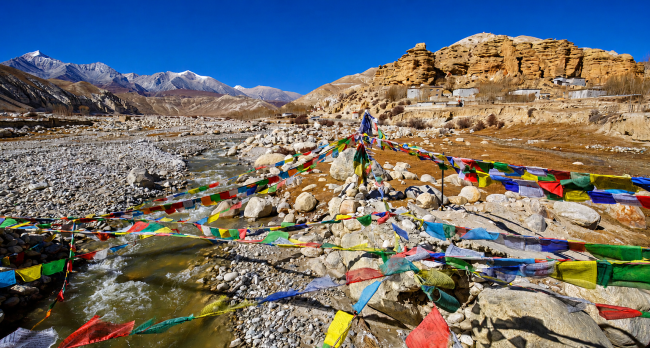
As you walk, your guide will help you understand the culture and traditions of the Mustang region. The villages are characterized by whitewashed houses, flat rooftops, prayer flags, mani walls, chortens, and ancient Buddhist influences. Mustang has maintained a distinctive cultural identity because of its geographical isolation and historical relationship with Tibet.
The trail eventually passes through Tangbe, a picturesque settlement known for its narrow alleys, traditional houses, cultivated fields, and surrounding apple orchards. From here, the route continues toward Chhusang and follows the Kali Gandaki Valley before ascending toward Chaile.
The final portion of today's journey involves a gradual climb as the landscape becomes more rugged. Chaile, situated at around 3,000 meters, provides an important stopping point before the route moves into higher elevations.
Upon arrival, you will settle into your teahouse or lodge and have time to rest. Your guide will monitor how everyone is adapting to the altitude, and it is important to drink plenty of water and maintain a comfortable walking pace.
The evening can be spent enjoying dinner with your trekking companions while taking in the peaceful surroundings.
Today provides an excellent introduction to Upper Mustang’s remote environment, combining dramatic scenery, traditional villages, Buddhist culture, and increasingly high-altitude terrain.
Overnight in Chaile.
Today's trail takes you farther into the remote heart of Upper Mustang. After breakfast in Chaile, you begin walking through a landscape of dry cliffs, barren hills, deep valleys, and spectacular Himalayan surroundings.
The route initially involves a steady ascent as you leave the lower Kali Gandaki Valley behind. The trail winds through rugged terrain where the effects of the strong Himalayan winds can be clearly seen. Vegetation becomes increasingly sparse, giving the landscape a distinctive desert-like appearance.
During the trek, you will pass through small settlements and areas of cultivated land where local communities grow crops despite the challenging environment. The ability of Mustang’s people to maintain agriculture in such an arid region is one of the remarkable characteristics of this area.
The route gradually climbs toward the Nyi La area before descending through beautiful mountain scenery toward Ghiling. Along the way, you will encounter traditional Buddhist monuments, prayer flags, mani walls, and chortens that reflect the deep spiritual heritage of the region.
Ghiling, also known as Ghami/Gheling depending on local spelling, is one of the traditional villages of Upper Mustang. The settlement is surrounded by cultivated fields and impressive barren mountains. Its traditional houses and monasteries provide opportunities to experience the distinctive architecture and culture of Mustang.
At approximately 3,570 meters, today's destination is considerably higher than Chaile, making altitude awareness important. Walk slowly, stay hydrated, and inform your guide immediately if you experience symptoms such as unusual headache, dizziness, nausea, or difficulty breathing.
After reaching Ghiling, you can relax at the lodge and enjoy views of the surrounding mountains. If time and energy allow, a short village walk can provide a wonderful opportunity to observe local life.
The evening will be spent with your trekking team over a warm meal while preparing for another fascinating day deeper into the Mustang region.
Overnight in Ghiling.
After breakfast, you continue your journey from Ghiling toward Charang, another culturally significant settlement in Upper Mustang. Although today's walking distance is shorter than some previous stages, the trail remains spectacular and provides plenty of opportunities to appreciate the region's unique geography and heritage.
The route crosses dry mountain terrain and follows trails carved naturally into the hillsides. As you progress, the surrounding landscape displays the characteristic colors of Mustang, with shades of brown, red, gray, and ochre appearing across the cliffs and ridges.
One of the most fascinating aspects of this region is the combination of natural scenery and ancient Buddhist culture. Along the trail, you will encounter prayer stones, chortens, mani walls, and traditional villages. Your guide will explain the cultural significance of these features and help you understand the customs of the communities living in this remote Himalayan region.
As you approach Charang, the trail provides increasingly impressive views across the surrounding valleys. Charang, located at approximately 3,520 meters, is a historic village known for its traditional whitewashed buildings and important Buddhist heritage.
A major attraction here is the old Charang Monastery, which contains religious artwork, statues, and traditional Tibetan Buddhist elements. The village also features an ancient palace and a distinctive red gompa, making it an important cultural stop on the Upper Mustang route.
After arriving, you will check into your lodge and enjoy lunch or refreshments before taking time to explore the settlement. Walking through the narrow village lanes allows you to observe traditional houses, agricultural fields, prayer wheels, and the peaceful rhythm of mountain life.
Because the next few days involve higher elevations, your guide will encourage you to rest well and stay properly hydrated. Avoid unnecessary exertion and allow your body to adapt naturally.
Charang offers a beautiful combination of cultural discovery and Himalayan scenery, making this a memorable stage of the journey.
Overnight in Tsarang
Today is one of the most anticipated days of your Upper Mustang adventure as you trek from Charang to Lo Manthang, the historic walled settlement and cultural heart of Upper Mustang.
After breakfast, you leave Charang and follow the trail through a spectacular high-altitude landscape. The route gradually rises and crosses several open ridges, offering magnificent views of the surrounding Himalayan terrain. On clear days, distant snow-covered peaks form an impressive backdrop to the barren Mustang hills.
The trail passes through the dramatic Lo Valley, where the scenery feels remarkably different from the lush lower valleys of Nepal. The dry climate, rugged cliffs, ancient caves, and Tibetan-style villages create an atmosphere that has remained relatively unchanged for generations.
As you approach Lo Manthang, anticipation builds. The settlement is famous for its historic walls, traditional mud-brick homes, monasteries, and royal heritage. For centuries, Lo Manthang served as the center of the former Kingdom of Mustang and remains one of the most culturally significant destinations in the Himalayan region.
The approximately five- to six-hour trek is moderate to demanding because of the altitude and exposed terrain. Your guide will maintain a steady pace and schedule appropriate breaks along the route.
Finally, the distinctive walls and rooftops of Lo Manthang come into view. Entering the settlement provides a powerful sense of arrival after several days of trekking through increasingly remote landscapes.
After checking into your lodge, you can relax and enjoy the surroundings. If time permits, your guide may take you on a short introductory walk through the old town.
The evening is an opportunity to enjoy a traditional meal and prepare for tomorrow's acclimatization and exploration day.
Lo Manthang is more than simply a trekking destination—it is a living center of Mustang's Tibetan-influenced culture, religion, architecture, and history.
Overnight in Lo Manthang.
Today is an important acclimatization day in Lo Manthang. Rather than remaining completely inactive, the day is designed around short walks and cultural exploration to help your body adjust to the altitude while allowing you to discover one of Nepal's most remarkable Himalayan settlements.
Lo Manthang is surrounded by a dramatic high-altitude desert landscape and is famous for its ancient monasteries, traditional architecture, historic palace, and Tibetan Buddhist culture. After breakfast, your guide will organize a suitable walking and sightseeing program depending on weather, local conditions, and your group's energy level.
You may explore the ancient walled city and its narrow lanes, where traditional mud-brick houses stand closely together. The settlement has a distinctive architectural character, with whitewashed buildings, wooden windows, prayer flags, and traditional courtyards.
The cultural exploration may include visits to historic monasteries such as Jampa, Thubchen, and Chode, subject to local access and opening conditions. These religious sites contain valuable examples of Himalayan Buddhist art and architecture.
You may also visit the former royal palace area and surrounding viewpoints. From elevated locations around Lo Manthang, the surrounding barren valleys and distant mountains create extraordinary photographic opportunities.
Acclimatization is particularly important because the following stages take you to substantially higher elevations. Your guide will explain the importance of hydration, rest, nutrition, and recognizing symptoms of altitude sickness. You should avoid rushing and allow your body to adjust gradually.
The afternoon can be spent relaxing at the lodge, reading, taking photographs, or walking gently around the village. You may also enjoy conversations with local residents and learn more about life in this remote Himalayan community.
This rest day provides both physical recovery and cultural enrichment. It ensures that the group is better prepared for the demanding high-altitude journey ahead.
Overnight in Lo Manthang.
After a valuable acclimatization day in Lo Manthang, you continue toward the remote settlement of Yara. Today's route introduces another fascinating section of the Upper Mustang landscape, characterized by dramatic cliffs, dry valleys, ancient caves, and isolated villages.
After breakfast, the trail gradually leaves the Lo Manthang area and heads toward the eastern side of the Mustang region. The route follows high mountain paths with expansive views across the barren Himalayan terrain.
One of the most memorable features of today's walk is the unusual geological landscape. Wind and water erosion have shaped the cliffs into dramatic formations, creating a landscape that often resembles a natural sculpture garden. Ancient caves carved into cliff faces are scattered throughout the region and provide evidence of the long history of human settlement in Mustang.
The trail requires steady walking, especially where the route crosses exposed sections and uneven ground. Your guide will choose the safest practical route according to weather and trail conditions.
As you continue, the landscape becomes increasingly remote. Villages are small and widely separated, emphasizing how isolated communities in Upper Mustang have traditionally adapted to the harsh environment.
Yara, located at approximately 3,610 meters, provides a peaceful overnight destination. The village is known for its traditional houses and spectacular surrounding cliffs. The settlement offers an excellent opportunity to experience the quieter side of Mustang away from the more frequently visited areas.
After reaching Yara, you will check into your lodge or teahouse and enjoy a well-earned meal. The remainder of the afternoon can be spent resting and exploring nearby areas at an easy pace.
Because the coming days involve very high elevations, your guide will continue monitoring everyone's health and acclimatization. Drinking sufficient water and maintaining a comfortable pace are especially important.
Tonight, surrounded by the remote Mustang landscape, you can enjoy the peaceful mountain atmosphere and prepare for the challenging high-altitude stages ahead.
Overnight in Yara.
Today marks a significant increase in altitude as you trek from Yara toward Ghumathanti, situated at approximately 4,890 meters. This is one of the more demanding stages of the adventure and requires careful pacing, good hydration, and close attention to altitude adaptation.
After breakfast, you begin the journey through increasingly barren and remote terrain. The trail climbs gradually through high mountain landscapes where vegetation becomes very limited. The surrounding scenery is dominated by rugged cliffs, open valleys, and distant Himalayan ridges.
The higher you climb, the more important it becomes to walk slowly and maintain a consistent rhythm. Your guide will set a manageable pace with regular breaks so that everyone has enough time to adapt to the increasing altitude.
The route may involve steep sections and exposed terrain, depending on the selected trail and local conditions. Weather can also change quickly at these elevations, so appropriate warm clothing, wind protection, sun protection, and good-quality trekking equipment are essential.
As you gain altitude, the views become increasingly expansive. Looking back across the Mustang landscape provides a dramatic perspective of the valleys and ridges you have crossed during the previous days.
Ghumathanti is a remote high-altitude stopping point where accommodation facilities are basic. The purpose of today's stage is not luxury but immersion in the remote Himalayan wilderness.
After reaching the camp or available accommodation area, you will have time to rest and recover. Your trekking team will provide a warm meal and monitor the group for signs of altitude-related problems.
At nearly 4,900 meters, everyone must take altitude seriously. If anyone develops significant symptoms of acute mountain sickness, the guide will assess the situation and make safety-focused decisions.
The evening is likely to be quiet, with the surrounding mountains creating an extraordinary sense of isolation.
This demanding day prepares you for the even higher journey toward Damodar Kunda.
Overnight at Ghumathanti.
Following a night at high altitude, today's trek takes you from Ghumathanti toward Bhujung Khola. Although the destination is at a lower elevation than your previous overnight point, the route continues through remote and demanding Himalayan terrain.
After breakfast, you begin walking through the stark high-altitude environment. The trail crosses barren slopes and rocky ridges, with little vegetation visible. The lack of trees and settlements reinforces the feeling that you are deep within one of Nepal's least developed mountain regions.
The route gradually descends toward Bhujung Khola, offering some relief after the previous day's ascent. Descending, however, does not mean the trek is effortless. Uneven ground, steep sections, strong winds, and high-altitude conditions still require careful movement.
Throughout the journey, your guide will continue to monitor your physical condition. Regular breaks allow the group to rest, hydrate, and enjoy the spectacular surroundings.
Bhujung Khola, at approximately 4,300 meters, is a remote stopping point surrounded by rugged mountain terrain. Accommodation here is generally basic, and facilities are limited compared with lower-altitude trekking villages. Your trekking crew will make every effort to ensure you remain warm, comfortable, and well fed.
The afternoon can be used for rest and recovery. If conditions permit, you may take a short walk around the area, but unnecessary exertion should be avoided because you will soon be traveling toward Damodar Kunda at a much higher elevation.
This section of the trek is especially rewarding for travelers who enjoy remote wilderness and genuine adventure. There are fewer signs of modern development, and the landscape feels almost untouched.
As evening approaches, enjoy a warm meal and spend time with your trekking companions. Your guide will brief you about the next day's demanding journey toward Damodar Kunda.
A good night's rest is particularly important before the long high-altitude trek ahead.
Overnight in Bhujung Khola.
Today is the most challenging and spectacular stage of the trek as you make your way toward the sacred Damodar Kunda, reaching approximately 5,400 meters. The long walking duration and extreme altitude make this a demanding day that requires strong preparation and careful pacing.
You will start early in the morning after breakfast. The trail gradually ascends through a remote, barren mountain environment. As you climb higher, the air becomes thinner and temperatures can drop significantly, particularly around exposed ridges and during periods of strong wind.
Your guide will maintain a slow and steady pace, with regular rest stops. The objective is to reach Damodar Kunda safely rather than rush. Proper hydration, appropriate clothing, and maintaining a manageable walking rhythm are essential.
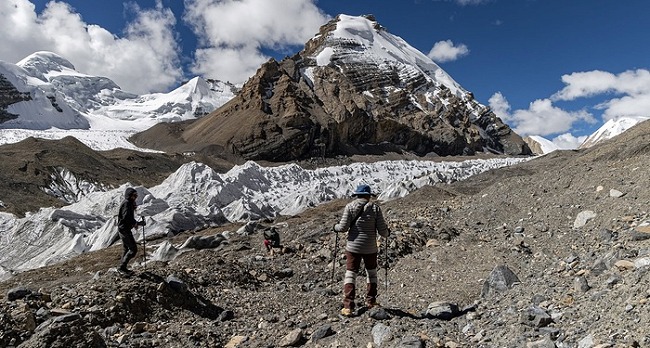
The landscape becomes increasingly dramatic as the route enters the high-altitude wilderness. Snow-covered peaks, rocky ridges, glacial terrain, and vast open valleys create extraordinary scenery.
Damodar Kunda is a group of sacred alpine lakes regarded as spiritually significant by Hindu and Buddhist pilgrims. The remote location and surrounding mountains give the lakes an especially peaceful and powerful atmosphere.
Reaching the area after a long day of trekking is a major achievement. Depending on weather and trail conditions, you will spend time near the sacred lakes to appreciate the landscape and spiritual significance of the area.
At approximately 5,400 meters, overnight conditions are basic and cold. Your trekking crew will prepare accommodation and warm meals as efficiently as possible. The guide will continue monitoring everyone's health because altitude at this level can affect trekkers significantly.
If any participant develops serious symptoms of altitude sickness, the group leader will prioritize safety and arrange appropriate descent rather than continuing.
The journey to Damodar Kunda is one of the defining experiences of this adventure, combining physical challenge, remote wilderness, dramatic Himalayan scenery, and spiritual heritage.
Overnight near Damodar Kunda.
After experiencing the remarkable surroundings of Damodar Kunda, you begin your return journey toward Ghumathanti. Although today's route generally follows a descending direction, the approximately nine-hour trek remains demanding because of the long distance and high-altitude environment.
An early start is recommended to make the most of favorable weather and daylight. After breakfast, you leave the sacred lakes behind and retrace sections of the high mountain route.
As you descend, the air gradually becomes denser, making breathing easier compared with the previous day. Nevertheless, the terrain remains rugged, and careful footing is required on rocky and uneven sections.
The journey provides an opportunity to appreciate the landscape from a different perspective. Looking back toward the high ridges and lakes, you can recognize the incredible distance and elevation you have covered.
Your guide will organize regular breaks for rest and hydration. A long descent can place considerable strain on the knees and legs, so trekking poles can be particularly useful.
The remote nature of this section means that facilities remain extremely basic. Your support crew will work to maintain a warm and comfortable camp or lodge environment despite the challenging conditions.
As you approach Ghumathanti, the landscape may gradually feel more manageable as you lose elevation. Reaching the overnight point will provide a welcome opportunity to rest after two demanding high-altitude days.
The evening can be spent enjoying a warm dinner and sharing experiences from the Damodar Kunda journey. Your guide will also explain the next stage, which takes you toward lower elevations and eventually reconnects you with the more established villages of Mustang.
Today's descent is an important recovery stage. Take time to eat well, drink enough fluids, and rest your body.
The journey through this remote region offers a rare opportunity to experience Mustang away from the more accessible trekking routes, making it one of the most adventurous components of the entire itinerary.
Overnight at Ghumathanti.
Today you descend significantly from the high-altitude wilderness toward Tangya, situated at approximately 3,200 meters. The reduction in elevation should gradually make the trek more comfortable, while the changing landscape provides a welcome contrast to the barren terrain of the previous days.
After breakfast, the trail continues through rugged valleys and open mountain slopes. The route may involve a combination of gradual descents, traverses, and uneven sections, requiring careful attention to footing.
As you lose elevation, you may notice subtle changes in the environment. The landscape becomes less severe, and small patches of vegetation become more visible. The route eventually leads toward traditional settlements where local communities have adapted to life in one of the world's most challenging environments.
Tangya is a traditional Mustang village with a distinctive collection of stone and mud-brick houses. The settlement provides an excellent opportunity to observe local architecture and everyday life.
After reaching Tangya, you will check into your lodge and enjoy a well-earned meal. The afternoon can be spent relaxing or taking a gentle walk through the village. You may observe local agricultural activities, prayer flags, mani walls, and traditional household structures.
After several days at very high altitude, the lower elevation of Tangya provides an important opportunity for recovery. Your guide will still encourage you to maintain good hydration and avoid unnecessary exertion.
The village's peaceful atmosphere allows you to reflect on the extraordinary landscapes and experiences of the previous days. The trek toward Damodar Kunda has taken you through some of the most isolated areas of the Mustang region, and today's descent marks the beginning of your return toward more populated areas.
Enjoy dinner with the trekking team and prepare for the next stage toward Chhusang.
Overnight in Tangya.
Today you continue your descent from Tangya toward Chhusang, located at approximately 2,980 meters. The trail passes through another fascinating section of Mustang's dry mountain landscape and gradually brings you closer to the Kali Gandaki Valley.
After breakfast, the route follows rugged trails through barren hills and deep valleys. Although the altitude is lower than during the previous stages, today's seven- to eight-hour trek requires endurance because of the distance and varied terrain.
The scenery remains impressive, with dramatic cliffs, colorful rock formations, and expansive views across the Mustang mountains. As you descend, you may begin to notice more vegetation and signs of agricultural activity.
The trail eventually reconnects with areas associated with the Kali Gandaki Valley. This region has historically served as an important route between Tibet and the lower parts of Nepal, and the villages reflect a fascinating mixture of Tibetan Buddhist and Himalayan traditions.
Chhusang is a picturesque settlement surrounded by striking cliffs and rocky mountains. Its traditional houses, cultivated fields, and Buddhist cultural features make it a rewarding place to spend the night.
Upon arrival, you will check into the local lodge and enjoy a warm meal. After the long walk, you can relax and allow your legs to recover.
If you still have energy, your guide may organize a short village exploration. Otherwise, resting at the lodge is recommended.
The lower elevation should make breathing noticeably easier than it was during the Damodar Kunda section. Nevertheless, continue to stay hydrated and maintain healthy trekking habits.
Today's journey represents another major step back toward the more accessible areas of Mustang. It is also a chance to appreciate how dramatically the environment changes as you descend from the high Himalayan wilderness.
Enjoy the evening with your trekking companions and prepare for tomorrow's trek toward the sacred pilgrimage destination of Muktinath.
Overnight in Chhusang.
Today you trek from Chhusang to Muktinath, one of the most important pilgrimage destinations in the Himalayas. Although the route involves a significant ascent back to approximately 3,710 meters, the journey is filled with cultural, natural, and spiritual highlights.
After breakfast, you begin walking through the dramatic Kali Gandaki region. The trail follows ancient paths used for generations by traders, pilgrims, villagers, and trekkers.
As you progress, the surrounding landscape continues to display Mustang's distinctive combination of dry mountains, deep valleys, and Himalayan peaks. The route may pass through traditional settlements and areas where local people cultivate crops despite the challenging climate.
Muktinath is revered by both Hindus and Buddhists. Hindus consider the site sacred as a place associated with Lord Vishnu, while Buddhists recognize it as an important spiritual destination connected with Guru Rinpoche and Buddhist traditions.
After reaching Muktinath, you will check into your lodge and have time to rest. If the group arrives early enough and weather conditions are suitable, you can visit the famous Muktinath Temple area. The sacred complex includes natural springs and the well-known eternal-flame shrine, creating an atmosphere of deep religious significance.
The surrounding mountain scenery is equally impressive. From Muktinath, you can enjoy views across the arid Mustang landscape and surrounding Himalayan peaks.
Because today's trek is relatively long and involves elevation gain, a comfortable pace is essential. Your guide will arrange suitable breaks along the route.
Reaching Muktinath is a fitting conclusion to the trekking portion of your adventure. After traveling through remote villages, high-altitude passes, dramatic valleys, and the sacred Damodar Kunda region, arriving at this renowned pilgrimage site provides an opportunity to reflect on the journey.
Overnight in Muktinath.
After breakfast, you leave Muktinath and begin the scenic drive toward Pokhara. This approximately six- to seven-hour journey provides an opportunity to enjoy the changing landscapes of the Kali Gandaki region without the physical demands of another trekking day.
The road follows the Kali Gandaki corridor through dramatic mountain scenery. As the vehicle descends, you will notice the landscape gradually changing from the dry, desert-like terrain of Mustang to greener hills and more densely vegetated areas.
Along the journey, you will pass traditional villages, rivers, waterfalls, agricultural fields, and rugged mountain slopes. The road may be rough or winding in sections, and travel time can vary depending on road conditions, weather, traffic, and local construction activity.
Your driver and guide will arrange appropriate breaks along the way for refreshments, photographs, and rest.
The journey provides a chance to look back on the remarkable landscapes you encountered during the trek. You have traveled from the high-altitude wilderness surrounding Damodar Kunda to the sacred pilgrimage center of Muktinath and now gradually descend toward the subtropical environment around Pokhara.
Upon reaching Pokhara, you will check into your hotel and have time to relax. After the basic accommodation and long trekking days, a comfortable hotel and the peaceful Lakeside environment provide a welcome change.
In the evening, you can enjoy a leisurely walk around Phewa Lake, visit a restaurant, or simply rest at the hotel. Pokhara is famous for its relaxed atmosphere, and this evening offers a chance to celebrate the successful completion of the trekking portion of your adventure.
Your Himalayan Adventure Intl Treks team will remain available to assist with any remaining arrangements and confirm your travel plans for the following day.
Overnight at a hotel in Pokhara.
After breakfast, you begin the final overland journey of your Himalayan adventure, traveling from Pokhara back to Kathmandu. The drive generally takes around seven hours, depending on traffic, road conditions, weather, and scheduled stops.
Leaving Pokhara, the road follows the scenic river valleys and rolling hills toward Kathmandu. The journey provides another opportunity to observe Nepal's rural landscapes, including terraced farmland, traditional villages, suspension bridges, forests, and rivers.
Your guide and driver will ensure that the journey is organized comfortably and safely. You can stop along the route for lunch, refreshments, photographs, and short breaks.
As the journey continues, you gradually return to the more populated areas surrounding Kathmandu. The landscape becomes increasingly busy as you approach the capital.
Upon arrival in Kathmandu, you will be transferred to your hotel and have time to relax after the long drive. Depending on your arrival time, you may explore nearby markets or shops, purchase souvenirs, or simply enjoy a final evening in Nepal.
This final evening is also an opportunity to celebrate the completion of your Upper Mustang and Damodar Kunda adventure. You have experienced some of the most remote and spectacular landscapes in Nepal, traveled through traditional Himalayan settlements, explored Lo Manthang, reached the sacred Damodar Kunda, and visited Muktinath.
Himalayan Adventure Intl Treks can arrange a farewell dinner if included in your selected package. You can spend the evening sharing photographs and memories with your trekking companions and guides.
Your team will also assist you with final airport arrangements and reconfirm your departure schedule for the following day.
Overnight at a hotel in Kathmandu.
Today marks the end of your unforgettable Upper Mustang and Damodar Kunda adventure with Himalayan Adventure Intl Treks. Depending on your international flight schedule, you will have some free time in Kathmandu before being transferred to Tribhuvan International Airport for your onward journey.
Our representative will ensure that you reach the airport comfortably and on time. The transfer schedule will be arranged according to your flight departure time, allowing sufficient time for airport check-in and security procedures.
Before leaving the hotel, make sure you have collected all your personal belongings, travel documents, passport, electronic equipment, trekking gear, and souvenirs. Our team will be happy to assist with any final transportation or logistical requirements.
As you leave Nepal, you will carry memories of a remarkable journey through some of the country's most extraordinary landscapes. From the vibrant streets of Kathmandu and the peaceful atmosphere of Pokhara to the windswept valleys of Mustang, every stage of the adventure has offered something unique.
The journey through Upper Mustang has provided an opportunity to experience ancient Himalayan culture, Tibetan Buddhist traditions, traditional villages, dramatic geological formations, and remote mountain landscapes. The adventure became even more memorable with the challenging journey toward the sacred Damodar Kunda at approximately 5,400 meters.
Himalayan Adventure Intl Treks is proud to have been part of your journey and hopes that your experience has provided lasting memories and a deeper appreciation for Nepal's mountains and communities.
We sincerely thank you for choosing Himalayan Adventure Intl Treks. We look forward to welcoming you again for another Himalayan adventure in the future.
Meals: Breakfast
Transportation: Airport transfer
Destination: Tribhuvan International Airport, Kathmandu
Trip Status: Departure / End of Trek
The Damodar Kunda Trek is one of the most remote, spiritual, and adventurous trekking experiences in Nepal. Located in the highlands of Upper Mustang, Damodar Kunda is a sacred alpine lake surrounded by the dramatic landscapes of the Damodar Himal and the rain-shadow valleys of the Himalayas. The journey combines ancient Tibetan-influenced culture, spectacular mountain scenery, centuries-old monasteries, remote Himalayan settlements, and a deeply meaningful pilgrimage experience.
At an elevation of approximately 4,890 meters (16,043 feet), Damodar Kunda is revered by both Hindus and Buddhists. For Hindu pilgrims, the lake is considered a holy destination where bathing and prayer are associated with spiritual purification. Buddhist traditions also attach great religious significance to the surrounding Himalayan landscape, monasteries, caves, and sacred sites.
The trek is considerably more challenging and remote than the classic Upper Mustang trekking route. Trekkers travel through arid valleys, high mountain passes, rugged trails, and sparsely populated landscapes before reaching the sacred lake. Because of the altitude, remoteness, restricted-area regulations, and limited facilities, traveling with a licensed guide and appropriate support staff is essential.
Himalayan Adventure Intl Treks organizes customized Damodar Kunda and Upper Mustang trekking packages for solo travelers, couples, families, private groups, and group-join trekkers. Our team manages permits, transportation, accommodation, guides, porters, meals, camping logistics, and other necessary arrangements so that you can concentrate on enjoying this extraordinary Himalayan adventure.
Himalayan Adventure Intl Treks is accepting bookings for upcoming trekking seasons. We organize the Damodar Kunda Trek according to your preferred travel dates, group size, trekking experience, budget, and desired level of comfort.
You can choose between a private trek and a group-join arrangement. Private departures are particularly suitable for travelers who want flexibility in walking hours, acclimatization, rest days, photography stops, and cultural exploration.
Our trekking arrangements can include:
We can also arrange female guides, language-speaking guides, private transportation, upgraded accommodation, and customized itineraries upon request.
The Damodar Kunda Trek is not simply a mountain trek. It is a combination of pilgrimage, adventure, culture, wilderness, and Himalayan exploration.
Several aspects make this journey particularly special.
Damodar Kunda is one of Nepal's important high-altitude pilgrimage destinations. Hindu pilgrims consider the lake sacred, while the wider region has a strong Buddhist spiritual heritage.
The trek takes you deep into Upper Mustang, an isolated Himalayan region characterized by barren cliffs, colorful rock formations, ancient settlements, monasteries, and Tibetan-influenced traditions.
The historic walled city of Lo-Manthang is one of the cultural highlights of Upper Mustang. Its monasteries, narrow alleys, traditional houses, and distinctive Himalayan architecture provide an extraordinary cultural experience.
Depending on the itinerary, trekkers may cross demanding high passes such as Kyumu La and Batsyak La, with elevations reaching above 5,000 meters.
The broader Mustang region is closely associated with the Kali Gandaki River and Shaligram fossils, which hold special religious importance in Hinduism.
Many Damodar Kunda itineraries incorporate Muktinath, one of Nepal's most important pilgrimage sites, situated at approximately 3,710 meters.
Damodar Kunda lies in the remote northern part of Mustang District, within the Himalayan landscape of northern Nepal and relatively close to the Tibetan border.
The lake is situated in a high-altitude basin associated with the Damodar Himal range. The surrounding terrain is predominantly dry and rugged because Upper Mustang lies within the rain-shadow region of the Annapurna and Dhaulagiri mountain systems.
Unlike Nepal's greener lower-altitude trekking regions, Upper Mustang features an almost desert-like Himalayan landscape. Trekkers encounter:
This unusual landscape makes the Damodar Kunda Trek visually different from many other trekking routes in Nepal.
Damodar Kunda is located at approximately:
Elevation: 4,890 meters / 16,043 feet
However, the maximum altitude experienced during some extended Damodar Kunda itineraries can be significantly higher because trekkers may cross mountain passes exceeding 5,000 meters.
This is why proper acclimatization is an essential component of the trek.
Trekkers should not consider the 4,890-meter lake elevation as the only altitude challenge. The combination of high camps, long walking days, cold temperatures, and high passes can make the trek physically demanding.
The Damodar Kunda Trek is generally considered moderate to strenuous, depending on the route, duration, weather, acclimatization schedule, and trekking experience of the participants.
It is more demanding than the standard Upper Mustang Trek because of the higher elevations and remote trails.
The main challenges include:
Previous trekking experience is helpful, but you do not necessarily need to be an experienced mountaineer. A good level of physical fitness, preparation, patience, and proper acclimatization can make the trek manageable.
Our guides monitor the condition of trekkers throughout the journey and adjust the walking schedule when necessary.
The duration depends on the route and transportation arrangements.
A customized Damodar Kunda journey can generally range from approximately 14 to 23 days, while extended Upper Mustang itineraries may take longer.
A shorter itinerary may use road transportation to reduce trekking days, whereas a longer itinerary provides more time for:
For travelers who want to fully experience Upper Mustang rather than simply reach Damodar Kunda, we recommend allowing sufficient time for acclimatization and cultural exploration.
Depending on the itinerary, the journey may continue toward Muktinath.
Visit the sacred Muktinath temple area and the famous 108 water spouts before traveling toward Jomsom and Pokhara.
From Pokhara, return to Kathmandu by flight, tourist bus, or private vehicle.
For travelers with more time, we highly recommend an extended itinerary of approximately 20–23 days or more.
This itinerary can include:
The extended version allows travelers to explore more of Upper Mustang instead of rushing through the region.
The approximate trekking distance between Muktinath and Damodar Kunda depends heavily on the route used.
A practical trekking journey may involve approximately 50–60 km of trekking, while road-based approaches and alternative routes can result in different total distances.
Because the region has limited roads and challenging terrain, distance alone does not accurately describe the difficulty. A relatively short distance at high altitude can take considerably longer than the same distance at lower elevation.
Muktinath is one of the most significant pilgrimage sites in Nepal.
Located at approximately 3,710 meters, it is sacred to both Hindus and Buddhists.
Hindu pilgrims traditionally visit the temple and take water from the famous 108 spouts. The site is also associated with natural gas flames and other religious features.
Combining Muktinath with Damodar Kunda creates a unique pilgrimage and trekking experience.
Damodar Kunda holds deep significance in Hindu tradition.
According to religious traditions associated with the region, bathing in the sacred waters of Damodar Kunda is believed to provide spiritual purification and help devotees overcome sins.
The journey to the lake itself is part of the pilgrimage experience.
The high-altitude location, remote environment, and peaceful surroundings create a powerful spiritual atmosphere.
Travelers should respect local religious practices and avoid disturbing pilgrims or sacred areas.
Upper Mustang has a strong Tibetan Buddhist cultural heritage.
During the trek, travelers encounter:
The people of Upper Mustang have preserved many traditions despite the increasing connection with the outside world.
A knowledgeable local guide can provide valuable insight into the history, religion, architecture, and customs of the region.
Lo-Manthang is the historic cultural heart of Upper Mustang.
The walled city is famous for its monasteries, traditional buildings, narrow streets, and festivals.
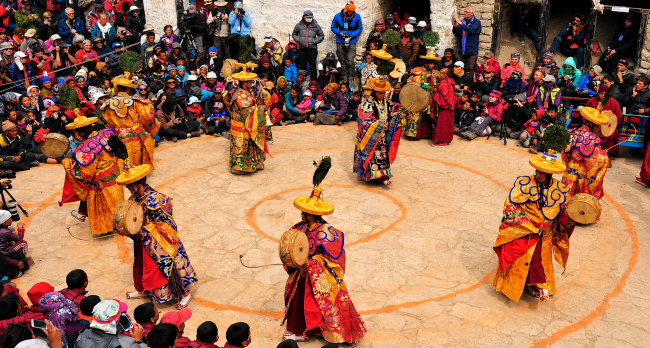
One of the most famous cultural celebrations is the Tiji Festival, a colorful Buddhist festival featuring traditional dances, costumes, rituals, and religious ceremonies.
If your travel dates coincide with the festival, you may have an opportunity to experience one of the most fascinating cultural events in the Himalayas.
The Mustang region is closely connected with the Kali Gandaki River, one of Nepal's major Himalayan rivers.
The river valley is famous for Shaligram fossils, which are regarded as sacred objects in Hinduism.
Shaligrams are naturally occurring fossil stones associated particularly with Lord Vishnu.
For pilgrims, the opportunity to encounter these sacred stones adds another spiritual dimension to a journey through Mustang.
Upper Mustang is a restricted trekking region. Travelers therefore need special permits and must comply with Nepal's restricted-area trekking regulations.
The principal permits generally include:
The restricted-area permit is generally calculated according to the number of days spent in the restricted area.
The commonly quoted structure is:
Permit regulations and fees can be revised by the Nepal government, so Himalayan Adventure Intl Treks will confirm the applicable fee before your departure.
The trek also requires an Annapurna Conservation Area Permit (ACAP) when traveling through the relevant conservation area.
The figures provided for the current planning information are:
Permit fees should always be confirmed at the time of booking because government regulations can change.
A guide is particularly important on the Damodar Kunda Trek because this is not a straightforward teahouse route throughout.
A licensed guide helps with:
Porters reduce the physical burden by carrying your main luggage.
For a high-altitude trek, we recommend keeping your personal backpack light and allowing the porter to carry the majority of your equipment.
Our estimated rates are:
Licensed Guide: USD 30–35 per day
Porter: USD 20–25 per day
Porter-Cum-Guide: USD 25–28 per day
Female Guide: approximately USD 30–35 per day, subject to availability
Language-Speaking Guide: available at an additional rate depending on the language and guide availability.
Guide and porter costs may vary depending on experience, language requirements, itinerary, season, and services included.
The final price depends on the itinerary, group size, number of trekking days, transportation, accommodation category, permit requirements, camping requirements, and additional services.
For two travelers seeking a private journey:
Estimated cost: USD 2,500–3,500 per couple
The final cost depends on whether the itinerary includes private transportation, camping, upgraded accommodation, additional staff, and other services.
For groups of approximately 4–10 travelers:
Estimated cost: USD 2,200–2,800 per person
Larger groups can often reduce transportation and guide-related costs per person.
A private solo journey generally costs more per person because transportation, guide, permits, and support expenses cannot be shared.
Estimated cost: USD 3,000–3,500 per person
These figures are indicative rather than fixed quotations.
Joining a group is an excellent option for travelers who want to reduce the overall cost while meeting other adventurers.
Our group-join departures may include:
Group-join availability depends on demand and seasonal conditions.
Contact Himalayan Adventure Intl Treks for the latest fixed departure dates and group pricing.
Transportation is an important component of the Damodar Kunda journey.
Estimated transportation costs include:
Domestic flight:
Approximately USD 185–200 one way
Flights are highly dependent on weather conditions.
Private jeep:
Approximately USD 350–500 per jeep
A jeep can generally accommodate around 5–7 travelers depending on luggage and vehicle configuration.
Sharing a jeep can significantly reduce the transportation cost per person.
For remote approaches toward areas such as Ghara or Ghuma Thanti, local jeep transportation may be arranged depending on road and trail conditions.
Food availability becomes more limited as you move deeper into remote Upper Mustang.
Typical trekking food includes:
A realistic food budget is approximately:
USD 30–35 per person per day
For remote camping sections, food costs can be higher because supplies must be transported by staff, vehicle, mule, or porter.
Accommodation varies considerably along the route.
In Kathmandu and Pokhara, travelers can select from budget hotels to luxury properties.
In trekking areas, accommodation may include:
Typical teahouse accommodation can cost approximately USD 5–10 per night, while the overall daily budget for food and accommodation may be around USD 30–35 per person depending on the location and services.
Remote camping sections require additional logistics and equipment.
Staying hydrated is especially important at high altitude.
Drinking water may be obtained through:
A typical cost may be approximately USD 1–3 per liter, depending on location and water source.
We recommend carrying a reusable bottle or hydration bladder and using water-purification methods whenever appropriate.
Altitude is one of the most important considerations on the Damodar Kunda Trek.
Damodar Kunda itself lies close to 4,900 meters, and some routes cross passes above 5,000 meters.
Possible symptoms of acute mountain sickness include:
The most important prevention method is gradual acclimatization.
We recommend:
Some trekkers use acetazolamide (Diamox) for altitude prevention. Medication should be discussed with a qualified medical professional before the trek rather than taken without medical guidance.
If serious altitude symptoms develop, the safest response can be descent rather than continuing upward.
Your guide will monitor the group and coordinate evacuation or medical assistance if necessary.
The best seasons are generally spring and autumn.
Spring provides pleasant trekking conditions and excellent scenery.
Advantages include:
March, April, and May are popular months for Himalayan trekking.
Autumn is widely regarded as one of the best trekking seasons in Nepal.
The weather is usually stable and the skies are often clear.
Advantages include:
October and November are particularly popular.
Upper Mustang lies in a rain-shadow region, so it generally receives considerably less rainfall than many other areas of Nepal during the monsoon.
This makes Mustang an interesting summer trekking destination.
However, conditions can still be unpredictable, and snowfall, landslides, road disruptions, or trail difficulties can affect travel.
Winter brings very cold temperatures and significant snowfall in higher areas.
Some routes and passes can become inaccessible.
Winter expeditions require careful planning and should only be undertaken after confirming current trail and weather conditions.
Packing correctly is essential for a high-altitude trek.
For high-altitude camping:
Sleeping bag rated around -20°C is recommended, depending on season and camping elevation.
A sleeping bag liner can provide additional warmth.
High-altitude sunlight can be intense.
Bring:
You do not necessarily need to purchase every piece of trekking equipment.
Himalayan Adventure Intl Treks can assist with arranging or hiring necessary equipment depending on availability.
Equipment may include:
We recommend discussing your equipment requirements with our team before departure.
Himalayan Adventure Intl Treks can organize several related trekking and climbing adventures.
Estimated cost: USD 2,200–3,500 per person
A classic journey through the ancient villages and cultural landscapes of Upper Mustang.
Estimated cost: USD 3,500–5,000 per person
An adventurous route involving the remote Saribung Pass.
Estimated cost: USD 3,500–5,500 per person
A demanding combination of Upper Mustang exploration and high-pass trekking.
Estimated cost: USD 3,800–5,500 per person
One of the most comprehensive options for experienced trekkers seeking a long Himalayan adventure.
Estimated cost: approximately USD 2,800–3,500 per person
A customized journey combining the sacred lakes with the cultural attractions of Upper Mustang.
For experienced mountaineers, Himalayan Adventure Intl Treks can also organize climbing expeditions in the Damodar region.
Estimated cost: USD 4,800–5,200 per person
Estimated cost: USD 4,000–4,500 per person
Climbing prices depend on expedition duration, permits, equipment, guides, climbing staff, transportation, food, camping, insurance, and logistical requirements.
Mountaineering expeditions require additional preparation and appropriate technical experience.
Travelers who have limited time or do not wish to complete the full trek may consider a helicopter tour.
Indicative private/shared helicopter costs can vary considerably according to aircraft, route, passenger numbers, fuel costs, permits, weather, and operator availability.
Previous planning estimates may range around:
These are indicative figures only, and a current quotation must be obtained before booking.
The advantages of a helicopter journey include:
The disadvantages are the high price and dependence on weather and flight conditions.
The standard Upper Mustang Trek can be accessible to many reasonably fit trekkers, but the Damodar Kunda extension should not be treated as a beginner-level trek.
The altitude and remoteness make it considerably more demanding.
Beginners who are physically fit and properly prepared may still participate in a carefully designed itinerary, but we strongly recommend:
Travelers with previous high-altitude trekking experience will generally find the journey more manageable.
Start preparing several weeks before departure.
Useful training includes:
You should gradually increase the length and elevation of your training hikes.
Mental preparation is equally important because remote Himalayan trekking sometimes requires patience when weather or trail conditions change.
Travel insurance is strongly recommended for the Damodar Kunda Trek.
Your policy should ideally cover:
Before purchasing insurance, check the maximum altitude covered by the policy.
Himalayan Adventure Intl Treks is committed to providing safe, responsible, and personalized trekking experiences throughout Nepal.
Our team provides:
Our guides understand Himalayan trails, altitude management, local culture, and trekking logistics.
Porters help carry your luggage so you can enjoy the trek with less physical strain.
We can design your trip according to your available time, budget, fitness level, group size, and interests.
Restricted-area trekking involves additional procedures. Our team handles the necessary trekking arrangements.
We organize domestic flights, private vehicles, jeeps, and other transportation required for your itinerary.
Choose from private, couple, family, group, or group-join departures.
We encourage respectful interaction with local communities and responsible travel practices throughout the journey.
A customized package can include some or all of the following:
The exact inclusions depend on the package selected.
Typical exclusions may include:
We provide a detailed quotation before confirming your booking.
Upper Mustang is a fragile Himalayan environment with unique cultural traditions.
Travelers should help protect the region by:
Responsible trekking helps ensure that future generations can experience the same remarkable landscape.
We organize Damodar Kunda journeys for:
Because the route is demanding, we customize the itinerary according to the fitness and experience of each group.
Damodar Kunda is approximately 4,890 meters (16,043 feet) above sea level.
Damodar Kunda is located in the remote northern part of Mustang District in Nepal, within the Damodar Himalayan region of Upper Mustang.
Depending on the route and acclimatization requirements, the trek generally takes approximately 14–23 days, although customized itineraries can be shorter or longer.
Yes. It is considered a moderate-to-strenuous high-altitude trek because of the remote terrain, high passes, limited facilities, and elevation approaching 4,900 meters.
Yes. Because Upper Mustang is a restricted trekking area and the route is remote, travelers should arrange the trek through an authorized trekking agency with the required guide and permits.
Spring and autumn are generally the most favorable seasons. March–May and September–November usually offer the best combination of weather and visibility.
Yes, helicopter arrangements may be possible subject to weather, aviation regulations, aircraft availability, and landing permissions.
Yes. We organize private trekking packages for couples, with a dedicated guide and porter arrangement.
Yes. Group-join departures can be arranged depending on the available fixed departure schedule.
Muktinath can be included in the itinerary and is highly recommended for travelers interested in combining the Damodar Kunda pilgrimage with another major Himalayan pilgrimage destination.
The Damodar Kunda Trek is an extraordinary journey for travelers looking beyond Nepal's popular trekking routes. It combines the spiritual importance of a sacred Himalayan lake with the ancient culture of Upper Mustang, the historic settlement of Lo-Manthang, the pilgrimage destination of Muktinath, dramatic high-altitude landscapes, and the unforgettable experience of traveling through one of Nepal's most remote regions.
From the moment you arrive in Kathmandu until your return, Himalayan Adventure Intl Treks can coordinate the essential elements of your adventure. Our team can arrange permits, guides, porters, flights, jeeps, accommodation, meals, camping equipment, acclimatization schedules, and other logistics.
Whether you are traveling as a solo adventurer, couple, family, private group, pilgrimage group, or group-join trekker, we can tailor the itinerary to your requirements.
The journey to Damodar Kunda is not only about reaching a destination. It is about walking through ancient Himalayan landscapes, discovering Tibetan-influenced communities, experiencing sacred traditions, crossing remote mountain terrain, and creating memories in a part of Nepal that few travelers have the opportunity to explore.
Contact Himalayan Adventure Intl Treks today to plan your Damodar Kunda and Upper Mustang adventure.
Your journey into the sacred highlands of Mustang awaits.