
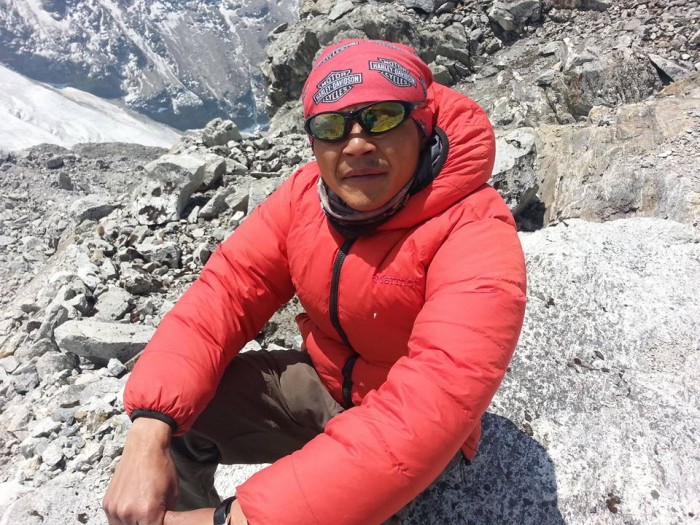
Have Questions? Talk to Expert (Binod)
Kusum Kanguru Peak Climbing is one of Nepal’s most demanding and rewarding alpine adventures, offering experienced mountaineers the opportunity to ascend one of the most technically challenging trekking peaks in the Everest region. Rising to an elevation of 6,367 meters (20,889 feet), Kusum Kanguru dominates the skyline between the famous Dudh Koshi Valley and the remote Hinku Valley, creating a spectacular mountain fortress of ice, rock, and snow.
Organized by Himalayan Adventure Intl Treks, this expedition combines high-altitude trekking, technical mountaineering, authentic Sherpa culture, and breathtaking Himalayan scenery. Unlike many trekking peaks in Nepal, Kusum Kanguru demands serious climbing skills, excellent physical conditioning, and previous alpine experience. The reward, however, is extraordinary: a thrilling ascent to one of the most beautiful summits in the Khumbu region, surrounded by the world’s highest mountains.
The mountain was first successfully climbed by a Japanese expedition team in the autumn of 1979, and since then it has earned a reputation among climbers as one of Nepal’s most challenging NMA-designated trekking peaks. Despite being categorized as a trekking peak by the Nepal Mountaineering Association, Kusum Kanguru presents technical difficulties comparable to many expedition peaks.
For climbers seeking an authentic Himalayan mountaineering challenge beyond the crowded routes of Island Peak and Mera Peak, Kusum Kanguru offers an unforgettable expedition experience in the heart of the Everest Himalayas.
The name Kusum Kanguru originates from the Sherpa and Tibetan languages. It is commonly translated as “Three Snow Peaks” or “Three Snow-White Gods.” The name perfectly reflects the mountain's structure, as Kusum Kanguru consists of three distinct summits:
Together these summits form a dramatic mountain massif that rises sharply above the surrounding valleys. The mountain’s elegant ridges, towering ice walls, and steep rock faces make it one of the most recognizable peaks in eastern Nepal.
Visible from the flight into Lukla and many viewpoints throughout the Khumbu region, Kusum Kanguru immediately captures attention with its striking pyramid shape and rugged alpine character.
Kusum Kanguru is located in the Everest (Khumbu) Region of Nepal, on the boundary between the Dudh Koshi Valley to the south and the Hinku Valley to the north.
The mountain lies within the greater Sagarmatha region, surrounded by some of the most famous peaks on Earth. Its strategic location provides climbers with remarkable panoramic views of numerous Himalayan giants.
Nearby mountains include:
The remote setting enhances the expedition experience, allowing climbers to enjoy pristine wilderness, isolated valleys, and spectacular Himalayan landscapes.
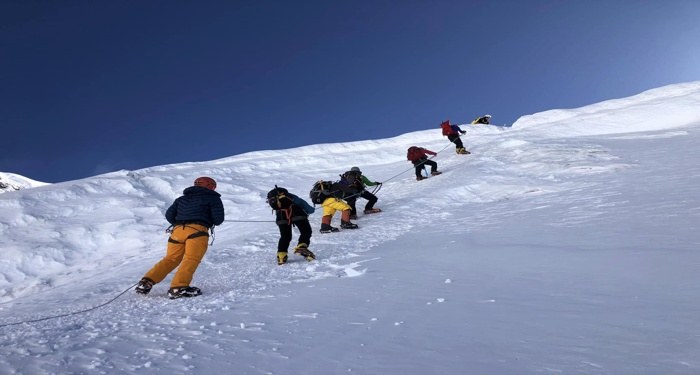
Kusum Kanguru is not simply another trekking peak. It is considered a true alpine challenge that attracts mountaineers looking for technical climbing and high-altitude adventure.
Reasons to choose Kusum Kanguru Peak Climbing include:
For skilled climbers seeking an expedition-style ascent, Kusum Kanguru represents one of the finest objectives in Nepal.
Standing atop Kusum Kanguru provides an incredible sense of achievement. The summit offers breathtaking views extending across the entire Everest region.
The summit rewards climbers with close-up views of:
The expedition passes through traditional Sherpa settlements where climbers experience local hospitality, Buddhist culture, monasteries, and mountain traditions.
The adventure begins with a thrilling mountain flight between Kathmandu and Lukla, offering incredible aerial views of the Himalayas.
The climb includes:
Compared with busier climbing routes, Kusum Kanguru offers a more isolated and authentic Himalayan expedition.
Kusum Kanguru remained unclimbed for many years due to its steep and complex structure. The mountain's first successful ascent was achieved in 1979 by a Japanese expedition team during the autumn climbing season.
Since that historic climb, only a relatively small number of climbers have successfully reached the summit. The technical nature of the mountain, combined with rapidly changing weather conditions and difficult terrain, has kept success rates comparatively low.
Its reputation as one of Nepal’s most demanding trekking peaks continues to attract ambitious climbers from around the world.
Kusum Kanguru is widely regarded as one of the most difficult trekking peaks in Nepal.
Unlike beginner-friendly climbing peaks, this mountain requires advanced mountaineering skills and previous experience at altitude.
Climbers encounter:
Participants should possess:
Kusum Kanguru is best suited for climbers who have previously completed peaks such as:
This expedition is not recommended for first-time climbers.
Several routes lead to the summit of Kusum Kanguru, each presenting unique challenges.
The South-East Ridge is the most commonly used route.
This route approaches from the beautiful Hinku Valley and offers the most practical line to the summit.
Typical route:
Kathmandu → Lukla → Chhetra La Pass → Tuli Kharka → Mosom Kharka → Thangnak → Base Camp → High Camps → Summit
Advantages include:
Most commercial expeditions utilize this route.
North Ridge Route
The North Ridge provides a more direct but demanding alternative.
Approach route:
Kathmandu → Lukla → Namche Bazaar → Base Camp → North Ridge → Summit
This route includes:
The North Ridge is generally chosen by experienced mountaineers seeking a more challenging asce