
Have Questions? Talk to Expert (Binod)
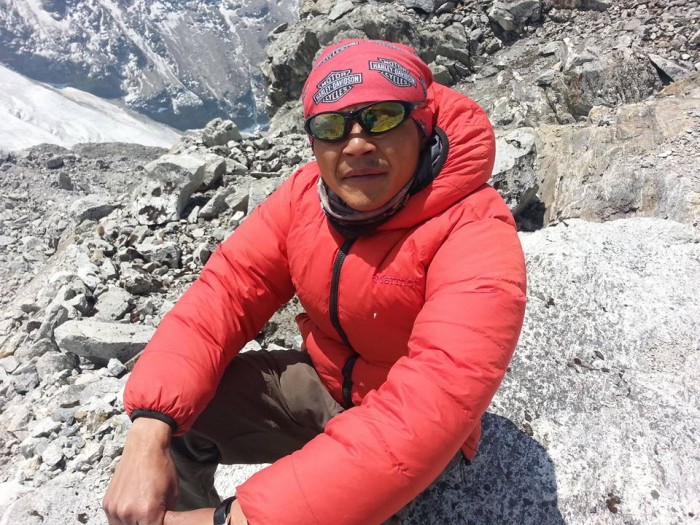
The Tilman Pass Trek is one of the most thrilling, remote, and challenging trekking adventures in Nepal. Situated between the spectacular Langtang Valley and the Panch Pokhari region, this extraordinary journey takes trekkers away from the crowded trekking routes and deep into a magnificent landscape of high mountains, alpine lakes, glaciers, rugged ridges, forests, remote villages, and traditional Himalayan communities.
Named after the legendary British explorer and mountaineer H.W. Tilman, the trek is particularly attractive to experienced trekkers and adventure seekers who want to experience a less-traveled side of the Nepal Himalayas. The route reaches the impressive Tilman Pass at approximately 5,302 meters, making the pass crossing the most challenging and memorable section of the journey.
The trek combines several very different Himalayan environments. The lower sections pass through green forests, terraced hills, villages, and traditional settlements, while the higher sections enter a remote alpine wilderness characterized by rocky slopes, moraine, snow, glaciers, and high mountain passes. The journey also provides an opportunity to experience the spiritual atmosphere of Panch Pokhari, one of Nepal's important high-altitude pilgrimage destinations.
For trekkers who are looking for something more adventurous than a conventional tea-house trek, the Tilman Pass Trek offers an exceptional combination of wilderness, culture, physical challenge, and spectacular Himalayan scenery.
Himalayan Adventure Intl Treks organizes this trek with experienced local guides, porters, camping arrangements, transportation, permits, food, accommodation, and carefully planned high-altitude logistics.
Himalayan Adventure Intl Treks is accepting bookings for the Tilman Pass Trek for private groups, couples, solo travelers, and group-joining trekkers.
Because Tilman Pass is a remote and demanding route, advance planning is strongly recommended. Unlike popular trekking routes where accommodation and services are available almost everywhere, several sections of the Tilman Pass route require organized camping support.
Early booking allows our team to prepare the necessary permits, transportation, guides, porters, camping equipment, food supplies, accommodation, and other logistical arrangements.
Whether you are an experienced Himalayan trekker looking for a new challenge or an adventure traveler interested in discovering a less-developed trekking region, our team can customize the trip according to your available time, group size, experience, and preferred services.
We offer:
Important: High-altitude sections and the Tilman Pass crossing are dependent on weather, snow, trail, and safety conditions. Final route decisions should always be made by the experienced trekking team according to conditions on the ground.
The Group Join Tilman Pass Trek is an excellent option for travelers who want to experience this challenging Himalayan adventure while sharing the cost and experience with other trekkers.
Joining a group can significantly reduce the per-person cost of guides, porters, transportation, camping logistics, and other operational expenses. It also creates an opportunity to meet travelers from different countries and share an unforgettable Himalayan experience.
The estimated price for the Group Join Tilman Pass Trek is:
USD 2,000–2,200 per person
The final price depends on group size, itinerary, transportation arrangements, accommodation standards, camping requirements, permits, season, and services selected.
We recommend contacting Himalayan Adventure Intl Treks before booking flights so that the exact departure date and operational status of the route can be confirmed.
The Tilman Pass Trek can be organized for solo travelers, but solo trekking on such a remote and high-altitude route requires considerably more preparation than a standard trekking route.
The terrain around Tilman Pass can be rugged, and weather conditions can change rapidly. Some sections are remote and have limited access to accommodation or emergency services. For this reason, we strongly recommend that solo travelers trek with an experienced local guide and appropriate porter support rather than attempting the route independently.
The estimated cost for a private solo Tilman Pass Trek is:
USD 3,500–4,400 per person
The higher price compared with group trekking reflects the fact that the traveler must cover a larger share of the guide, porter, transportation, camping, and operational costs.
Depending on the package, the cost can include:
The exact quotation is prepared according to the traveler's preferred services and itinerary.
For adventurous couples, the Tilman Pass Trek offers a unique opportunity to explore some of Nepal's most remote Himalayan landscapes together.
Rather than following a busy trekking trail, couples can experience quiet mountain paths, sacred lakes, alpine wilderness, remote camps, and spectacular Himalayan scenery.
The estimated cost for a private couple's Tilman Pass Trek is:
USD 5,500–6,500 per couple
The package can include a private trekking guide, porter support, permits, accommodation, meals, transportation, camping equipment, and other necessary arrangements.
A private couple's itinerary can also be customized according to walking pace and preferred accommodation.
The Tilman Pass Trek passes through protected Himalayan areas, and trekkers need the appropriate permits and documentation before beginning the trek.
The commonly listed costs include:
Permit rules and fees can change, so Himalayan Adventure Intl Treks confirms the applicable requirements before departure and handles the necessary permit arrangements for organized trekking packages.
Trekkers should not rely solely on older online pricing because Nepal's permit and trekking regulations can be updated by the relevant authorities.
Transportation is an important part of the Tilman Pass Trek because the route begins and ends through road-accessible areas.
Depending on the itinerary and current road conditions, transportation can be arranged by private Jeep, shared Jeep, or public bus.
The actual cost depends on the departure point, destination, season, road conditions, vehicle type, and number of travelers.
For private groups, a private Jeep is generally the most comfortable option because it provides greater flexibility with departure times and luggage.
A professional guide is one of the most important components of a safe and successful Tilman Pass Trek.
The route includes remote areas, high-altitude terrain, difficult navigation, and a demanding pass crossing. Experienced guides understand local trails and weather patterns and can help manage pacing, accommodation, meals, camping, and emergency decisions.
Rates can vary depending on experience, language skills, season, itinerary, and responsibilities.
For trekkers who need a specialized language-speaking guide, Himalayan Adventure Intl Treks can also make arrangements upon request.
The Tilman Pass Trek includes a mixture of village accommodation and camping, depending on the route and season.
In lower settlements, trekkers may stay in simple lodges or guesthouses. As the trail reaches higher and more remote sections, organized camping becomes necessary.
Basic lodge accommodation can cost approximately:
USD 5–15 per night
Camping costs depend on the equipment, staff, food, transportation of supplies, and number of trekkers.
Meals generally include local and trekking-friendly dishes such as:
A meal may cost approximately USD 5–10, depending on location and menu.
At higher elevations, food and fuel become more expensive because supplies must be transported long distances.
Safe drinking water is essential during a high-altitude trek.
Water may be available from local sources, lodges, boiled-water services, or bottled-water stations where available. Trekkers should use an appropriate purification method when drinking untreated natural water.
Estimated water costs can range from USD 1–3 per liter, depending on location and treatment method.
Himalayan Adventure Intl Treks encourages trekkers to carry reusable water bottles or hydration systems and minimize unnecessary plastic waste.
Choosing the right season is extremely important for the Tilman Pass Trek because the route reaches more than 5,300 meters.
Spring is one of the best periods for trekking in Nepal.
During March, April, and May, temperatures gradually become warmer, mountain visibility is often good, and rhododendron forests can be in bloom.
The lower and middle sections of the trail become particularly beautiful during spring.
April and May can be excellent months for experienced trekkers, although high-altitude conditions must still be monitored carefully.
Autumn is another highly recommended season.
After the monsoon, the atmosphere is often clearer, mountain views can be excellent, and trekking conditions are generally more favorable.
September may still experience some residual monsoon weather, while October and November are traditionally popular months for Himalayan trekking.
The monsoon season is generally not recommended for the Tilman Pass route.
Heavy rainfall can result in:
The actual conditions vary each year, so an experienced trekking company should assess the route before departure.
Winter brings very cold conditions, particularly above 4,000 meters.
Snow accumulation can make the Tilman Pass crossing considerably more difficult or impossible depending on the season.
Only highly experienced trekkers with appropriate equipment, preparation, and professional support should consider attempting the route during severe winter conditions.
Altitude is one of the defining characteristics of this trek.
The journey gradually progresses from the lower Himalayan foothills to high-altitude areas around Panch Pokhari, Intermediate Camp, Moraine Camp, South Base Camp, and eventually Tilman Pass.
The highest point is approximately:
Tilman Pass – 5,302 meters
The ascent to this elevation should be gradual, and trekkers should listen to their bodies throughout the journey.
Our guides encourage a steady pace, adequate hydration, appropriate rest, and careful monitoring of symptoms.
Acute Mountain Sickness (AMS) can affect anyone traveling to high altitude, regardless of age or fitness level.
Possible symptoms include:
The most important prevention strategy is gradual acclimatization.
Trekkers should:
Medication such as acetazolamide (Diamox) may be considered by some travelers, but it should only be used after discussing it with a qualified medical professional, particularly because medications can have contraindications and side effects.
If serious altitude-related symptoms develop, continuing higher is not appropriate. Descent to a lower elevation and professional medical assessment may be necessary.
On a remote trek such as Tilman Pass, safety decisions take priority over reaching the planned destination.
The route is particularly appealing because it combines several distinct Himalayan environments.
Panch Pokhari, meaning Five Lakes, is one of the major highlights of the trek. The sacred alpine lakes are surrounded by dramatic mountain scenery and hold religious significance for local communities.
The remote sections of the route provide a genuine wilderness experience. Trekkers can walk for long periods without encountering the crowds associated with Nepal's more popular trekking routes.
The route around the high camps includes rugged moraine and rocky terrain shaped by glacial activity.
Crossing Tilman Pass is the ultimate challenge of the journey. The pass provides dramatic views and a tremendous sense of achievement.
After crossing the pass, trekkers descend toward Langshisha Kharka, surrounded by spectacular high Himalayan landscapes.
The journey eventually connects with the beautiful Langtang Valley, where trekkers encounter traditional Himalayan villages, Buddhist culture, mountain views, and the famous Kyangjin area.
The Langtang region is one of Nepal's most diverse trekking destinations.
In addition to Tilman Pass, travelers can explore several other remarkable routes.
The Langtang Valley Trek is one of Nepal's classic Himalayan journeys, combining mountain scenery, Tamang culture, forests, villages, and the beautiful Kyangjin Valley.
The Gosaikunda Trek leads to the sacred alpine lake of Gosaikunda and can be combined with other Langtang and Helambu routes.
Helambu offers a relatively accessible Himalayan experience close to Kathmandu, with mountain scenery, forests, villages, and cultural experiences.
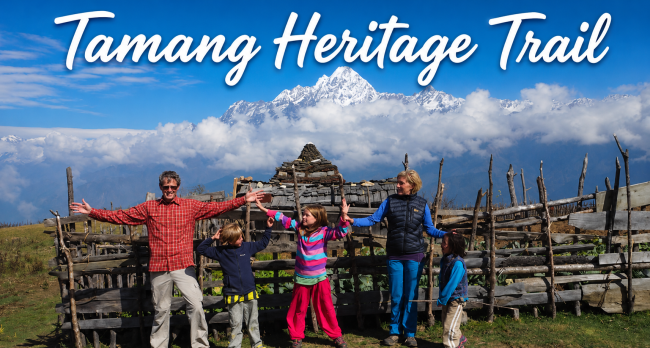
The Tamang Heritage Trek focuses particularly on the culture and traditions of the Tamang communities of the Langtang region.
For trekkers seeking a serious high-altitude challenge, however, Tilman Pass offers a much more remote and demanding experience.
Packing correctly is essential for a high-altitude trek.
Your trekking boots should be well broken in before the journey.
Because the trek reaches more than 5,000 meters, your guide will provide additional advice about equipment according to current seasonal conditions.
The Tilman Pass Trek is not only a mountain adventure; it is also a cultural journey.
The Langtang region is strongly influenced by Tamang and other Himalayan communities, with Tibetan Buddhist traditions visible throughout many villages.
Trekkers may encounter:
The cultural experience becomes particularly meaningful when travelers take time to interact respectfully with local communities.
Our guides can help explain local customs, religious traditions, architecture, and everyday life.
Himalayan Adventure Intl Treks is dedicated to providing carefully organized trekking and adventure experiences throughout Nepal.
For a demanding route like Tilman Pass, organization and local experience are particularly important.
Our trekking services can include:
We understand that every traveler has different expectations. Some guests prefer budget arrangements, while others prefer more comfortable private services. We therefore provide flexible trekking packages according to group size, budget, experience, and preferred services.
Our priority is to provide a responsible and well-organized Himalayan adventure without losing the authentic character of the trek.
We believe that a successful high-altitude journey depends on:
Good preparation + experienced local staff + appropriate acclimatization + reliable logistics + responsible decision-making.
Our guides are trained to monitor trail and weather conditions and to communicate with trekkers throughout the journey.
At high altitude, reaching the planned destination is never more important than the safety of the trekking group.
The Tilman Pass Trek is best suited to trekkers who are comfortable with long walking days, steep ascents, rugged terrain, camping, and high-altitude conditions.
Previous experience with high-altitude trekking is strongly beneficial.
The trek should not be selected simply because of the distance or number of days. The combination of altitude, remote terrain, weather, and the Tilman Pass crossing makes it a serious Himalayan adventure.
Trekkers should prepare physically before arrival in Nepal and obtain suitable travel insurance that covers high-altitude trekking and emergency evacuation where applicable.
Himalayan Adventure Intl Treks encourages responsible tourism throughout the Tilman Pass region.
Trekkers can help protect the Himalayas by:
The Tilman Pass region remains relatively remote, and responsible trekking is essential to preserving its natural and cultural character.
The Tilman Pass Trek Nepal is an extraordinary journey for travelers who want to experience the Himalayas beyond the usual trekking routes.
From the sacred waters of Panch Pokhari to the remote high-altitude camps, from rugged moraine landscapes to the dramatic 5,302-meter Tilman Pass, and from the isolated wilderness to the culturally rich Langtang Valley, this trek delivers a remarkable variety of experiences.
It is challenging, remote, physically demanding, and highly rewarding.
Whether you are planning a Group Join Tilman Pass Trek, Private Trek, Solo Trek, or Couple Trek, Himalayan Adventure Intl Treks can organize the necessary trekking services and logistics to make your Himalayan journey as smooth and well-supported as possible.
Our team can assist with permits, transportation, accommodation, camping, guides, porters, meals, airport transfers, and customized trekking arrangements.
Contact our team for the latest Tilman Pass Trek cost, fixed departure dates, private group quotations, permit requirements, availability, and customized itinerary.
Book your Tilman Pass Trek with Himalayan Adventure Intl Treks and discover one of Nepal's most challenging and unforgettable Himalayan adventures.
Your Tilman Pass adventure begins with your arrival in Kathmandu, the cultural and historical capital of Nepal. After landing at Tribhuvan International Airport, you will be welcomed by a representative of Himalayan Adventure Intl Treks and transferred to your hotel.
Once you have checked in and settled into your room, you can relax after your journey or explore the lively streets of Kathmandu. Depending on your arrival time, our team will brief you about the trek and check your trekking equipment.
This day is also important for completing any last-minute preparations. Since the Tilman Pass route is remote and reaches more than 5,000 meters, your guide will check essential equipment and make sure you have appropriate clothing, footwear, sleeping equipment, and personal items.
In the evening, you can enjoy a traditional Nepali dinner and meet your trekking team.
Accommodation: Hotel in Kathmandu
Altitude: 1,350m
Meals: Welcome dinner
After breakfast, your journey begins with a scenic drive from Kathmandu toward the foothills of the Himalayas. The road gradually leaves the busy Kathmandu Valley and enters green hills, terraced farmland, forests, and traditional settlements.
The drive takes approximately 4–5 hours, depending on road and traffic conditions. You will eventually reach Chimti at approximately 1,700 meters.
From Chimti, the trekking section begins. The initial trail passes through forested landscapes and gradually climbs toward Deurali, situated at approximately 2,400 meters.
The short trek of around two hours provides a gentle introduction to the route. You will notice that the landscape becomes increasingly rural as you move away from the main roads and settlements.
Deurali offers a peaceful mountain environment and is an excellent place to spend your first night on the trail.
Driving: 4–5 hours
Trekking: Approximately 2 hours
Accommodation: Camping/trekking lodge depending on local conditions
Maximum altitude: 2,400m
Today the trek becomes more demanding as you gain significant altitude. After breakfast, you follow the mountain trail through forests and gradually ascend toward Nyasim Pati at approximately 3,620 meters.
The trail passes through beautiful rhododendron and mixed Himalayan forests. During spring, rhododendron flowers can add vibrant color to the surrounding landscape.
As you climb higher, the vegetation gradually becomes thinner. The forest begins to open, providing increasingly expansive views of the surrounding hills and mountains.
The approximately 6–7-hour trek requires a steady pace. Your guide will encourage you to walk slowly and maintain a comfortable rhythm rather than rushing uphill.
Nyasim Pati is an important stop before reaching the higher Panch Pokhari region. The colder temperatures and increasing altitude provide an early indication that the trek is entering a true high-mountain environment.
After reaching camp, you can rest, enjoy a warm meal, and prepare for the next day's journey.
Trekking: 6–7 hours
Maximum altitude: 3,620m
Accommodation: Camping
Highlight: Forests, mountain scenery, changing alpine vegetation
Today you trek toward one of the most beautiful and culturally significant destinations of the journey: Panch Pokhari.
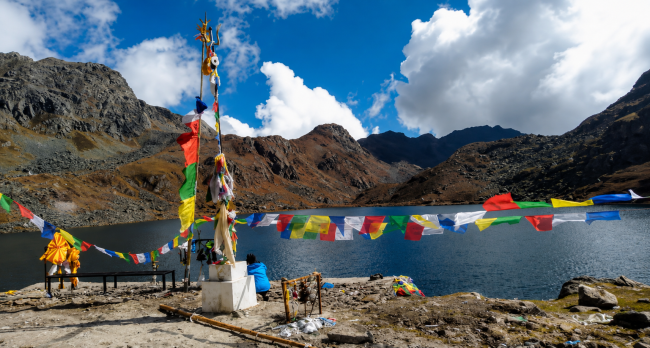
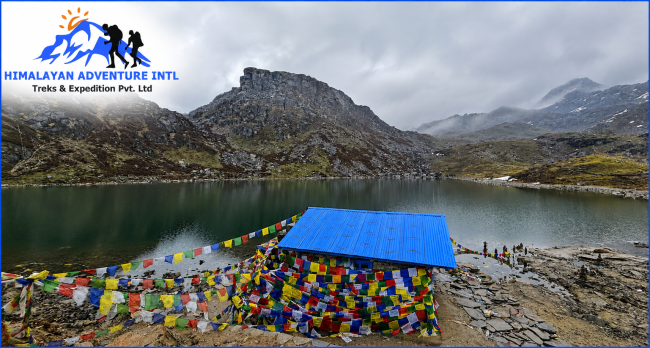
Panch Pokhari means “Five Lakes” and refers to a group of sacred alpine lakes situated at approximately 4,074 meters. The area holds considerable religious importance for local Hindu and Buddhist communities.
The trek takes around 3–4 hours, but the increasing altitude makes the journey more challenging than the relatively short distance might suggest.
As you ascend, the landscape becomes more open and alpine. The forests gradually disappear, replaced by rocky slopes, grasslands, and Himalayan terrain.
Upon reaching Panch Pokhari, the scenery becomes particularly impressive. On clear days, you can enjoy panoramic views of surrounding Himalayan peaks and vast mountain landscapes.
The peaceful setting of the five sacred lakes provides an excellent opportunity to appreciate the remote character of this trek.
Because you are now above 4,000 meters, acclimatization becomes increasingly important. Your guide will monitor your condition and encourage adequate hydration and rest.
Trekking: 3–4 hours
Altitude: 4,074m
Accommodation: Camping
Highlight: Sacred Panch Pokhari, alpine scenery, Himalayan panoramas
Today you leave the Panch Pokhari area and continue deeper into the high Himalayas.
The trail gradually climbs through increasingly rugged terrain toward the Intermediate Camp at approximately 4,400 meters. The trek takes around 5–6 hours.
The environment changes dramatically at this elevation. Trees become scarce, while rocky slopes, alpine grasslands, boulders, and snow-covered mountain ridges dominate the landscape.
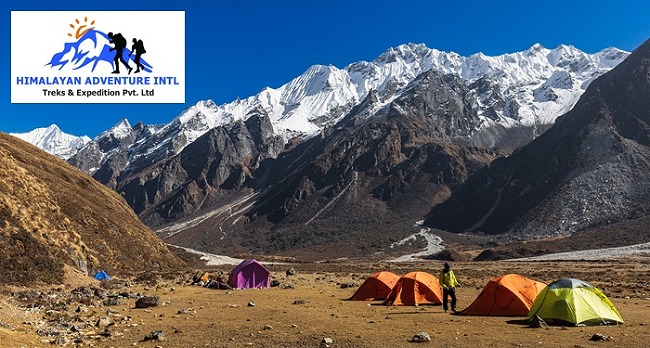
This is a remote section of the trek where facilities are limited. Himalayan Adventure Intl Treks therefore prepares the necessary camping logistics in advance, including tents, food, cooking arrangements, and trekking support.
The journey may be physically demanding, particularly because of the altitude. A slow and controlled pace is essential.
Once you reach the Intermediate Camp, your trekking team will establish camp. After a warm meal, you can rest and enjoy the extraordinary silence of the high mountains.
Trekking: 5–6 hours
Approximate altitude: 4,400m
Accommodation: Camping
Highlight: Remote alpine wilderness and high-altitude landscapes
Today's trek takes you through rugged Himalayan terrain toward the Moraine Camp above Tin Kund, situated at approximately 4,255 meters.
Although the listed altitude is somewhat lower than the previous night's camp, the route remains challenging because of uneven terrain, rocky sections, and the remote environment.
The trail takes approximately 5–6 hours and gradually leads into a landscape shaped by ancient glaciers and Himalayan geological processes.
Moraine terrain consists of rocks and debris deposited by glaciers, and walking across such surfaces requires careful attention. Your experienced guide will help identify the safest sections of the trail and maintain an appropriate pace.
The surroundings become increasingly dramatic as you approach the higher mountains. Depending on weather and visibility, you may see snow-covered ridges, rocky peaks, and glacial landscapes.
The night at Moraine Camp is an important preparation for the upcoming ascent toward Tilman Pass.
Trekking: 5–6 hours
Altitude: Approx. 4,255m
Accommodation: Camping
Highlight: Moraine landscape, alpine wilderness, dramatic mountain scenery
Today is another important high-altitude trekking day as you move toward Tilman Pass South Base Camp at approximately 4,700 meters.
The trek takes around 4–5 hours. Although relatively short in duration, the altitude makes it physically demanding.
The surrounding landscape is now distinctly high alpine. Trees and dense vegetation have disappeared, leaving a world of rocks, snow, glaciers, and exposed mountain slopes.
Your guide will maintain a slow pace and schedule appropriate breaks. Reaching base camp is a major milestone because the following day involves the most challenging section of the entire trek: crossing Tilman Pass.
At approximately 4,700 meters, temperatures can become very cold, particularly after sunset. Your trekking team will prepare a warm meal and make sure you are comfortable inside the tent.
Before sleeping, your guide will provide a briefing about the next day's route, weather conditions, equipment, and the early start required for the pass crossing.
Trekking: 4–5 hours
Altitude: 4,700m
Accommodation: Camping
Highlight: Tilman Pass South Base Camp and preparation for the pass crossing
Today is the highlight and most challenging day of the Tilman Pass Trek.
You will start very early, usually before sunrise, to maximize daylight and allow sufficient time for the pass crossing and descent.
The route climbs from South Base Camp toward Tilman Pass at 5,302 meters. The terrain can include steep slopes, loose rock, snow, ice, and glacial or moraine sections depending on seasonal conditions.
The crossing requires careful footwork and strong concentration. Weather conditions can change quickly at this altitude, and your guide will make decisions based on snow, ice, visibility, wind, and overall trail conditions.
Reaching the top of Tilman Pass is a memorable achievement. From the pass, you can experience an extraordinary high-Himalayan panorama, with rugged peaks, glaciers, snow-covered ridges, and deep valleys extending into the distance.
After spending some time at the pass, you begin the long descent toward Langshisha Kharka at approximately 4,300 meters.
The entire day's journey takes approximately 10–11 hours, making it the longest and most demanding day of the trek.
Because of the combination of high altitude, difficult terrain, cold temperatures, and long walking hours, this section requires appropriate preparation and an experienced trekking team.
Reaching Langshisha Kharka after crossing the pass provides an enormous sense of accomplishment.
Trekking: 10–11 hours
Highest point: 5,302m
Destination: Langshisha Kharka, approx. 4,300m
Accommodation: Camping
Highlight: Tilman Pass crossing at 5,302m
After the demanding pass-crossing day, today's trek gradually descends toward the famous Langtang Valley.
The route takes approximately 5–6 hours and follows increasingly greener landscapes as you lose altitude.
The surrounding mountains remain spectacular, but the environment begins to change. Alpine wilderness gradually gives way to more vegetation, pastureland, and traditional Himalayan settlements.
Depending on route and local trail conditions, the day's destination is Kyangjin Gompa at approximately 3,830 meters or the Langtang Valley area.
Kyangjin Gompa is one of the most important cultural and scenic destinations in the Langtang region. Surrounded by spectacular mountains, glaciers, and high Himalayan peaks, it offers an ideal place to recover after the demanding pass crossing.
The change from remote camping wilderness to a more established Himalayan settlement is noticeable.
You can spend the afternoon resting, exploring the surroundings, or enjoying the mountain scenery.
Trekking: 5–6 hours
Altitude: Approx. 3,830m
Accommodation: Lodge/camping depending on final route
Highlight: Entering Langtang Valley and reaching Kyangjin Gompa
Today you continue descending through the Langtang region toward Tiwari Village at approximately 2,300 meters.
The approximately 7–8-hour trek provides a dramatic contrast to the high-altitude landscapes experienced during the previous days.
As you descend, the air becomes warmer and vegetation becomes increasingly dense. You will pass through forests, mountain settlements, cultivated fields, and traditional villages.
This section also provides opportunities to observe the local lifestyle of Himalayan communities. Stone houses, prayer flags, Buddhist cultural elements, farmland, and traditional trails create an authentic picture of rural Nepal.
The descent is generally easier in terms of altitude, but long downhill walking can still be tiring. Trekking poles can be especially useful.
After reaching Tiwari Village, enjoy a well-earned dinner and rest before the final journey back to Kathmandu.
Trekking: 7–8 hours
Altitude: Approx. 2,300m
Accommodation: Lodge/guesthouse or camping depending on local arrangements
Highlight: Forests, villages, local culture, and dramatic altitude descent
After breakfast, you leave the mountains behind and begin your return journey to Kathmandu by private or shared Jeep, depending on the final arrangement.
The drive takes approximately 6–7 hours, although road conditions and traffic can affect the travel time.
The journey provides a final opportunity to enjoy Nepal's beautiful countryside. You will pass through winding mountain roads, green hills, terraced farmland, rivers, villages, and roadside settlements before eventually reaching Kathmandu.
After arriving in Kathmandu, you will check into your hotel and have time to relax after the long journey.
In the evening, Himalayan Adventure Intl Treks can arrange a farewell dinner or you can enjoy your final evening exploring Kathmandu.
Driving: 6–7 hours
Accommodation: Hotel in Kathmandu
Meals: Breakfast and farewell dinner, depending on package
Your unforgettable Tilman Pass Trek comes to an end today.
Depending on your flight schedule, you can enjoy breakfast at the hotel before being transferred to Tribhuvan International Airport for your onward flight.
A representative from Himalayan Adventure Intl Treks will assist you with the airport transfer and departure arrangements.
If you have additional time in Nepal, we can also arrange an extension to destinations such as Pokhara, Chitwan, Lumbini, or other cultural and adventure destinations.
Your journey may be ending, but the memories of Panch Pokhari, remote Himalayan camps, the dramatic Tilman Pass crossing, Langshisha Kharka, and Langtang Valley will remain with you long after you leave Nepal.
Accommodation: Not included unless additional nights are requested
Meals: Breakfast, depending on departure time
Activity: Airport transfer and final departure
The Tilman Pass Trek is one of Nepal’s most remote, challenging, and rewarding Himalayan adventures. Far from the busy trekking routes of Everest and Annapurna, this spectacular journey takes experienced trekkers through rugged mountain terrain, peaceful highland settlements, pristine forests, glacial landscapes, alpine lakes, and one of the most demanding high passes in the Langtang and Jugal Himalayan region.
Named after the legendary British explorer and mountaineer H. W. Tilman, the route combines wilderness adventure with remarkable Himalayan scenery. Trekkers can experience panoramic views of magnificent peaks, including Langtang Lirung, Ganesh Himal, Dorje Lakpa, Jugal Himal, and Shishapangma, depending on weather and visibility.
The trek is particularly attractive to travelers looking for a genuine off-the-beaten-path experience. Unlike popular trekking destinations where trails can become busy during peak seasons, the Tilman Pass route offers long stretches of solitude and a strong sense of wilderness.
At Himalayan Adventure Intl Treks, we organize Tilman Pass Trek programs with experienced mountain guides, porters, transportation, permits, accommodation, meals, camping logistics where required, and appropriate safety planning. Because the route involves high altitude, remote camps, difficult terrain, and a demanding pass crossing, careful preparation is essential.
This complete guide explains the Tilman Pass Trek cost, itinerary, permits, best trekking seasons, guide and porter costs, packing list, accommodation, meals, altitude concerns, AMS prevention, safety considerations, and other important information you should know before beginning this Himalayan adventure.
The Tilman Pass Trek is not simply another Himalayan walking holiday. It is an expedition-style trekking adventure through remote mountain landscapes.
Several features make this trek particularly attractive:
One of the greatest attractions is the feeling of being away from the crowds. Much of the route passes through remote areas where modern infrastructure is limited.
The journey reaches Tilman Pass at approximately 5,300 meters, making altitude one of the major challenges of the trek. Proper acclimatization and preparation are therefore extremely important.
The beautiful Panch Pokhari, meaning “Five Lakes,” is one of the most remarkable highlights of the route. The sacred alpine lakes are surrounded by dramatic Himalayan scenery and offer an unforgettable high-altitude experience.
As the trail climbs higher, forests gradually give way to alpine meadows, rocky landscapes, glaciers, moraine, snowfields, and high mountain passes.
The remote environment provides opportunities to encounter Himalayan wildlife and birds. Depending on the season and location, trekkers may see animals such as Himalayan thar, musk deer, langur monkeys, and a variety of mountain birds.
The route also passes through communities influenced by Tamang, Sherpa, and other Himalayan traditions. The villages provide opportunities to observe local lifestyles, architecture, customs, and mountain culture.
The total cost of the Tilman Pass Trek depends on group size, trekking duration, transportation arrangements, accommodation standards, permits, guide and porter requirements, and whether the trek is organized privately or as a group departure.
For a fully organized trek, an approximate cost structure is:
| Trekking Option | Estimated Cost |
|---|---|
| Solo Trek | USD 2,000–2,400 |
| Group Join Trek | USD 1,600–1,900 per person |
| Couple Trek | USD 3,500–4,200 for two |
| Private Group of 4–6 | USD 1,400–1,700 per person |
| Guide | USD 30–35 per day |
| Porter | USD 20–25 per day |
| Trekking Permits | Approximately USD 50–100, depending on applicable permits |
These figures are approximate and can change according to the final itinerary, group size, transportation requirements, accommodation, season, permit regulations, and services requested.
A larger group generally reduces the per-person cost because transportation, guide services, equipment, and other logistical expenses can be shared among participants.
For a customized quotation, Himalayan Adventure Intl Treks can prepare the package according to your preferred trekking style and travel dates.
Tilman Pass is considerably more remote than many established trekking routes. The higher cost is related to logistics rather than simply the number of trekking days.
The route may require:
The actual price should therefore be considered in relation to the level of support and safety included in the package.
The following itinerary is a challenging program designed for experienced trekkers. Depending on weather, trail conditions, road conditions, acclimatization requirements, and group fitness, the itinerary may be modified by the professional trekking team.
Your Tilman Pass adventure begins with your arrival in Kathmandu, Nepal’s vibrant capital city.
After completing airport immigration and customs formalities, you will meet a representative from Himalayan Adventure Intl Treks and transfer to your hotel.
Depending on your arrival time, you can rest or explore nearby areas of Kathmandu.
In the evening, the trekking team will conduct a briefing covering the route, equipment, altitude, weather, safety procedures, and final preparations.
Overnight: Kathmandu hotel
Meals: Welcome dinner
After breakfast, the journey begins with a drive toward the trailhead at Chimti.
The road journey provides views of Nepal’s countryside, rivers, hills, forests, terraced farmland, and traditional settlements.
After reaching Chimti, you begin trekking toward Deorali Top.
This first walking section introduces you to the terrain and allows your body to gradually adjust to the increasing elevation.
Approximate duration: 6–7 hours driving and around 2 hours trekking
Overnight: Deorali Top
Today the trail climbs steadily toward Nyasim Pati.
The landscape becomes increasingly mountainous as you move away from lower-elevation settlements.
The trail passes through forests and open mountain terrain, with occasional Himalayan viewpoints.
At approximately 3,620 meters, Nyasim Pati is already a significant altitude gain. You should maintain a slow, comfortable pace and drink sufficient water.
Trekking duration: Approximately 6–7 hours
Overnight: Nyasim Pati
Today is one of the most scenic stages of the trek.
The route climbs toward Panch Pokhari, one of the most important natural and cultural attractions in this region.
Panch Pokhari translates as “Five Lakes” and refers to a group of sacred alpine lakes surrounded by rugged Himalayan terrain.
At over 4,000 meters, the environment becomes much colder and thinner. Your guide will monitor your pace and physical condition.
Trekking duration: Approximately 3–4 hours
Overnight: Panch Pokhari
Today you continue toward the higher wilderness areas.
The vegetation becomes increasingly sparse as you move above the tree line. The landscape consists of alpine meadows, rocky slopes, mountain ridges, and high-altitude terrain.
The relatively short walking distance does not mean the day is easy. At this altitude, even moderate uphill sections can require considerable effort.
Your trekking team will establish camp at the appropriate location depending on weather and trail conditions.
Trekking duration: Approximately 5–6 hours
Overnight: Intermediate Camp
The trail continues through increasingly rugged terrain toward the moraine areas above Tin Kund.
This is a remote section where the trail can be less obvious than on established commercial routes.
Weather conditions can change quickly, and your guide's knowledge of the terrain becomes particularly important.
The camp provides an opportunity to rest before the demanding high-altitude stages ahead.
Trekking duration: Approximately 5–6 hours
Overnight: Moraine Camp
Today you enter the high-altitude environment surrounding Tilman Pass.
The landscape is dominated by rocky slopes, moraine, snow-covered peaks, and glacial terrain.
At approximately 4,700 meters, the South Base Camp provides an important staging point before crossing the pass.
The guide will inspect weather conditions and discuss the next day's crossing with the group.
Trekking duration: Approximately 4–5 hours
Overnight: South Base Camp
This is the most challenging and exciting day of the trek.
An early start is essential because the pass crossing can be affected by weather, snow, visibility, and trail conditions.
The route climbs from the high camp toward Tilman Pass at approximately 5,300 meters.
The final ascent can involve steep and rocky terrain, snow, ice, loose stones, and challenging mountain conditions. Depending on the season and current conditions, additional technical safety equipment and fixed-rope assistance may be necessary.
Once you reach the pass, you will be rewarded with spectacular views of the surrounding Himalayan peaks and high-altitude wilderness.
After celebrating the successful pass crossing, the trail descends toward Langshisha Kharka.
This is a long and physically demanding day, often requiring around 10–11 hours.
Trekking duration: Approximately 10–11 hours
Highest point: Approximately 5,300m
Overnight: Langshisha Kharka
After the demanding pass-crossing day, the route gradually descends toward the Langtang Valley.
The reduction in altitude usually provides welcome relief.
The surrounding landscape becomes more diverse, with mountain pastures, dramatic peaks, glacial valleys, and traditional Himalayan settlements.
Depending on the exact route and local trail conditions, the overnight location can be arranged around Kyanjin Gompa or the Langtang Valley.
Trekking duration: Approximately 5–6 hours
Overnight: Kyanjin Gompa or Langtang area
Today you continue descending toward lower elevations.
The trail passes through forests, villages, mountain streams, and increasingly green landscapes.
After several days above 4,000 meters, the lower elevation feels warmer and the air becomes richer in oxygen.
The day's walk provides an opportunity to recover from the strenuous high-altitude sections.
Trekking duration: Approximately 7–8 hours
Overnight: Tiwari Village
After breakfast, you leave the trekking region and begin the drive back toward Kathmandu.
The journey can take approximately 6–7 hours depending on road and traffic conditions.
After reaching Kathmandu, check into your hotel and enjoy a well-earned rest.
The evening can be used for shopping, sightseeing, or enjoying a farewell dinner with your trekking team.
Driving duration: Approximately 6–7 hours
Overnight: Kathmandu
Your Tilman Pass adventure officially comes to an end.
Depending on your flight schedule, a representative from Himalayan Adventure Intl Treks will assist with your transfer to Tribhuvan International Airport.
If you wish to extend your stay in Nepal, additional programs such as Kathmandu sightseeing, Pokhara tours, Chitwan Jungle Safari, cultural tours, or other trekking and climbing adventures can be arranged.
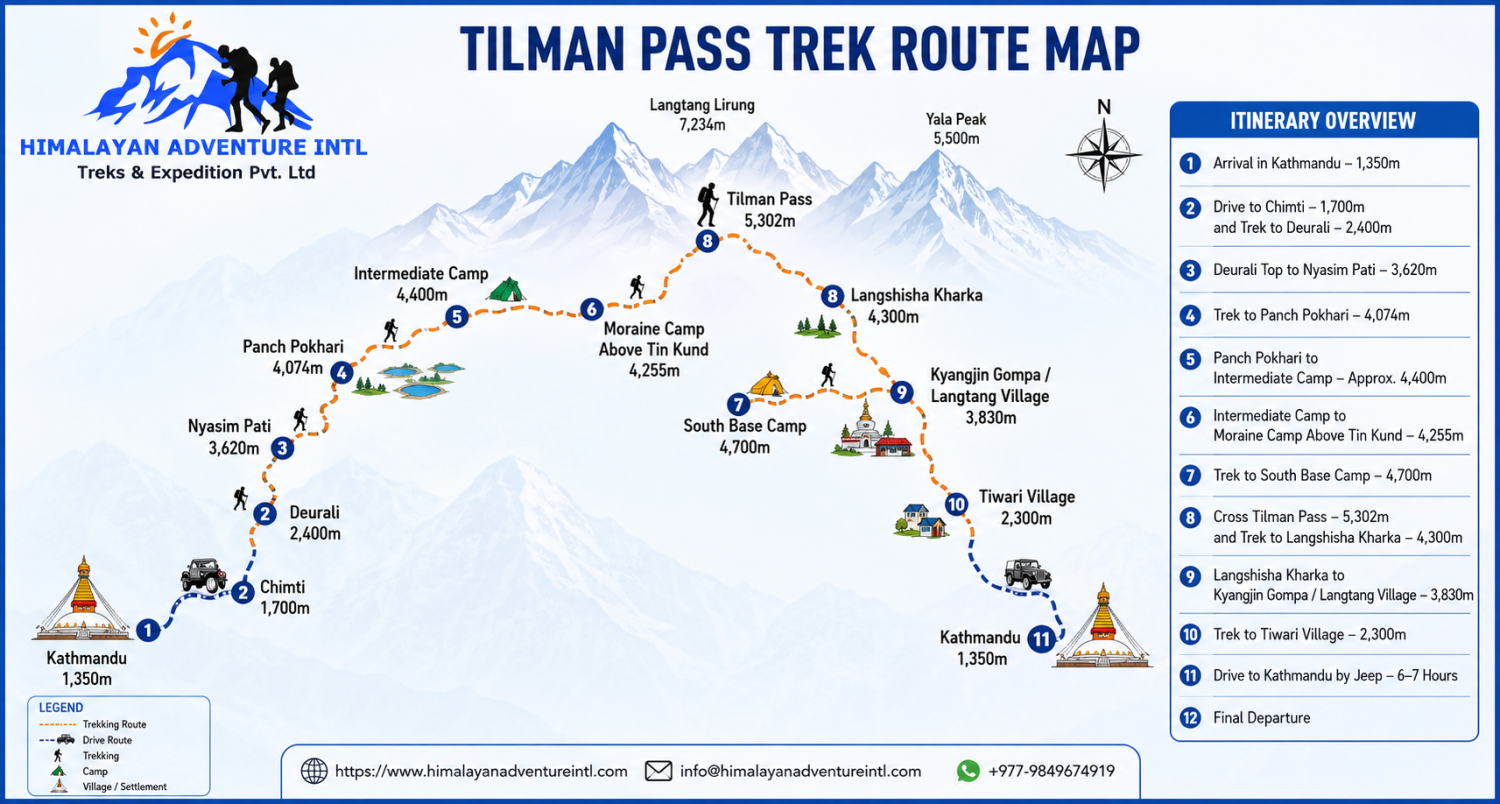
The Tilman Pass region contains several interconnected trekking routes, and the exact route can vary according to the selected itinerary, season, trail conditions, and access points.
A detailed route map should clearly show:
Some versions of the wider Tilman Pass route connect areas of the Langtang, Jugal Himal, Panch Pokhari, and Helambu regions. Therefore, trekkers should always check the exact route shown on their itinerary rather than relying on a generic map.
GPS applications and offline mapping tools can be useful, but they should supplement—not replace—the experience and navigation skills of a qualified local guide.
Choosing the correct season is one of the most important factors for a successful Tilman Pass adventure.
Spring is one of the best seasons for high-altitude trekking in Nepal.
Advantages include:
Snow can still remain around the pass, particularly early in the season, so conditions should be checked before departure.
Autumn is traditionally one of Nepal's best trekking seasons.
The monsoon generally leaves behind clear mountain landscapes, and the atmosphere is often crisp.
Advantages include:
Winter can bring heavy snowfall and extremely cold conditions at high elevations.
Tilman Pass may become difficult or inaccessible depending on snow conditions.
Winter expeditions should only be considered after careful assessment by an experienced trekking operator.
The monsoon brings heavy rainfall to many parts of Nepal.
Possible challenges include:
For these reasons, monsoon is generally not the preferred season for crossing Tilman Pass.
Permit requirements depend on the exact route and protected areas covered by the itinerary.
Potential requirements may include:
If your route enters Langtang National Park, the applicable national park entry permit is required.
Trekkers may also need a Trekkers' Information Management System registration depending on the prevailing regulations and whether they are traveling with an authorized trekking agency.
Some municipalities and local conservation or tourism authorities may charge additional fees.
Permit regulations and prices can change, so Himalayan Adventure Intl Treks confirms the applicable requirements before departure.
Trekkers should normally carry:
Yes. Tilman Pass Trek is considered a challenging high-altitude trek and is best suited to trekkers with previous experience in mountainous environments.
The difficulty comes from several factors:
The route reaches approximately 5,300 meters, where oxygen levels are significantly lower than at sea level.
Some sections are isolated, and medical facilities are limited.
The pass-crossing day can involve approximately 10–11 hours of walking.
Snow, wind, cloud, rain, and sudden temperature changes can affect the route.
Moraine, rocks, steep slopes, snow, and glacial terrain can make walking difficult.
Trekkers should therefore prepare through regular hiking and cardiovascular conditioning before arriving in Nepal.
Altitude sickness is one of the most important health concerns on the Tilman Pass Trek.
AMS can affect anyone, regardless of age or fitness level.
Possible symptoms include:
More serious altitude-related illnesses can become life-threatening and require immediate action.
Avoid gaining altitude too quickly.
Above approximately 3,000 meters, a conservative ascent profile is especially important.
Drink regularly throughout the day.
A slow and steady pace is generally more appropriate at high altitude than trying to maintain the speed used at lower elevations.
Do not ignore worsening symptoms.
Alcohol can contribute to dehydration and may interfere with good acclimatization practices.
The itinerary should allow your body enough time to adapt to increasing altitude.
Some trekkers use acetazolamide (Diamox) for altitude prevention, but medication decisions should be made with qualified medical advice rather than self-prescribed.
The most important rule is not to continue ascending when significant altitude-related symptoms are worsening.
Depending on the severity of the symptoms, the trekking team may:
Because Tilman Pass is remote, comprehensive travel insurance that covers high-altitude trekking and emergency evacuation is strongly recommended.
A professional guide is highly recommended for this trek.
A qualified guide can assist with:
Approximate guide cost:
USD 30–35 per day
The final price depends on the duration and service level.
A porter can significantly reduce the physical burden of a long high-altitude trek.
Approximate porter cost:
USD 20–25 per day
A porter normally carries a controlled load according to company policy and local regulations. Trekkers should avoid overloading porters and should ensure that porters have appropriate clothing, footwear, insurance, and equipment.
Himalayan Adventure Intl Treks places importance on responsible porter treatment and proper working conditions.
A group departure is generally the most economical option for solo travelers.
Approximate price:
USD 1,600–1,900 per person
Advantages include:
The exact departure dates and group size depend on the season.
A private trek is suitable for couples, families, friends, photographers, researchers, and travelers who prefer flexible arrangements.
Benefits include:
A private couple trek may cost approximately USD 3,500–4,200 for two people, depending on the services selected.
Proper equipment is essential for this adventure.
Pack:
A high-quality sleeping bag suitable for cold mountain conditions is strongly recommended.
A sleeping bag rated around –15°C may be appropriate depending on the season and camping arrangements, but trekkers should confirm the expected conditions and equipment provided by the trekking agency.
Bring:
Useful items include:
Consider bringing:
Battery performance can decline significantly in cold weather, so keeping electronic devices warm when possible is useful.
Accommodation varies considerably along this remote route.
Lower sections may provide access to local lodges or basic guesthouses, while remote high-altitude sections may require camping.
During camping sections, the trekking crew normally handles:
Meals are designed to provide enough energy for long trekking days.
Common trekking foods may include:
At high altitude, simple, warm, carbohydrate-rich meals can be particularly useful because trekking requires substantial energy.
Safety is the highest priority on this route.
The trekking team should continually evaluate:
The itinerary should remain flexible because mountain conditions cannot always be predicted weeks or months in advance.
If conditions become unsafe, the guide may recommend changing the itinerary, waiting, or turning back.
Successfully completing a trek is important, but returning safely is always the primary objective.
Comprehensive travel insurance is strongly recommended.
Your policy should cover:
Before purchasing insurance, check the maximum altitude covered by the policy. A standard travel policy may not automatically cover trekking above 5,000 meters.
You should begin physical preparation several weeks before the trek.
Useful training includes:
Training should focus on endurance rather than simply speed.
If possible, practice hiking while carrying a light backpack.
Mental preparation is equally important because high-altitude trekking can involve long days, cold weather, difficult terrain, and changing plans.
This trek is particularly suitable for:
It is not generally the best choice for someone looking for a short, easy Himalayan holiday.
Trekkers should be comfortable with long walking days and remote mountain environments.
Himalayan Adventure Intl Treks provides organized trekking services designed to make remote Himalayan adventures safer, more manageable, and more enjoyable.
Depending on the selected package, arrangements can include:
Customized arrangements are also available for private groups, couples, families, research teams, photographers, and experienced adventure trekkers.
A typical full-board package may include:
The exact inclusions should always be confirmed in your final quotation.
Unless specifically included in your package, the following are generally excluded:
The Tilman Pass route is considerably more demanding than many commercial trekking routes.
Using a professional trekking company provides important advantages, including experienced local staff, organized permits, transportation planning, high-altitude logistics, emergency coordination, and knowledge of local conditions.
A reliable trekking company should also provide clear information about:
Himalayan Adventure Intl Treks can customize the trek according to your group size, preferred departure date, budget, and level of service.
Tilman Pass is a challenging high-altitude trek. The maximum elevation is approximately 5,300 meters, and the pass-crossing day can be long and physically demanding.
The route reaches approximately 5,300 meters at Tilman Pass. Exact elevation figures can vary slightly between maps and route descriptions.
A professional guide is strongly recommended because the route is remote and includes difficult high-altitude terrain.
It is not normally recommended as a first Himalayan trek. Previous trekking experience and good physical preparation are highly beneficial.
Spring and autumn are generally the preferred seasons, especially March–May and September–November, subject to current trail and weather conditions.
Winter conditions can bring heavy snow and may make the pass unsafe or inaccessible. A winter attempt requires specialized assessment and preparation.
Connectivity can be limited or unavailable in remote sections. Trekkers should not depend on continuous mobile or internet service.
Emergency helicopter evacuation may be possible from suitable locations, subject to weather, aircraft availability, landing conditions, insurance authorization, and the exact location of the trekker.
Yes. Comprehensive travel insurance with high-altitude trekking and emergency evacuation coverage is strongly recommended.
The Tilman Pass Trek is an extraordinary Himalayan journey for trekkers who want something beyond Nepal's crowded and highly commercialized trekking routes.
From the peaceful mountain environment around Panch Pokhari to remote alpine camps, glacial landscapes, high mountain terrain, and the demanding crossing of Tilman Pass, the journey provides a genuine wilderness experience.
It is also a trek that should never be underestimated. High altitude, unpredictable weather, remote trails, long trekking days, and difficult terrain make proper preparation essential.
Choosing the right season, maintaining a sensible pace, allowing proper acclimatization, carrying suitable equipment, purchasing appropriate travel insurance, and trekking with experienced local professionals can greatly improve your experience.
Whether you are interested in a solo-supported trek, couple adventure, private group, or group-join departure, Himalayan Adventure Intl Treks can organize the necessary logistics and help you prepare for this remarkable Himalayan journey.
For trekkers seeking solitude, high-altitude adventure, spectacular mountain scenery, remote villages, sacred alpine lakes, and an authentic wilderness experience, the Tilman Pass Trek is an adventure worth considering.
Plan your Tilman Pass adventure with Himalayan Adventure Intl Treks and experience one of Nepal's most spectacular and lesser-known high-altitude trekking routes.