
Have Questions? Talk to Expert (Binod)
sland Peak, officially known as Imja Tse (6,189m / 20,305 ft), is one of Nepal’s most iconic trekking peaks. Located in the heart of the Everest region, it offers a perfect combination of adventurous climbing, cultural encounters, and breathtaking Himalayan views. For those seeking a cost-effective and social climbing experience, Group Join Island Peak Climbing is the ideal choice. By joining a group, climbers share costs, enjoy companionship, and gain added confidence in a team-oriented adventure.
At Himalayan Adventure International Treks, we specialize in organizing safe, reliable, and well-managed Island Peak climbing group join packages. Whether you’re a solo traveler, a couple, or a small group looking to merge with fellow adventurers, our professionally guided departures ensure a rewarding Himalayan journey.
Joining a group climb for Island Peak has numerous advantages compared to a private expedition. Some of the key benefits include:
Affordability: Shared costs for guides, porters, permits, and logistics make it budget-friendly.
Companionship: Meet like-minded trekkers and climbers from across the world.
Safety in Numbers: Trekking and climbing with a team enhances security and confidence.
Fixed Departures: Scheduled dates allow easier planning and reliable logistics.
Cultural Exchange: Share stories, experiences, and motivation with international climbers.
Our Group Join Island Peak expeditions are carefully designed to balance adventure, acclimatization, and cultural immersion.
Conquer Island Peak (Imja Tse) 6,189m, one of Nepal’s most popular trekking peaks.
Scenic Everest Base Camp trek route with panoramic views of Everest, Lhotse, Makalu, Ama Dablam, and Nuptse.
Immersive cultural encounters in Sherpa villages such as Namche Bazaar, Tengboche, and Dingboche.
Expert climbing training and practice sessions before summit day.
Adventure at a cost-effective price with like-minded international climbers.
Professional guidance from certified climbing guides and porters.
A perfect introduction to Himalayan mountaineering for beginner and intermediate climbers.
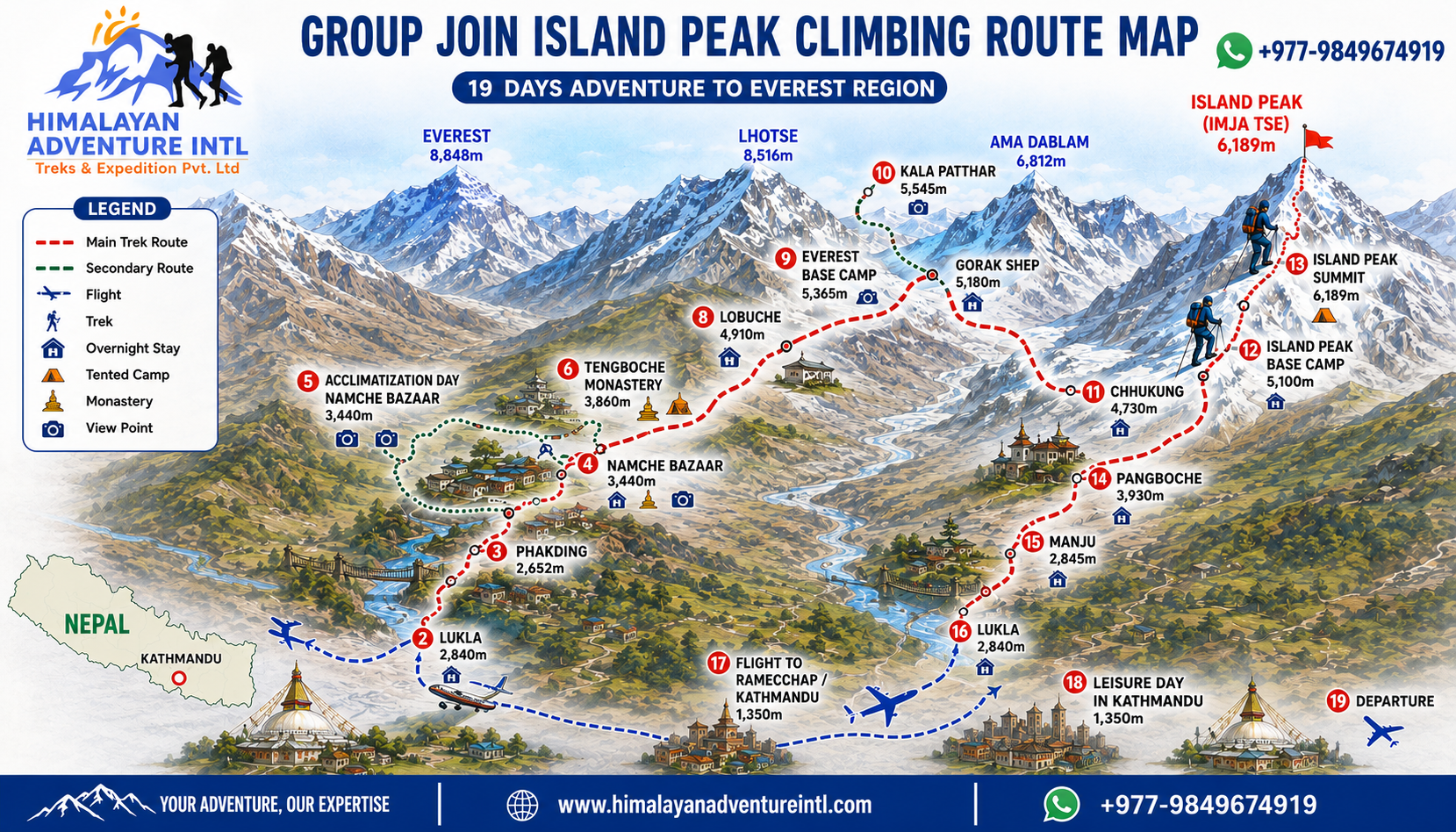
Below is the standard 18-day Island Peak climbing group itinerary, designed with proper acclimatization and summit preparation:
Airport pickup by Himalayan Adventure International Treks team.
Transfer to hotel, briefing, and welcome dinner.
Guided city tour (UNESCO sites: Pashupatinath, Boudhanath, Swayambhunath, Kathmandu Durbar Square).
Gear check and climbing briefing.
Scenic 35-minute flight.
Gentle trek to Phakding.
Crossing suspension bridges and beautiful forests.
Overnight in the vibrant Sherpa town.
Short hike to Everest View Hotel.
Explore Sherpa museum and market.
Visit Tengboche Monastery with stunning views of Ama Dablam.
Walk through Pangboche village and highland landscapes.
Hike to Nagarjun Hill (5,100m) for panoramic Himalayan views.
Last settlement before Island Peak base area.
Overnight camping.
Preparation and practice on climbing gear.
Rope techniques, ice axe, crampon use, and ladder crossing training.
Start early morning (around 1–2 AM).
Use ropes, crampons, and ice axe for final steep sections.
Reach summit with views of Everest, Lhotse, Makalu, Baruntse, and Ama Dablam.
Descend to Base Camp.
Return journey begins.
Retrace steps with easier descent.
Final trek day with celebrations.
Transfer to hotel.
Extra day for flight delays or acclimatization.
Airport transfer by our team.
(Itinerary may vary depending on weather and group pace.)
The Group Join Island Peak Climbing cost with Himalayan Adventure International Treks is competitive and transparent. It generally ranges between USD 2,200 – 2,400 per person, depending on group size, inclusions, and seasonal demand.
Airport transfers (international & domestic).
Kathmandu hotel accommodation with breakfast.
Domestic flights (Kathmandu–Lukla–Kathmandu).
Experienced English-speaking trekking and climbing guides.
Group climbing gear (ropes, tents, etc.).
Meals (breakfast, lunch, dinner) during trek & climb.
Island Peak climbing permit and national park fees.
Porters for luggage (2 clients = 1 porter).
First aid kit and safety equipment.
International airfare to/from Nepal.
Nepal visa fees.
Personal climbing gear (boots, down jacket, crampons, ice axe, harness, etc.).
Travel insurance (must cover emergency helicopter rescue).
Alcoholic drinks, hot showers, Wi-Fi, and personal expenses.
Tips for guides and porters.
The ideal seasons for Island Peak climbing are:
Spring (March–May): Clear skies, blooming rhododendrons, and moderate temperatures. Excellent climbing conditions.
Autumn (September–November): Stable weather, crisp mountain views, and peak climbing season.
Winter (December–February) and monsoon (June–August) are less favorable due to harsh weather and safety concerns.
Island Peak is considered a moderately difficult trekking peak. Key challenges include:
High altitude (6,189m) – risk of AMS (Acute Mountain Sickness).
Technical sections requiring ropes, crampons, ladders, and ice axe.
Cold temperatures and variable Himalayan weather.
With proper acclimatization, basic climbing skills, and professional guidance, Island Peak is achievable for fit trekkers and beginner climbers.
For the Group Join Island Peak Climb, the following permits are required:
Island Peak Climbing Permit (issued by NMA).
Sagarmatha National Park Entry Permit.
Khumbu Pasang Lhamu Rural Municipality Entry Fee.
All permits are arranged by Himalayan Adventure International Treks.
In Kathmandu: Standard 3-star hotel with breakfast.
On Trek: Tea houses/lodges with shared rooms.
At Base Camp: Tented accommodation.
Meals: Nutritious meals (Nepali, Tibetan, and Western options) served throughout the trek.
Though Island Peak is suitable for beginner climbers, preparation is essential. Recommended training includes:
Cardio: Running, hiking, cycling, swimming.
Strength Training: Squats, lunges, push-ups, core workouts.
Endurance: Multi-day hikes carrying a backpack.
Altitude Training: If possible, practice at higher altitudes before the expedition.
At Himalayan Adventure International Treks, safety is our priority:
Certified climbing guides with high-altitude experience.
Proper acclimatization days built into itinerary.
Oxygen cylinders and first aid kits available.
Emergency helicopter evacuation support.
24/7 assistance from our Kathmandu office.
Decades of experience organizing treks and climbs across Nepal.
Fixed group departures for Island Peak in 2025/26.
Affordable packages without compromising safety and quality.
Local Sherpa expertise with deep knowledge of the Everest region.
Eco-friendly practices supporting local communities and environment.
Essential Gear:
Mountaineering boots
Crampons, ice axe, climbing harness
Down jacket and sleeping bag (-20°C rated)
Thermal base layers, gloves, hats
Trekking poles, sunglasses, headlamp
Backpack (50–70L)
Personal Items:
Water bottles & purification tablets
First aid kit & personal medicines
Snacks/energy bars
Travel insurance documents
(Gear rental available in Kathmandu on request.)
The Group Join Island Peak Climbing (Imja Tse) package with Himalayan Adventure International Treks offers an unforgettable Himalayan adventure at an affordable price. Whether you’re traveling solo or with friends, our group join departures ensure safety, companionship, and an enriching climbing experience. Standing on the summit of Island Peak at 6,189m, surrounded by the world’s highest peaks, is a life-changing achievement.
Book your Group Join Island Peak Climbing 2025/26 with us today and embark on a Himalayan journey filled with adventure, culture, and unforgettable memories.
Welcome to Nepal!
Upon your arrival at Tribhuvan International Airport in Kathmandu, a representative from Himalayan Adventure Intl Treks will meet you and transfer you to your hotel. After checking in, you can rest and recover from your journey.
Depending on your arrival time, you may have the opportunity to explore the surrounding area of Thamel, Kathmandu’s vibrant tourist district. Thamel is filled with restaurants, cafés, trekking shops, souvenir stores, and travel services.
In the evening, you may meet your trekking and climbing team and receive a briefing about the Island Peak climbing itinerary. Your guide will explain the trekking route, acclimatization plan, safety procedures, equipment requirements, and general expectations for the journey.
Accommodation: Hotel in Kathmandu
Meals: Welcome dinner
Altitude: 1,350 m
Today is dedicated to preparation for your Everest Base Camp and Island Peak climbing adventure.
You will meet your climbing guide and trekking team for a detailed trip briefing. Your guide will check your climbing equipment and help ensure that you have the necessary clothing and gear for high-altitude trekking and peak climbing.
If you need to rent or purchase any equipment, Kathmandu offers a wide range of trekking and mountaineering shops. Items such as down jackets, sleeping bags, trekking poles, crampons, ice axes, harnesses, helmets, and other climbing equipment can be arranged before departure.
The preparation day is also important for finalizing permits, checking documents, organizing baggage, and preparing your equipment for the flight to Lukla.
You may spend the remainder of the day exploring Kathmandu or relaxing at the hotel. It is important to rest well before beginning the trek.
Accommodation: Hotel in Kathmandu
Meals: Breakfast
Activity: Trek and climbing preparation
Your Himalayan adventure begins with an exciting flight to Lukla.
Depending on the operational schedule, flights to Lukla may depart from Kathmandu or Ramechhap Airport. The scenic flight offers breathtaking views of the Himalayan foothills and mountain landscapes. After landing at Tenzing-Hillary Airport in Lukla, you will meet the rest of the trekking crew and begin your trek.
The trail passes through beautiful mountain scenery, small Sherpa settlements, forests, and suspension bridges. The route gradually descends and follows the Dudh Koshi River toward Phakding.
Today is a relatively short and gentle trekking day, allowing your body to begin adjusting to the Himalayan environment. You will pass through traditional villages and enjoy your first experience of the famous Everest region trekking trails.
Phakding is a pleasant village surrounded by green hills and mountain scenery. After arriving, you can relax at the teahouse and enjoy a warm meal.
Trekking time: Approximately 3–4 hours
Accommodation: Teahouse
Meals: Breakfast, lunch, and dinner
Altitude: 2,652 m
Today you trek toward the famous Sherpa capital of Namche Bazaar.
The trail follows the Dudh Koshi River and crosses several suspension bridges decorated with colorful prayer flags. As you continue toward Sagarmatha National Park, the landscape becomes increasingly mountainous.
After entering the national park, the trail climbs gradually through pine and rhododendron forests. You will cross the famous Hillary Suspension Bridge before beginning the challenging uphill climb to Namche Bazaar.
The final section involves a steady ascent, but the first views of Everest and other Himalayan peaks may reward you along the way, depending on weather conditions.
Namche Bazaar is the largest settlement in the Khumbu region and is an important trading, cultural, and trekking center. The village is built in a natural amphitheater and offers spectacular views of surrounding mountains.
After arriving at your teahouse, you can relax and enjoy the lively atmosphere of Namche.
Trekking time: Approximately 5–6 hours
Accommodation: Teahouse
Meals: Breakfast, lunch, and dinner
Altitude: 3,440 m
Today is an important acclimatization day.
Rather than remaining completely inactive, the recommended approach is to take a short hike to a higher elevation and then return to Namche Bazaar to sleep. This helps your body gradually adapt to the increasing altitude.
A popular option is a hike toward the Everest View Hotel, where you may enjoy spectacular views of Everest, Lhotse, Ama Dablam, Thamserku, and other Himalayan peaks. You may also visit the Khumjung Valley or explore the Sherpa villages surrounding Namche.
Namche itself offers bakeries, cafés, shops, museums, and beautiful viewpoints. This is also a good opportunity to check your equipment, charge batteries, communicate with family, and enjoy a more relaxed day before continuing higher.
Your guide will monitor the group for signs of altitude-related problems and provide advice regarding hydration, nutrition, and pacing.
Accommodation: Teahouse
Meals: Breakfast, lunch, and dinner
Altitude: 3,440 m
After breakfast, the trail leaves Namche Bazaar and follows a scenic route high above the Dudh Koshi Valley.
The trail offers magnificent views of Everest, Lhotse, Nuptse, Ama Dablam, and Thamserku. The landscape is particularly beautiful during the rhododendron flowering season, when the forests become colorful.
The trail gradually descends toward the river before climbing through forests to Tengboche.
Tengboche is one of the most important spiritual centers in the Everest region. The famous Tengboche Monastery is surrounded by spectacular mountain scenery, with Ama Dablam forming one of the most dramatic backdrops in the Himalayas.
If time allows, you may visit the monastery and learn more about the Buddhist traditions of the Sherpa people. The peaceful surroundings make Tengboche a memorable stop on the journey.
Trekking time: Approximately 5–6 hours
Accommodation: Teahouse
Meals: Breakfast, lunch, and dinner
Altitude: 3,860 m
Today the trail continues deeper into the Khumbu Valley.
You will descend through beautiful forests toward Deboche and cross the Imja Khola. The trail then continues toward Pangboche, one of the oldest settlements in the region.
As you gain altitude, the vegetation becomes thinner and the landscape more rugged. The magnificent peak of Ama Dablam remains a constant presence along the route.
From Pangboche, the trail continues through the Imja Valley toward Dingboche. The scenery gradually changes from forested landscapes to open alpine terrain.
Dingboche is a popular acclimatization destination for trekkers and climbers heading toward Everest Base Camp, Island Peak, and other high mountain destinations.
After arriving at the teahouse, your guide will explain the next stages of the trek and the importance of continued acclimatization.
Trekking time: Approximately 5–6 hours
Accommodation: Teahouse
Meals: Breakfast, lunch, and dinner
Altitude: 4,350 m
Today you continue toward the higher elevations of the Everest region.
The trail gradually climbs through an increasingly rugged and barren landscape. You will pass through the settlement of Duglha before ascending toward the terminal moraine of the Khumbu Glacier.
Along the trail, you will see memorials dedicated to climbers and mountaineers who lost their lives while attempting Himalayan peaks. These memorials are a reminder of the challenges and respect required when traveling in high-altitude environments.
The route continues toward Lobuche, a small settlement located at the foot of the Lobuche peaks.
The air is noticeably thinner at this altitude, so maintaining a slow and steady pace is essential. Drink plenty of water and follow your guide’s advice.
Trekking time: Approximately 5–6 hours
Accommodation: Teahouse
Meals: Breakfast, lunch, and dinner
Altitude: 4,910 m
Today is one of the major highlights of the entire journey: Everest Base Camp.
You will begin the trek from Lobuche toward Gorak Shep, the last major settlement before Everest Base Camp. After a short break, you continue along the rocky trail toward the base camp.
The route follows the Khumbu Glacier and offers spectacular views of the surrounding mountains and glacial landscape. The trail can be physically demanding because of the altitude and uneven terrain.
Reaching Everest Base Camp is a memorable achievement. During the main climbing season, the area may be filled with expedition tents and mountaineering activity. The exact appearance of the base camp varies depending on the season.
After spending time at Everest Base Camp and taking photographs, you return to Gorak Shep for the night.
Trekking time: Approximately 7–8 hours
Accommodation: Teahouse
Meals: Breakfast, lunch, and dinner
Altitude: Everest Base Camp 5,365 m; Gorak Shep 5,180 m
Today begins early with a hike to Kala Patthar, one of the best viewpoints in the Everest region.
The climb to Kala Patthar is steep but relatively short. From the summit, you can enjoy breathtaking panoramic views of Mount Everest, Nuptse, Pumori, Ama Dablam, and the surrounding Himalayan peaks.
The view of Mount Everest from Kala Patthar is one of the most iconic experiences in Nepal. Sunrise over the Himalayan peaks can create spectacular colors across the mountain landscape.
After enjoying the views, you descend to Gorak Shep for breakfast before continuing back toward Lobuche.
The descent provides a welcome change after several days of climbing at high altitude. You will spend the night in Lobuche and prepare for the route toward Chhukung and Island Peak.
Trekking time: Approximately 6–7 hours
Accommodation: Teahouse
Meals: Breakfast, lunch, and dinner
Altitude: Kala Patthar approximately 5,545 m; Lobuche 4,910 m
Today you leave the main Everest Base Camp route and head toward the Imja Valley.
The trail passes through beautiful high-altitude landscapes with spectacular views of Ama Dablam, Island Peak, Lhotse, and surrounding peaks.
Depending on the route and trail conditions, your group may travel through the Kongma La area or follow the lower route toward Chhukung. The exact route may be adjusted by the climbing guide according to weather, trail conditions, and the group’s physical condition.
Chhukung is a small mountain settlement and an important base for Island Peak climbers. The village is surrounded by some of the most impressive mountains in the Everest region.
After arriving, your climbing guide will discuss the upcoming Island Peak Base Camp journey and summit preparation.
Trekking time: Approximately 6–8 hours, depending on route
Accommodation: Teahouse
Meals: Breakfast, lunch, and dinner
Altitude: 4,730 m
Today you trek toward Island Peak Base Camp.
The trail follows the Imja Valley and gradually enters a more remote and rugged alpine environment. As you approach the base camp, Island Peak becomes increasingly impressive.
The route passes through rocky moraine landscapes and glacial terrain. The views of Island Peak, Lhotse, Nuptse, Ama Dablam, and surrounding peaks are spectacular.
After reaching Island Peak Base Camp, your climbing crew will establish the necessary camp arrangements and prepare for the summit attempt.
Your climbing guide will provide a detailed briefing about the climb. You will learn about the route, rope systems, crampon techniques, ice axe use, climbing safety, and summit-day procedures.
Depending on the group’s experience and conditions, additional technical training may be conducted near Base Camp.
The evening should be spent resting, hydrating, and preparing mentally and physically for the summit attempt.
Trekking time: Approximately 4–5 hours
Accommodation: Tented camp
Meals: Breakfast, lunch, and dinner
Altitude: 5,100 m
Today is the most challenging and exciting day of the adventure.
The summit attempt usually begins very early, often during the night, so that the team can reach the summit during the best possible weather conditions.
You will climb through rocky and glacial terrain before reaching the higher sections of the mountain. Depending on the route and conditions, the climb involves technical sections where crampons, harnesses, ropes, and ice axes may be required.
Your experienced climbing guide will lead the group and manage the technical sections of the route. Fixed ropes may be used on steep sections, and climbers will be connected to the safety system according to the conditions and climbing procedures.
The final climb toward the summit can be physically demanding due to the altitude, cold, wind, and steep terrain. Reaching the summit of Island Peak provides spectacular views of Lhotse, Nuptse, Ama Dablam, Makalu, Baruntse, and many other Himalayan peaks.
After spending time at the summit, you begin the descent. Descending safely is equally important, and the team will proceed carefully back to Island Peak Base Camp.
After returning to Base Camp, you can rest and celebrate the achievement with your climbing team.
Climbing time: Approximately 10–14 hours, depending on conditions
Accommodation: Tented camp
Meals: Breakfast, lunch, and dinner
Maximum altitude: 6,189 m
After the demanding summit day, you begin your descent to lower elevations.
The return journey passes through Chhukung and follows the beautiful Imja Valley. As you descend, the air becomes warmer and more comfortable, and the landscape gradually becomes greener.
You will pass through Dingboche and continue toward Pangboche.
Pangboche is one of the oldest villages in the Everest region and offers beautiful views of Ama Dablam and the surrounding mountains. The lower elevation provides an excellent opportunity to recover after the Island Peak climb.
Enjoy a relaxing evening with your trekking group and reflect on the incredible experience of reaching the summit.
Trekking time: Approximately 6–7 hours
Accommodation: Teahouse
Meals: Breakfast, lunch, and dinner
Altitude: 3,930 m
Today you continue your descent through the beautiful Khumbu Valley.
The trail passes through forests, traditional Sherpa villages, and several scenic viewpoints. You will follow the Dudh Koshi River and gradually lose altitude.
The landscape becomes greener as you descend. You will pass through areas such as Tengboche and Namche Bazaar before continuing toward the lower villages.
Depending on the group’s pace and trail conditions, the itinerary may be adjusted to ensure a comfortable and safe trekking experience.
Manju is located at a much lower elevation than the high mountain settlements, allowing your body to recover further after the Island Peak climb.
Trekking time: Approximately 6–8 hours
Accommodation: Teahouse
Meals: Breakfast, lunch, and dinner
Altitude: 2,845 m
Today is the final trekking day of your Island Peak climbing adventure.
The trail continues through the lower Khumbu region, following the Dudh Koshi River and passing through villages and forests.
The final section of the trek takes you back to Lukla. After arriving, you can relax and enjoy a well-deserved celebration with your trekking and climbing team.
This is an opportunity to thank your guides, porters, and support staff who helped make your Everest Base Camp and Island Peak climbing journey successful.
Enjoy your final evening in the Khumbu region before returning to Kathmandu.
Trekking time: Approximately 6–7 hours
Accommodation: Teahouse
Meals: Breakfast, lunch, and dinner
Altitude: 2,840 m
Today you take a scenic flight from Lukla.
Depending on the season and flight operations, flights may operate between Lukla and Kathmandu or between Lukla and Ramechhap, with an onward transfer to Kathmandu.
The flight offers a final opportunity to enjoy views of the Himalayan landscapes from above.
Upon arrival in Kathmandu, our representative will transfer you to your hotel. You can spend the remainder of the day resting, relaxing, shopping, or exploring the city.
After several weeks in the mountains, Kathmandu provides a welcome opportunity to enjoy comfortable accommodation, restaurants, cafés, and cultural attractions.
Accommodation: Hotel in Kathmandu
Meals: Breakfast
Altitude: 1,350 m
Today is a free day in Kathmandu.
You may relax at the hotel or explore some of the city’s cultural and historical attractions. Popular places to visit include ancient temples, traditional courtyards, Buddhist stupas, and UNESCO World Heritage Sites.
You may also enjoy shopping for souvenirs, traditional handicrafts, trekking clothing, prayer flags, and Nepalese gifts.
This leisure day also provides a useful buffer in case of flight delays or unexpected changes during the trekking journey.
In the evening, Himalayan Adventure Intl Treks may organize a farewell dinner to celebrate your successful Island Peak summit and Everest Base Camp adventure.
Accommodation: Hotel in Kathmandu
Meals: Breakfast and farewell dinner
Altitude: 1,350 m
Your unforgettable Island Peak climbing and Everest Base Camp adventure comes to an end today.
A representative from Himalayan Adventure Intl Treks will assist with your transfer to Tribhuvan International Airport according to your flight schedule.
As you leave Nepal, you take home unforgettable memories of the Himalayas, Everest Base Camp, Kala Patthar, Island Peak, Sherpa culture, mountain villages, Buddhist monasteries, and the friendships created during the journey.
We hope to welcome you again for another adventure in the Himalayas.
Meals: Breakfast
Trip ends: Kathmandu
Himalayan Adventure Intl Treks is a local Nepal-based trekking and mountaineering company specializing in Everest Base Camp trekking, Island Peak climbing, trekking peak expeditions, and customized Himalayan adventures.
Our experienced team provides professional support throughout the journey, including:
Our goal is to provide a safe, enjoyable, responsible, and memorable Himalayan experience.
Island Peak climbing is considered a challenging Himalayan adventure that combines high-altitude trekking with technical mountaineering.
Previous climbing experience is beneficial but not always essential for physically fit and well-prepared participants. However, climbers should be comfortable walking for several hours per day at high altitude and should be prepared for cold temperatures, steep terrain, glacier travel, and long summit days.
Good physical preparation before the trip is strongly recommended. Cardiovascular training, long-distance hiking, strength training, and endurance exercises can help prepare you for the demands of the climb.
Your professional climbing guide will provide practical instruction and support during the technical sections of the ascent.
The best seasons for Island Peak climbing are generally spring and autumn.
Spring, particularly March to May, offers relatively stable weather and excellent mountain views. The rhododendron forests are also beautiful during this season.
Autumn, especially October and November, is one of the most popular trekking and climbing seasons in Nepal. The skies are often clear, visibility is excellent, and mountain views are spectacular.
Winter climbs are possible for experienced and well-equipped climbers, but conditions can be significantly colder. The monsoon season may bring rain, cloud, and challenging trail conditions at lower elevations.
Joining a group Island Peak climbing expedition is an excellent way to experience one of Nepal’s most exciting trekking peaks while meeting fellow adventurers from around the world.
With professional local guides, careful acclimatization, technical climbing support, and comprehensive logistical arrangements, Himalayan Adventure Intl Treks helps you focus on enjoying the journey and achieving your Himalayan climbing goals.
Book your Island Peak Climbing with Everest Base Camp adventure with Himalayan Adventure Intl Treks and experience the legendary Everest region, stand at Everest Base Camp, witness sunrise from Kala Patthar, and climb to the summit of Island Peak at 6,189 meters.
Professional Guidance and Expertise
Permits and Documentation
Accommodation
Meals
Transportation
Safety and Equipment
Other Services
International Travel
Personal Expenses
Insurance
Optional Tips
Miscellaneous
At Himalayan Adventure Intl Treks, we believe in providing a seamless and enriching experience. Our carefully crafted inclusions ensure that you can focus on the adventure while we handle the logistics. Whether it's the detailed briefings, the quality of our equipment, or the friendly support of our experienced guides, every aspect of your journey is designed to make your climb safe, enjoyable, and memorable. Our team is here to support you every step of the way, creating memories that will last a lifetime.
Group Join Island Peak Climbing is a shared climbing expedition where individual travelers, couples, friends, and small groups join a fixed departure to climb Island Peak (6,189m), one of Nepal's most famous trekking peaks. The program allows climbers to share transportation, guides, climbing logistics, and permits, making the expedition more affordable than a private climb.
Island Peak is popular because it combines the world-famous Everest trekking route with a genuine Himalayan mountaineering experience. Climbers enjoy breathtaking views of Everest, Lhotse, Nuptse, Ama Dablam, Makalu, and Baruntse while learning basic mountaineering skills.
Himalayan Adventure Intl Treks organizes group departures throughout the year with flexible itineraries, professional climbing guides, and customized arrangements based on fitness level, age, budget, and trekking experience.
Island Peak, also known as Imja Tse, is located in the Everest Region of eastern Nepal within Sagarmatha National Park. The mountain stands above Chhukung Valley and is surrounded by some of the most spectacular Himalayan peaks.
The peak appears like an island rising from a sea of glaciers, which inspired its name. It lies near the traditional Everest Base Camp trekking route, making it an excellent addition to Everest region adventures.
Island Peak rises to an elevation of 6,189 meters (20,305 feet). It is considered one of the best introductory climbing peaks in Nepal because it offers a realistic mountaineering experience without requiring advanced technical climbing skills.
The summit provides panoramic views of:
The combination of altitude, glacier travel, and rope climbing makes it an exciting Himalayan challenge.
Himalayan Adventure Intl Treks offers multiple package options:
USD 2,100 per person
USD 2,200 per person
USD 2,800 per person
USD 3,200+ per person with one-way helicopter service
USD 2,650 per person
Starting from USD 1,100 per person depending on group size
The final cost depends on accommodation standard, transportation choice, group size, and service level.
The Budget Package includes all essential climbing services:
This package is ideal for students, backpackers, and budget-conscious adventurers.
The Regular Package is our most popular option because it provides additional comfort and support while remaining affordable.
Benefits include:
This package offers excellent value for most climbers.
The Deluxe Package is designed for travelers who want additional comfort during their expedition.
Features include:
The package balances adventure with comfort.
The Luxury Package is designed for travelers seeking a premium Himalayan experience.
Services include:
Luxury clients enjoy greater flexibility and convenience throughout the trip.
Yes. Many successful Island Peak climbers are first-time mountaineers. While previous climbing experience is helpful, it is not mandatory.
Participants should have:
Our guides provide comprehensive climbing instruction before the summit attempt.
Island Peak is considered moderately difficult. The challenge comes from:
Most fit trekkers who prepare properly can successfully reach the summit.
The standard climbing itinerary usually takes between 14 and 20 days depending on:
Flexible itineraries are available for private groups.
Yes. Our Everest Base Camp and Island Peak package costs USD 2,650 per person and is one of our most popular adventures.
The combination provides:
Many climbers choose this package to maximize their Everest region adventure.
The required permits include:
Himalayan Adventure Intl Treks arranges all permits before the expedition.
We offer multiple transportation choices:
Kathmandu to Lukla
Kathmandu to Surke
Kathmandu to Lukla or Lukla to Kathmandu
Transportation can be customized according to budget and personal preference.
Yes. We arrange:
Helicopter services are especially popular during peak trekking seasons.
Absolutely.
Solo climbers can:
Many solo travelers prefer joining groups to reduce costs and meet fellow adventurers.
Yes. Couples frequently choose Island Peak as a shared adventure.
We offer:
Many couples combine Everest Base Camp and Island Peak for a memorable Himalayan holiday.
Unlike many operators, Himalayan Adventure Intl Treks carefully matches participants according to:
This approach creates a more enjoyable and successful climbing experience.
2–8 climbers
9–15 climbers
16–30 climbers
Smaller groups provide personalized attention, while larger groups often reduce costs.
Accommodation depends on the selected package.
Basic tea houses
Comfortable mountain lodges
Higher-quality lodges and Kathmandu hotels
Premium accommodation and luxury hotels
Private rooms can often be arranged upon request.
The package includes three meals daily.
Popular menu options include:
Eggs, bread, pancakes, porridge, tea, coffee
Rice, noodles, pasta, soup, potatoes
Dal Bhat, vegetables, rice dishes, pasta, noodles
Nutritious meals are essential for maintaining energy at altitude.
Yes.
Our climbing gear rental service includes:
Renting equipment helps reduce travel costs and baggage weight.
Yes.
Available rental items include:
All equipment is inspected before every expedition.
The Base Camp Service starts from USD 1,100 per person depending on group size.
The package includes:
This option is ideal for trekkers who have already reached Chhukung independently.
Altitude sickness can affect anyone above 2,500 meters regardless of age or fitness.
To reduce risks, we provide:
Our itineraries prioritize safety over speed.
Stable weather, warmer temperatures, and excellent summit conditions.
Clear skies, dry trails, and spectacular mountain views.
Fewer crowds and beautiful snow-covered landscapes.
Greener scenery and quieter trails but more weather challenges.
Spring and autumn remain the most popular climbing seasons.
Experienced local guides and porters play a critical role in expedition success.
Benefits include:
Himalayan Adventure Intl Treks employs experienced climbing guides and strong local porters who know the Everest region exceptionally well.
Himalayan Adventure Intl Treks is a locally owned trekking and climbing company with extensive experience in the Everest region.
Whether you are a beginner attempting your first Himalayan summit or an experienced trekker seeking a new challenge, Himalayan Adventure Intl Treks provides professional planning, reliable logistics, quality equipment, expert guidance, and flexible travel options to help you successfully climb Island Peak (6,189m) and create unforgettable memories in the Himalayas of Nepal.
Island Peak Climbing (Imja Tse) with Himalayan Adventure Intl Treks is one of Nepal’s most rewarding Himalayan adventures, combining the world-famous Everest Base Camp trekking route with the thrill of a real Himalayan summit. Rising to 6,189 meters (20,305 feet), Island Peak is the most popular trekking peak in Nepal because it offers both accessibility and genuine mountaineering excitement. With our experienced climbing guides, local Sherpa support, carefully planned acclimatization, and full logistical arrangements, you can attempt this magnificent peak safely and confidently.
Whether you are a beginner looking for your first Himalayan summit or an experienced trekker seeking a technical climbing challenge, Himalayan Adventure Intl Treks provides the perfect balance of safety, adventure, and cultural immersion. Our Island Peak climbing packages include permits, experienced climbing guides, local porters, transportation, accommodation, meals, climbing equipment support, and complete base camp logistics. We also offer a Base Camp to Summit service only package from USD 1,100 per person, ideal for climbers who have already completed the Everest Base Camp trek and want professional support from Island Peak Base Camp to the summit.
Island Peak was named by British mountaineer Eric Shipton in 1953 because it appears like an island rising from a sea of ice when viewed from Dingboche. Its Nepali name, Imja Tse, reflects its location near the Imja Valley in the Khumbu region of eastern Nepal.
Island Peak is considered a trekking peak by the Nepal Mountaineering Association (NMA), but it still requires basic mountaineering skills such as using crampons, walking with an ice axe, ascending fixed ropes, and crossing glaciers. This makes it an excellent introduction to Himalayan climbing.
The peak offers breathtaking panoramic views of some of the world’s highest mountains, including:
Mount Everest
Lhotse
Nuptse
Ama Dablam
Makalu
Baruntse
At Himalayan Adventure Intl Treks, we understand that a successful Island Peak expedition depends on careful planning, professional guidance, and reliable logistics. Our packages are designed to provide everything you need for a safe and enjoyable climbing experience.
We arrange all necessary permits for Island Peak climbing, including:
Permit | Details |
|---|---|
Island Peak climbing permit | USD 350 in Spring, USD 175 in Autumn |
Sagarmatha National Park entry | Required for all trekkers in the Everest region |
Khumbu Rural Municipality fee | Local government permit for Khumbu region |
TIMS card (if applicable) | Trekking Information Management System |
Our team handles all paperwork in Kathmandu, ensuring that you do not have to worry about permit procedures before your climb.
Safety is our highest priority. Every Island Peak expedition is led by licensed and experienced climbing guides who are trained in high-altitude mountaineering, rescue procedures, and first aid.
Our guides provide:
Pre-climb training in crampon, ice axe, and rope techniques
Route fixing and safety checks on the mountain
Continuous monitoring of climbers’ health and acclimatization
Emergency response coordination if needed
Motivation and support throughout the expedition
Many of our guides are local Sherpas from the Khumbu region, bringing generations of Himalayan climbing experience and deep knowledge of the mountain environment.
We employ local porters from the Khumbu region, supporting the local economy while reducing the physical burden on climbers. A porter typically carries up to 20–25 kg shared between two trekkers, allowing you to trek with only a light daypack containing essentials such as water, snacks, a camera, and warm clothing.
Our packages include all necessary transportation:
Kathmandu to Lukla flight (subject to seasonal airport operations)
Manthali to Lukla flight during peak seasons when flights are diverted from Kathmandu
Airport transfers in Kathmandu
Ground transportation between hotels and airports
Logistical support for equipment and supplies
We carefully monitor flight schedules and weather conditions to minimize delays and ensure smooth travel arrangements.
During the trekking portion of the expedition, accommodation is provided in comfortable teahouses and lodges along the Everest trail. Meals are freshly prepared and include a variety of Nepali, Tibetan, and international dishes.
At Island Peak Base Camp, we provide:
High-quality expedition tents
Sleeping tents and dining tents
Nutritious meals prepared by our camp kitchen team
Hot drinks and boiled water
Basic sanitation facilities
For climbers who have already trekked to Chhukung or Island Peak Base Camp, we offer a specialized Base Camp to Summit service only package starting from USD 1,100 per person. This package is ideal for independent trekkers who want professional climbing support without booking the full Kathmandu-to-Kathmandu expedition.
Island Peak climbing permit
Licensed and experienced climbing guide
Base Camp accommodation in expedition tents
All meals at Base Camp
Fixed ropes and route preparation
Group climbing equipment (ropes, anchors, safety gear)
Summit support from Base Camp to the top and back
Safety briefing and basic climbing training
The exact cost may vary depending on group size. Larger groups can often reduce the per-person cost because guide and logistics expenses are shared among participants. Himalayan Adventure Intl Treks can customize this service according to your team’s requirements.
A standard Island Peak climbing expedition usually takes 14–16 days from Kathmandu to Kathmandu. The itinerary includes gradual acclimatization to reduce the risk of altitude sickness.
Day | Destination |
|---|---|
1 | Arrival in Kathmandu |
2 | Fly to Lukla, trek to Phakding |
3 | Trek to Namche Bazaar |
4 | Acclimatization in Namche |
5 | Trek to Tengboche |
6 | Trek to Dingboche |
7 | Acclimatization in Dingboche |
8 | Trek to Chhukung |
9 | Trek to Island Peak Base Camp |
10 | Climbing training and rest |
11 | Summit Island Peak and return to Chhukung |
12 | Trek to Namche Bazaar |
13 | Trek to Lukla |
14 | Fly to Kathmandu |
The climb from Island Peak Base Camp to the summit is challenging but achievable with proper preparation and guidance.
The route begins with a steep ascent over rocky terrain and glacial moraine. Climbers use helmets and harnesses as they move toward the glacier.
After reaching the glacier, climbers put on crampons and use ice axes for stability. The glacier section may include crevasses, which are carefully crossed using fixed ropes and guidance from the climbing team.
The final challenge is a steep snow and ice headwall leading to the summit ridge. Fixed ropes are installed by our guides, and climbers ascend using a jumar/ascender attached to the rope.
The narrow summit ridge offers spectacular views of the surrounding Himalayan giants. After reaching the summit, climbers descend carefully back to Base Camp and then continue to Chhukung.
Choosing the right season is crucial for a successful Island Peak expedition. Each season offers different weather conditions, challenges, and advantages.
Spring is widely considered the best season for Island Peak climbing. During this period, the weather is relatively stable, temperatures are moderate, and the mountain is covered with fresh snow, creating excellent climbing conditions.
Advantages of Spring:
Clear skies and excellent visibility
Comfortable daytime temperatures
Stable snow conditions on the glacier
Beautiful rhododendron forests in lower elevations
High summit success rates
The Island Peak climbing permit costs USD 250 in Spring.
Autumn is another excellent season for Island Peak climbing. After the monsoon rains, the skies become crystal clear, offering some of the best mountain views in Nepal.
Advantages of Autumn:
Dry and stable weather
Excellent visibility of Himalayan peaks
Comfortable trekking conditions
High availability of teahouses and services
Strong summit success rates
The Island Peak climbing permit costs USD 125 in Autumn.
Winter climbing is possible but more challenging due to extremely cold temperatures and heavy snowfall at higher elevations.
Advantages of Winter:
Fewer climbers on the route
Peaceful mountain environment
Clear skies on many days
Challenges of Winter:
Extreme cold, especially at night
Increased risk of frostbite
More technical snow and ice conditions
Shorter daylight hours
Winter climbing is recommended only for experienced climbers with proper cold-weather gear.
Summer is the least recommended season for Island Peak climbing because the monsoon brings heavy rainfall, cloudy skies, and unstable trail conditions.
Challenges of Summer:
Frequent rain and snowfall
Poor visibility
Slippery trails and landslides
Higher risk of flight delays to Lukla
Unstable glacier conditions
However, some experienced climbers still attempt Island Peak during this season, especially in the rain-shadow areas of the Himalayas.
For most climbers, Spring (March to May) is the best season because of its stable weather, moderate temperatures, and excellent snow conditions. Autumn (September to November) is a close second, offering crystal-clear views and dry trekking conditions.
The cost of climbing Island Peak varies depending on the level of service, group size, and itinerary length. Below is a general cost breakdown for 2026.
Package Type | Cost (USD) |
|---|---|
Budget package | 1,800 – 2,200 |
Standard package | 2,400 – 3,200 |
Luxury package | 3,500 – 4,500 |
Group joining package | 1,900 – 2,300 |
Base Camp to Summit only | 1,100 |
Airport transfers in Kathmandu
Domestic flights to and from Lukla
Hotel accommodation in Kathmandu
Teahouse accommodation during the trek
Three meals per day during the trek
Island Peak climbing permit
Sagarmatha National Park permit
Khumbu Rural Municipality fee
Licensed climbing guide
Porter services
Base Camp tents and meals
Fixed ropes and group climbing equipment
First aid kit and emergency support
International flights to Nepal
Nepal visa fees
Travel insurance with helicopter evacuation coverage
Personal climbing gear (boots, crampons, harness, sleeping bag)
Hot showers, charging fees, and beverages on the trail
Personal expenses and tips for guides and porters
One of the most important aspects of Island Peak climbing is understanding Acute Mountain Sickness (AMS), also known as altitude sickness. AMS occurs when the body cannot adapt quickly enough to the reduced oxygen levels at high altitude.
Common symptoms include:
Headache
Nausea or vomiting
Dizziness
Loss of appetite
Fatigue and weakness
Difficulty sleeping
Shortness of breath during rest
Severe forms of altitude sickness include High Altitude Pulmonary Edema (HAPE) and High Altitude Cerebral Edema (HACE), both of which can be life-threatening if not treated immediately.
At Himalayan Adventure Intl Treks, we follow strict acclimatization protocols to minimize the risk of AMS.
Gradual ascent: Our itinerary includes acclimatization days in Namche Bazaar and Dingboche.
Hydration: Drink 3–4 liters of water per day.
Avoid alcohol and smoking: These can worsen dehydration and altitude symptoms.
Eat properly: Consume high-carbohydrate meals for energy.
Climb high, sleep low: Short acclimatization hikes help the body adapt.
Listen to your body: Report any symptoms immediately to your guide.
Use medication if advised: Diamox (Acetazolamide) may help prevent AMS, but should only be used under medical guidance.
If a climber shows signs of AMS, our guides will:
Monitor symptoms closely
Provide rest and hydration
Administer oxygen if necessary
Descend to a lower altitude if symptoms worsen
Arrange emergency helicopter evacuation in severe cases
Island Peak climbing requires a good level of physical fitness. We recommend preparing at least 2–3 months before the expedition with:
Cardiovascular training (running, cycling, swimming)
Hiking with a backpack
Strength training for legs and core
Stair climbing
Basic mountaineering practice if possible
Climbers should bring or rent the following gear:
Mountaineering boots
Crampons
Ice axe
Harness
Helmet
Jumar/ascender
Carabiners
Warm down jacket
Waterproof outer layers
Gloves and hat
Sleeping bag rated for -20°C
Himalayan Adventure Intl Treks can assist with renting high-quality climbing equipment in Kathmandu.
Choosing the right trekking and climbing company can make the difference between a successful expedition and a disappointing experience. Himalayan Adventure Intl Treks is committed to providing:
Safety-first expeditions
Experienced Sherpa climbing guides
Local porter support
Transparent pricing with no hidden costs
Customized itineraries for individuals and groups
High-quality food and accommodation
Complete permit and logistics management
Strong focus on acclimatization and AMS prevention
Island Peak Climbing (Imja Tse) is more than just a trekking peak—it is a life-changing Himalayan adventure that combines the beauty of the Everest region with the excitement of real mountaineering. With Himalayan Adventure Intl Treks, you will receive professional guidance, reliable logistics, and personalized support from the moment you arrive in Nepal until you stand on the summit of Island Peak.
Whether you choose our full Island Peak expedition package or the Base Camp to Summit service only package from USD 1,100 per person, we will organize every detail according to your group size, experience level, and climbing goals.
The best time to climb Island Peak is during Spring (March to May) or Autumn (September to November), when weather conditions are most stable and summit success rates are highest. By following proper acclimatization procedures and AMS prevention guidelines, you can maximize your chances of a safe and successful ascent.
Join Himalayan Adventure Intl Treks for your Island Peak Climbing adventure and experience the thrill of standing on one of Nepal’s most iconic Himalayan summits while being supported by a team that truly understands the mountains.