
Have Questions? Talk to Expert (Binod)
The Dhaulagiri Expedition (8,167m) is an extraordinary journey to the seventh-highest mountain in the world and one of Nepal’s most imposing Himalayan peaks. Rising dramatically above the remote valleys of western Nepal, Mount Dhaulagiri offers an unforgettable combination of high-altitude mountaineering, pristine wilderness, demanding technical climbing, and remarkable Himalayan scenery.
The name Dhaulagiri comes from Sanskrit, with Dhawala meaning “white,” “bright,” or “shining,” and Giri meaning “mountain.” The name perfectly describes this magnificent peak, whose snow-covered slopes dominate the surrounding landscape. Dhaulagiri lies in the western-central region of Nepal and is separated from the Annapurna massif by the spectacular Kali Gandaki Gorge, one of the deepest river gorges in the world.
At 8,167 meters above sea level, Dhaulagiri rises dramatically from the surrounding terrain. Its immense vertical relief, extensive glaciers, steep ridges, and isolated valleys make the mountain both visually spectacular and technically demanding. Compared with some of Nepal’s more frequently climbed 8,000-meter peaks, Dhaulagiri generally receives fewer climbers, partly because of its remote location, challenging approach, and demanding climbing conditions.
The mountain was first successfully climbed in 1960 by a Swiss-Nepali-Austrian expedition, marking an important milestone in Himalayan mountaineering history. Since then, Dhaulagiri has remained a highly respected objective for experienced mountaineers seeking a serious Himalayan expedition.
Himalayan Adventure Intl Treks organizes the Dhaulagiri Expedition with a strong focus on safety, acclimatization, experienced high-altitude staff, logistics, and personalized expedition support. The journey is much more than a summit attempt. It begins with an adventure through remote Himalayan landscapes, traditional mountain communities, dramatic valleys, glaciers, and increasingly high alpine terrain.
The expedition approach takes us away from the busy trekking routes and into the isolated Dhaulagiri region. As the trail gradually gains altitude, the surrounding environment changes from cultivated hills and temperate forests to alpine landscapes dominated by snow, ice, and towering Himalayan peaks.
The journey also provides an opportunity to experience the traditional lifestyle of mountain communities. Villages along the approach route continue to practice time-honored agricultural methods and maintain distinctive cultural traditions. Walking through these settlements allows climbers to experience a side of Nepal that is far removed from the country’s major tourist centers.
As we continue higher, the landscape becomes increasingly rugged and remote. The spectacular views of Dhaulagiri and neighboring Himalayan peaks provide constant inspiration during the approach. Proper pacing and acclimatization are maintained throughout the journey because adapting to increasing altitude is one of the most important factors in a successful high-altitude expedition.
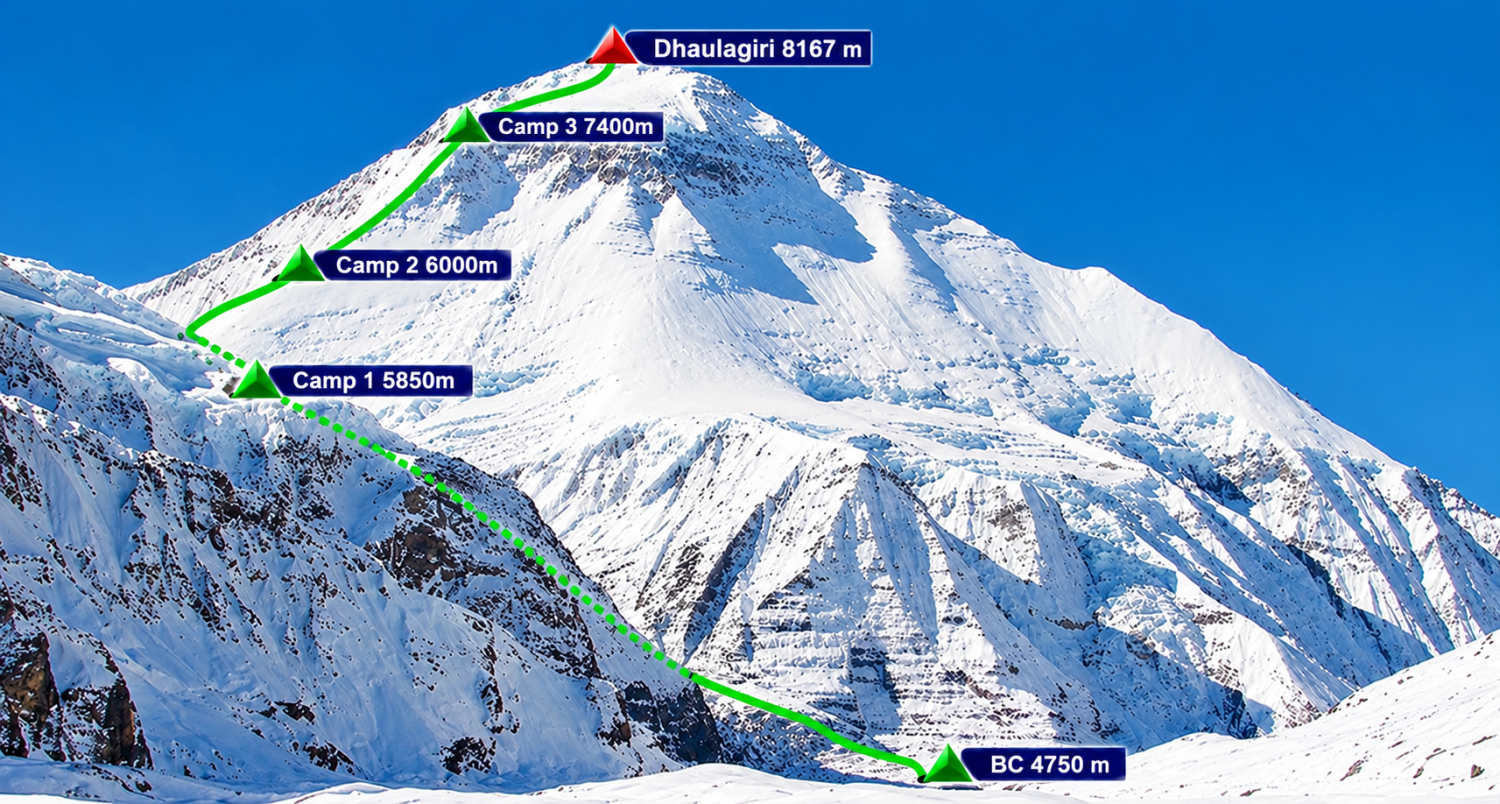
At higher elevations, our expedition team establishes Dhaulagiri Base Camp, situated at approximately 4,700 meters. Base Camp becomes the central location for expedition preparations, acclimatization rotations, equipment management, weather monitoring, meals, rest, and communication.
From Base Camp, the expedition enters a more technical and demanding phase. The climbing route involves glacier travel, steep snow and ice sections, fixed ropes, high-altitude camps, and challenging terrain. The exact climbing strategy may be adjusted according to current mountain conditions, weather, snow stability, and guidance from the expedition leadership.
The route generally progresses through the following high-altitude camps:
From Base Camp, climbers proceed across the glacier toward the North Col, navigating extensive glaciated terrain. After negotiating the appropriate route and establishing the necessary fixed ropes and climbing systems, Camp I is established in the vicinity of the broad North Col.
This section marks the transition from the trekking environment into a true high-altitude climbing expedition.
Above Camp I, the route continues across broad snow-covered slopes toward higher elevations. Camp II is generally established around 6,500 meters, although the exact location may vary according to mountain conditions and the expedition team's strategy.
At this altitude, the effects of reduced oxygen become increasingly noticeable. Climbers therefore need to move carefully, maintain hydration and nutrition, and follow the acclimatization strategy established by the expedition leaders.
The route toward Camp III involves more demanding climbing as the terrain becomes steeper and more exposed. Climbers progress toward the Northeast Ridge, where the combination of altitude, cold, wind, and technical terrain requires considerable concentration and experience.
Camp III serves as an important high-altitude staging point before the summit attempt.
The summit push is the most demanding stage of the expedition. Depending on weather, route conditions, acclimatization, and the expedition leader's assessment, climbers may begin their summit attempt around midnight.
The climb takes place in darkness initially, with headlamps illuminating the route ahead. At extreme altitude, every movement requires energy and concentration. Climbers must manage their pace carefully while negotiating snow, ice, steep sections, and potentially strong winds.
The goal is to reach the summit of Dhaulagiri at 8,167 meters, where climbers can experience an extraordinary panorama of the Himalayan landscape. Standing on the summit after weeks of trekking, acclimatization, preparation, and climbing is a remarkable achievement.
However, reaching the summit is only part of the objective. A successful expedition also means returning safely to lower elevations. Our team therefore places equal importance on the descent, monitoring weather and individual health conditions and making decisions based on safety rather than simply pursuing the summit.
The principal climbing seasons for the Dhaulagiri Expedition are spring and autumn.
Spring, particularly from March to May, generally provides favorable conditions for high-altitude mountaineering, with increasingly stable weather windows and impressive mountain scenery.
Autumn, especially from September to November, is another popular period for Himalayan expeditions. The monsoon season has generally cleared, providing improved visibility and beautiful views across the mountain landscape.
Although these seasons traditionally offer more favorable conditions, Himalayan weather can change rapidly. No expedition schedule can guarantee perfect conditions, and the final climbing program must remain flexible.
Dhaulagiri is a serious 8,000-meter expedition and should not be considered a beginner's mountaineering objective. Climbers need excellent physical fitness, strong mental preparation, previous high-altitude experience, and appropriate technical climbing skills.
Experience with crampons, ice axes, fixed ropes, glacier travel, steep snow and ice, and expedition-style climbing is essential. Previous experience on 7,000-meter or 8,000-meter peaks is highly valuable because climbers need to understand how their bodies respond to extreme altitude and prolonged exposure to challenging mountain environments.
Adequate preparation before arriving in Nepal is strongly recommended. Cardiovascular endurance, strength, climbing technique, and previous experience carrying loads at altitude can all contribute to better expedition performance.
Acclimatization is one of the most important components of a successful Dhaulagiri expedition.
As altitude increases, atmospheric pressure and available oxygen decrease. The body needs time to adapt. For this reason, our itinerary incorporates gradual elevation gain and acclimatization rotations rather than attempting to move rapidly toward the summit.
During the expedition, climbers may ascend to higher camps and then return to lower elevations for rest and recovery. These rotations allow the body to adapt progressively while also allowing the expedition team to assess climbing conditions and individual performance.
Our expedition leaders closely monitor weather, route conditions, and the physical condition of climbers throughout the journey. Summit plans may be modified when conditions require it.
Nutrition is particularly important during a demanding high-altitude expedition. Throughout the expedition, our experienced kitchen team prepares nutritious and energizing meals designed to support the physical demands of trekking and climbing.
Meals are planned to provide a balance of carbohydrates, protein, fats, and essential nutrients while taking into account the limited resources available in remote mountain environments.
Our experienced guides, climbing staff, cooks, porters, and high-altitude support team work together to maintain expedition logistics and help create a safe and organized climbing environment.
The Dhaulagiri region is remote, and trekking and mountaineering activities are strongly influenced by weather and mountain conditions. Even when an expedition is scheduled during the most favorable seasons, unexpected weather can affect transportation, trekking routes, climbing schedules, and summit opportunities.
Domestic flights, including flights to and from Pokhara, can occasionally be delayed or canceled because of poor weather or operational conditions. If delays occur, additional accommodation, meals, transportation, or other expenses beyond the scheduled itinerary may be the responsibility of the client.
Where practical, Himalayan Adventure Intl Treks can assist in arranging alternative transportation, including helicopter services, at an additional cost, subject to availability, weather, and operational conditions.
Clients should also maintain some flexibility around their international flight schedules. Himalayan Adventure Intl Treks cannot be held responsible for losses resulting from missed international flights caused by unforeseen delays, cancellations, weather, or other circumstances beyond our control. We will nevertheless provide reasonable assistance to help minimize inconvenience and arrange necessary alternatives.
Because the expedition travels through remote terrain and areas affected by extreme climatic conditions, trails may occasionally become damaged, blocked, or altered. The expedition itinerary may therefore need to be adjusted when required for safety and logistical reasons.
Any itinerary changes will be made with the primary objective of protecting the safety and well-being of our clients and expedition team. We remain committed to maintaining the quality of our services throughout the journey.
The cost of a Dhaulagiri Expedition depends on several factors. These may include the size of the expedition group, climbing permits and royalty fees, accommodation arrangements, transportation, the number of climbing Sherpa and support staff, equipment requirements, food and logistics, and the level of customization requested.
Because every expedition can have different requirements, Himalayan Adventure Intl Treks provides expedition costs according to the specific services and arrangements selected by the client.
For a detailed quotation, inclusions, exclusions, permit information, equipment requirements, and customized expedition arrangements, please contact Himalayan Adventure Intl Treks.
The Dhaulagiri Expedition (8,167m) is an adventure into one of the most spectacular and demanding environments in the Himalayas. From remote villages and deep valleys to glaciers, high camps, steep ridges, and the summit of one of the world'