
Have Questions? Talk to Expert (Binod)
The Arun Valley Trek is one of Nepal’s most rewarding off-the-beaten-path trekking experiences, offering an exceptional combination of pristine Himalayan landscapes, traditional mountain communities, rich biodiversity, and spectacular views of some of the world’s highest peaks. Unlike the heavily traveled trekking routes of Nepal, the Arun Valley remains relatively peaceful, making it an excellent choice for travelers who want to experience the mountains away from large crowds.
Organized by Himalayan Adventure Intl Treks, the Arun Valley Trek takes you through remote hills, terraced farmland, dense forests, traditional villages, dramatic river valleys, and high mountain passes before connecting with the famous Everest trekking region. Depending on the itinerary, the journey can be combined with the Everest Base Camp route, providing a remarkable adventure that begins in the lower Arun Valley and eventually reaches the high Himalayas.
The region lies between the Everest and Makalu areas and is closely associated with Makalu-Barun National Park and Conservation Area, one of Nepal’s most spectacular wilderness regions. The landscape changes dramatically throughout the trek. You may begin your journey in warm subtropical surroundings and gradually move through temperate forests, rhododendron woodland, alpine terrain, and eventually snow-covered highlands.
Along the way, trekkers can encounter traditional Rai, Sherpa, and other Himalayan communities whose lifestyles, architecture, festivals, songs, dances, and religious traditions have developed over generations. The Arun Valley therefore offers much more than mountain scenery—it provides a fascinating cultural journey through some of Nepal’s less-explored landscapes.
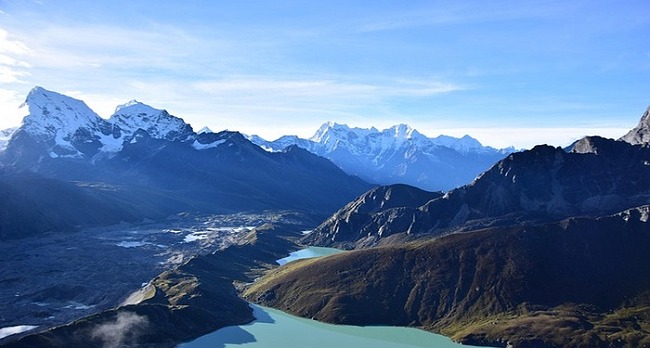
The views are equally impressive. Depending on weather and location, the route provides opportunities to admire Mount Everest, Mount Makalu, Lhotse, Nuptse, Baruntse, Ama Dablam, Thamserku, Mera Peak and numerous other Himalayan summits.
The Arun Valley Trek is a wilderness journey through one of the most geographically and culturally diverse areas of eastern Nepal. The classic adventure begins around the Arun River basin and gradually climbs toward the higher valleys before connecting with the Khumbu trekking region.
One of the most attractive aspects of this trek is its changing environment. At lower elevations, the trail passes through lush vegetation, farms, forests, waterfalls and villages. As the altitude increases, the scenery becomes increasingly alpine, with rocky landscapes, mountain valleys, glaciers and snow-covered peaks dominating the horizon.
The Arun River is one of the defining geographical features of the region. Originating in the Tibetan Plateau, the river flows through the Himalayas and creates a spectacular valley system in eastern Nepal. The trekking trail follows sections of this river and its tributaries while gradually gaining altitude.
The route is particularly appealing to experienced trekkers who want something different from Nepal’s busiest trails. Instead of immediately joining a crowded trekking route, you spend considerable time walking through quiet villages and wilderness areas where encounters with other trekking groups can be limited.
A major attraction is the opportunity to experience the transition from the lower hills to the high Himalayas. The journey can begin in relatively warm surroundings and eventually reach elevations where snow, freezing temperatures, strong winds and rapidly changing mountain weather become important considerations.
Depending on the selected itinerary, the Arun Valley route can eventually connect with the Everest region near the Pangom area. This creates an extraordinary long-distance trekking experience combining the remote Arun Valley with the legendary Khumbu landscape.
For travelers who appreciate wilderness, cultural encounters, biological diversity and challenging trails, the Arun Valley Trek is an outstanding alternative to more conventional Nepal trekking holidays.
There are many reasons to consider the Arun Valley Trek for your next Nepal adventure.
The Arun Valley is significantly quieter than many of Nepal’s better-known trekking routes. The lower sections of the trail allow travelers to enjoy peaceful surroundings, traditional villages and natural landscapes without the constant flow of trekkers found on some popular routes.
The trek provides opportunities to see some of the highest and most famous mountains in the world. Mount Makalu, rising above 8,000 meters, is one of the great highlights of the journey. Depending on the route and visibility, trekkers may also see Everest, Lhotse, Nuptse, Ama Dablam, Baruntse, Thamserku and other spectacular peaks.
Few trekking routes in Nepal provide such dramatic ecological changes. The Arun Valley route moves from lower-elevation forests and agricultural settlements toward alpine environments and high Himalayan terrain.
The trek provides opportunities to meet communities including Rai and Sherpa people. Traditional houses, farming practices, religious traditions, local celebrations, songs and dances add an important cultural dimension to the journey.
The Arun and Barun landscapes support an impressive range of flora and fauna. The region is renowned for its forests, orchids, rhododendrons, birds and butterflies, while the wider conservation area provides habitat for rare Himalayan wildlife.
For travelers who want a longer Himalayan adventure, the Arun Valley route can connect with the classic Everest trekking corridor. This makes it possible to combine remote eastern Nepal with the famous Khumbu region.
The Arun Valley Trek is not simply about reaching a particular destination. The journey itself is the main attraction.
The trail passes through forests, villages, agricultural terraces, river valleys and mountain landscapes before gradually entering more rugged terrain.
Lower sections of the route are characterized by warm weather, lush vegetation and cultivated hillsides. The trail then moves through forests where rhododendrons, orchids and other Himalayan plants can be found.
During spring, rhododendrons can transform sections of the forest into colorful corridors. The combination of flowering woodland, mountain streams and distant Himalayan peaks creates some of the most memorable scenery of the trek.
As the trail continues northward, the environment becomes increasingly remote. Traditional settlements appear at intervals along the route, providing opportunities to learn about the daily lives of mountain communities.
Crossing high passes is another major feature of the adventure. The Barun La, commonly associated with an elevation of around 4,110 meters, is one of the important high points on routes through this region. Weather conditions can change quickly around high passes, so careful planning and appropriate equipment are essential.
The upper Barun Valley provides a dramatically different landscape. Steep mountain walls, waterfalls, glaciers, rocky slopes and snow-covered summits create a powerful Himalayan atmosphere.
For trekkers continuing toward the Everest region, the landscape gradually transitions into the more recognizable Khumbu environment. The eventual connection with the classic Everest Base Camp trekking route makes the Arun Valley adventure particularly appealing to travelers seeking a longer and more diverse Himalayan journey.
One of the greatest attractions of the Arun Valley region is its proximity to Mount Makalu, one of the world's highest mountains.
Makalu rises to more than 8,400 meters and is recognized for its distinctive pyramid-shaped summit and dramatic surrounding landscape. The mountain dominates the skyline from various viewpoints along the Makalu region.
The Arun Valley and Barun Valley together create an extraordinary mountain environment. Deep gorges sit below enormous Himalayan peaks, while waterfalls descend from steep slopes and glaciers feed mountain rivers.
The contrast between the powerful river systems and enormous snow-covered mountains is one of the defining characteristics of the region.
Trekkers should be prepared for a gradual transition in climate. Lower sections can be warm and humid, while higher elevations can be cold, windy and snowy. This variation is one of the reasons proper clothing and equipment are so important.
The Arun Valley is especially attractive to travelers interested in nature and wildlife.
The region contains several ecological zones, resulting in remarkable biological diversity. Depending on altitude, trekkers may pass through subtropical forests, broadleaf woodland, rhododendron forests, coniferous forests and alpine environments.
Rhododendrons are particularly prominent during spring. Nepal has numerous rhododendron species, and the flowering forests can become one of the most beautiful features of a spring trek.
Orchids and other wildflowers can also be found along the trail.
The wider Makalu-Barun region is known for its biodiversity, supporting numerous species of birds, butterflies and mammals. The conservation area provides habitat for wildlife adapted to different elevations, including rare and elusive Himalayan species.
Travelers may encounter colorful birds, butterflies and other wildlife, although sightings can never be guaranteed.
The region is also associated with the habitat of the red panda, one of Nepal's most iconic and endangered mammals. Spotting one in the wild is extremely difficult, but knowing that these remarkable animals inhabit the forests adds another dimension to the trekking experience.
For nature enthusiasts, the Arun Valley is therefore much more than a mountain route. It is an opportunity to walk through a living ecological corridor where vegetation and wildlife change dramatically with elevation.
The Arun Valley Trek is also a cultural journey.
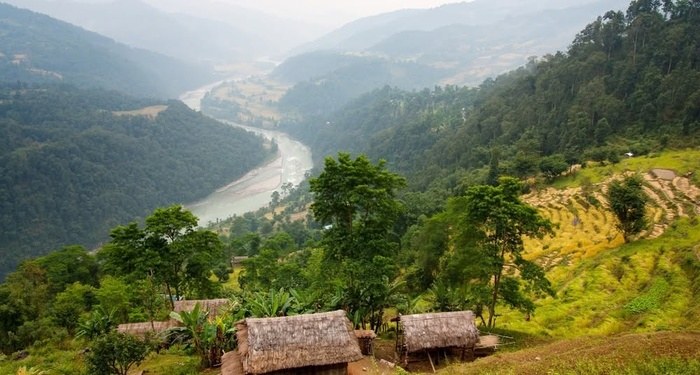
The lower and middle sections of the route pass through traditional communities where agriculture remains an important part of everyday life. Terraced fields cover many hillsides, reflecting generations of adaptation to the mountainous environment.
The Rai community has a strong cultural presence in parts of the eastern Nepal hills. As the trek approaches higher elevations, Sherpa culture becomes increasingly visible.
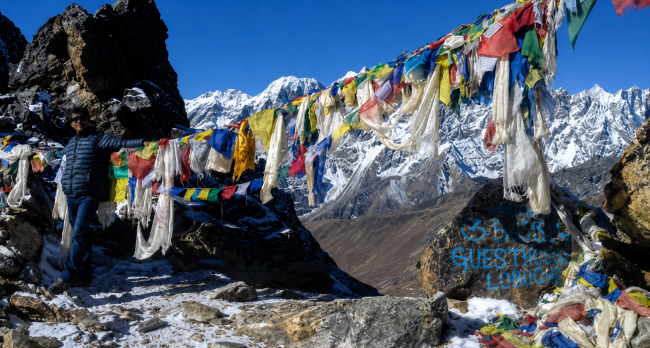
Traditional houses, Buddhist prayer flags, monasteries, shrines, agricultural practices and local festivals provide opportunities to understand the cultural diversity of the region.
Music and traditional dances are also important elements of village life. With proper arrangements, visitors may have opportunities to experience local cultural performances and interact with community members.
The cultural experience is especially meaningful because the Arun Valley receives fewer international visitors than the major trekking corridors.
Rather than simply passing through a tourist destination, trekkers have opportunities to experience landscapes where traditional lifestyles remain closely connected to the mountains.
Choosing the right season is important for a successful Arun Valley Trek.
The two most favorable trekking periods are generally spring and autumn.
Spring is one of the most beautiful times to explore the Arun Valley.
Temperatures become increasingly pleasant in the lower and middle elevations, while mountain visibility is often good. Rhododendron forests begin flowering, adding color to the trail.
March, April and May are particularly attractive for travelers interested in flowers, forests and wildlife as well as mountain scenery.
Higher elevations can still be cold, however, so trekkers need appropriate equipment.
Autumn is widely regarded as one of Nepal's best trekking seasons.
After the summer monsoon, landscapes are refreshed and mountain visibility often improves. The skies can be clear, and the mountain panorama can be spectacular.
September can still receive some post-monsoon rainfall, while October and November are generally favored for stable trekking conditions.
Winter trekking is possible in some lower sections, but high passes and elevated areas can become extremely cold and snowy.
If you plan to cross high passes or trek into the upper Himalayan areas during winter, careful assessment of weather and trail conditions is essential.
The monsoon season brings heavy rainfall to much of eastern Nepal. Trails can become muddy and slippery, while landslides and leeches may be encountered in lower areas.
For these reasons, the traditional trekking seasons of spring and autumn are generally preferable.
The Arun Valley Trek is considered a challenging trekking adventure because of its remote character, long walking days, changing elevations and high mountain passes.
Trekkers may walk approximately six to seven hours on many days, although the exact duration depends on the itinerary, trail conditions, altitude and walking pace.
The difficulty is not only related to altitude. The trail itself can be rugged, with steep ascents and descents, stone steps, narrow paths and uneven terrain.
The gradual increase in elevation is important. Starting from a low altitude and eventually reaching more than 4,000 meters means the body has to adapt to substantial changes in temperature, oxygen availability and physical demands.
Previous trekking experience is highly beneficial.
However, experienced guides can help manage the pace, rest periods, hydration and acclimatization schedule. A properly planned itinerary gives trekkers a much better chance of enjoying the journey safely and comfortably.
Good physical preparation can make a major difference to your trekking experience.
You do not need to be an elite athlete, but you should be comfortable walking for several hours on consecutive days.
Before traveling to Nepal, consider building your endurance through:
It is also useful to train on uneven terrain because Himalayan trails are very different from flat urban roads.
The goal is not maximum speed. A steady, sustainable walking pace is more valuable during a long-distance Himalayan trek.
Altitude is one of the most important considerations on the Arun Valley Trek.
As the trail climbs above 3,000 meters, the air contains less available oxygen. Some trekkers experience symptoms associated with altitude sickness, particularly if they ascend too quickly.
Common warning signs can include headache, unusual tiredness, dizziness, nausea or difficulty sleeping.
Trekkers should communicate openly with their guide if they feel unwell.
The safest approach is to ascend gradually, stay hydrated, maintain a sensible pace and allow enough time for acclimatization.
Medication for altitude-related problems should only be taken according to appropriate medical advice. It is a good idea to discuss altitude trekking and any medications with a qualified healthcare professional before your trip.
Your guide should monitor the group throughout the trek and adjust the itinerary if necessary.
Accommodation varies considerably according to the location.
In Kathmandu, Himalayan Adventure Intl Treks can arrange comfortable tourist-standard hotel accommodation according to your package.
During the trek, accommodation is generally provided in local lodges, teahouses or guesthouses.
Lower and more established trekking settlements may have a wider choice of facilities. As you move deeper into remote areas, accommodation becomes simpler.
Rooms are usually basic, with beds and blankets provided according to local standards. Bathroom facilities may be shared, particularly in remote settlements.
Trekkers should remember that remote Himalayan trekking is fundamentally different from staying in city hotels. The simplicity of the accommodation is part of the adventure and reflects the remote environment.
Food is an important part of maintaining energy during a long Himalayan journey.
During the trek, meals commonly include a mixture of traditional Nepali food and simple international-style dishes.
Dal Bhat, consisting of rice, lentil soup and accompanying vegetables or curry, is one of the most popular trekking meals because it provides substantial carbohydrates and energy.
Other possible foods include:
Food choices can become more limited at higher and more remote elevations.
Staying hydrated is equally important. Trekkers should drink water regularly throughout the day and use an appropriate purification method where necessary.
Transportation depends on the selected itinerary.
Travelers may reach the eastern Nepal region by domestic flight or road transportation, depending on current schedules, route conditions and the specific trekking program.
Tumlingtar is an important access point for Arun Valley and Makalu-area adventures.
Because transportation schedules in mountainous Nepal can be affected by weather, operational conditions and seasonal factors, itineraries should retain a degree of flexibility.
Himalayan Adventure Intl Treks coordinates transportation arrangements according to the chosen itinerary and current travel conditions.
For airport transfers and Kathmandu transportation, private vehicles can be arranged for greater convenience.
Packing appropriately is essential for comfort and safety.
You should avoid both extremes: carrying too little equipment or taking unnecessary heavy items.
Your trekking boots should be broken in before the trek.
Depending on the package, some trekking equipment may be available through the company.
At high altitude, UV exposure can be intense.
Bring:
Pack a small personal hygiene kit containing:
Electricity may not always be readily available in remote settlements, so a power bank is useful.
Bring your regular personal medications and a small personal first-aid kit.
Useful basic items can include:
A guide may carry a group first-aid kit, but every traveler should remain responsible for their own personal medications.
Travelers should keep important documents secure and accessible.
Recommended items include:
It is also wise to keep digital copies of important documents in secure cloud storage or on your phone.
The Arun Valley is a sensitive Himalayan environment, and responsible tourism is extremely important.
Trekkers should follow the principle of leaving the mountains as they found them.
Avoid:
Carry reusable water bottles where practical and minimize single-use plastic.
Respect local customs when visiting villages, homes and religious places. Ask permission before photographing people, especially during ceremonies or private activities.
Responsible trekking helps protect the environment while ensuring that local communities benefit from tourism.
At Himalayan Adventure Intl Treks, we understand that a successful Himalayan journey requires more than simply following a trail.
Our team focuses on thoughtful itinerary planning, experienced trekking guides, transportation coordination, accommodation arrangements and practical support throughout the journey.
We can customize Arun Valley Trek programs according to your available time, trekking experience, preferred accommodation and desired route.
Whether you are interested in a remote cultural journey, a wilderness adventure through the Makalu-Barun region, or a longer itinerary connecting the Arun Valley with the Everest region, we can help develop an itinerary suitable for your goals.
Our trekking team can also assist with:
Choosing the right trekking company can make a major difference, particularly on a remote route such as Arun Valley.
Our approach emphasizes safety, organization, local knowledge and responsible travel.
Local guides understand the terrain, villages, weather patterns and cultural environment. Their knowledge can make the journey more informative and enjoyable.
Not every traveler wants the same trekking experience. We can adapt itineraries according to walking ability, available time and preferred destinations.
Travelers can choose between group joining and private trekking arrangements depending on their preferences.
Our guides can help introduce travelers to the communities and traditions encountered along the route.
From transportation and accommodation to permits and porter arrangements, our team helps coordinate the essential components of the trek.
The Arun Valley Trek is particularly suitable for travelers who:
Because the trek involves long walking days and significant altitude changes, it is best suited to people prepared for a physically demanding adventure.
Some of the major highlights include:
The Arun Valley Trek is a remote Himalayan adventure, so flexibility is important.
Weather can affect domestic flights, especially in mountainous regions. Trail conditions can also change because of rainfall, snowfall, landslides and seasonal conditions.
Travelers should therefore maintain some flexibility in their schedule.
Remote trekking also means that facilities become increasingly basic as you move away from major settlements.
The rewards, however, are exceptional. The absence of extensive infrastructure is precisely what gives the Arun Valley its unique character.
The Arun Valley Trek is an invitation to experience Nepal from a different perspective.
It is a journey through changing landscapes—from warm valleys and cultivated hillsides to rhododendron forests, high mountain passes and dramatic Himalayan wilderness.
It is also a cultural journey. The people living in these valleys have developed unique traditions and ways of life shaped by their environment. Meeting local communities and seeing their villages provides an experience that cannot be captured simply by photographing the mountains.
And above all, it is a wilderness adventure.
The Arun Valley's combination of spectacular mountains, rivers, forests, wildlife and remote trails makes it one of Nepal's most fascinating trekking destinations.
For travelers who have already experienced Nepal's popular trekking routes and want something quieter, more challenging and culturally immersive, the Arun Valley Trek can be an exceptional choice.
From the first steps through the lower Arun Valley to the high Himalayan landscapes near Makalu and the eventual connection toward the Everest region, every stage of the journey brings a new perspective.
Join Himalayan Adventure Intl Treks for an unforgettable Arun Valley adventure and discover one of Nepal's remarkable hidden Himalayan landscapes.
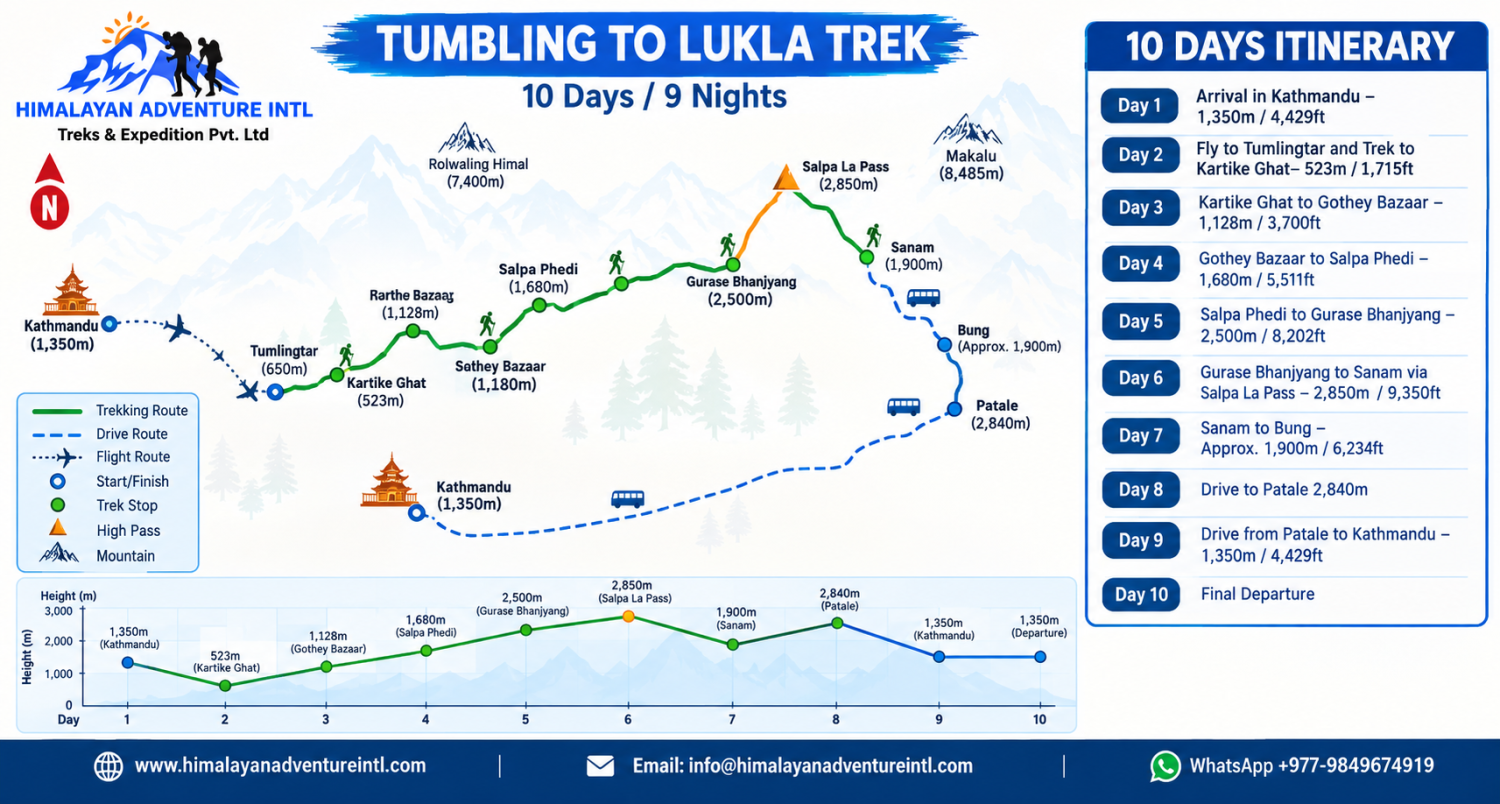
Welcome to Nepal! Upon your arrival at Tribhuvan International Airport in Kathmandu, a representative from Himalayan Adventure Intl Treks will greet you and transfer you comfortably to your hotel. After check-in, you can relax and recover from your journey or take a leisurely walk around the vibrant streets of Thamel. This is also an opportunity to meet your trekking team and receive a briefing about the upcoming adventure.
Elevation: 1,350m
Distance: Approx. 6 km airport to hotel
Trekking: No trekking 25 minute drive
Your eastern Nepal adventure begins with an early morning flight from Kathmandu to Tumlingtar. The scenic flight offers wonderful views of Nepal's hills and Himalayan peaks. After meeting the local trekking crew, we continue toward the trailhead and begin walking through rural settlements, forested paths, and cultivated farmland.
The trail gradually follows the Arun River, crossing a suspension bridge before passing through Bheteni and Chewabesi. Walking southward along the river valley, you eventually arrive at Kartike, a peaceful settlement surrounded by green hills. On clear days, distant views toward Makalu and Chamlang add to the excitement of the journey.
Elevation: 523m / 1,715ft
Distance: Approx. 10–12 km trekking
Trekking: 4–5 hours
After breakfast, we leave Kartike and follow the trail toward Baluwa Besi. The route crosses small streams and a bridge before entering sections of Sal forest. Continuing through traditional villages and terraced farmland, we gradually gain altitude.
The trail passes through Marduwa, where you can observe the distinctive lifestyle and culture of the local Rai communities. We continue alongside the Irkhuwa River, enjoying peaceful woodland, agricultural landscapes, and scattered mountain settlements before reaching Gothey for our overnight stay.
Elevation: 1,128m / 3,700ft
Distance: Approx. 12–14 km
Trekking: 5–6 hours
Today the trail becomes more adventurous as we gradually climb through beautiful forests and traditional settlements. We cross suspension bridges and small streams while following the Irkhuwa Khola. The surrounding landscape becomes increasingly mountainous as we gain elevation.
Rhododendron, oak, and other native vegetation provide pleasant shade along sections of the route. After several steady ascents and descents, we reach Salpa Phedi, an important resting point before the higher section of the trek.
Elevation: 1,680m / 5,511ft
Distance: Approx. 10–12 km
Trekking: 5–6 hours
Today involves a substantial ascent toward Gurase Bhanjyang. After breakfast, we begin climbing along a forested mountain trail. The route is physically demanding in places, but the peaceful surroundings make the effort rewarding.
We walk through dense oak, birch, and rhododendron forests, with occasional openings providing impressive views across the surrounding hills. The change in vegetation and landscape becomes noticeable as we gain altitude. After several hours of steady uphill walking, we arrive at Gurase Bhanjyang.
Elevation: 2,500m / 8,202ft
Distance: Approx. 9–11 km
Trekking: 6–7 hours
This is one of the most exciting days of the trek. We leave Gurase and climb toward Salpa La Pass at approximately 3,360m. The ascent is steady and requires a good level of stamina, but the spectacular scenery makes the climb worthwhile.
From the pass, clear-weather views may extend toward the Makalu range and Chamlang. After enjoying the mountain panorama, we descend through beautiful rhododendron woodland toward Dhaka before continuing toward Sanam village. The changing landscapes and traditional settlements make this a memorable section of the journey.
Highest point: Salpa La Pass – 3,360m / 11,024ft
Overnight elevation: 2,850m / 9,350ft
Distance: Approx. 11–13 km
Trekking: 6–7 hours
Leaving Sanam behind, we continue through the scenic hills of eastern Nepal toward Bung. The trail passes through forested sections, terraced fields, and small settlements where traditional rural life remains closely connected with the surrounding landscape.
The route includes gradual descents and undulating terrain, allowing us to enjoy the peaceful environment after crossing Salpa La. We reach Bung in the afternoon and have time to rest and explore the village.
Elevation: Approx. 1,900m / 6,234ft
Distance: Approx. 10–12 km
Trekking: 5–6 hours
After breakfast, we leave the trekking trails and begin our road journey toward Patale. The drive follows winding mountain roads through beautiful landscapes, traditional villages, forests, and terraced hillsides.
Patale is a scenic settlement situated along the route toward the Kathmandu region. After arrival, we check into our accommodation and enjoy a relaxing evening surrounded by the Himalayan foothills.
Elevation: Approx. 2,840m / 9,318ft
Distance: Approx. 70–90 km by road
Driving: 5–7 hours
Today we return to Kathmandu by road. The journey takes us through Nepal's changing landscapes, from high mountain terrain toward lower green hills and eventually into the Kathmandu Valley.
Upon reaching Kathmandu, you can relax at the hotel or spend your remaining free time shopping for souvenirs and exploring Thamel. In the evening, you may enjoy a farewell dinner celebrating the completion of your eastern Nepal adventure.
Elevation: 1,350m / 4,429ft
Distance: Approx. 240–260 km by road
Driving: 7–9 hours
Your memorable journey in Nepal comes to an end today. Depending on your international flight schedule, you can enjoy some free time before a representative from Himalayan Adventure Intl Treks transfers you to Tribhuvan International Airport.
We sincerely hope the landscapes, mountain views, villages, forests, and cultural encounters of the Salpa region have created lasting memories. We look forward to welcoming you again for another Himalayan adventure.
Elevation: 1,350m / 4,429ft
Trekking: No trekking
The Arun Valley Trek is one of Nepal’s most rewarding off-the-beaten-path trekking adventures. Situated in eastern Nepal between the spectacular Everest and Makalu regions, the Arun Valley offers an extraordinary combination of Himalayan scenery, peaceful mountain villages, rich indigenous cultures, lush forests, high alpine landscapes, and remarkable views of some of the world’s highest mountains.
While destinations such as Everest Base Camp and the Annapurna Circuit receive international attention, Arun Valley remains comparatively quiet and authentic. Its peaceful trails allow trekkers to experience Nepal at a slower pace, walking through communities where traditional lifestyles, farming practices, Buddhist and Kirati traditions, and warm Himalayan hospitality remain an important part of everyday life.
Himalayan Adventure Intl Treks organizes Arun Valley Trek packages for travelers looking for a more adventurous and less crowded Himalayan experience. We provide group joining treks, fixed departure dates, private trips, solo trekking arrangements, couple trekking packages, and customized itineraries according to the traveler's available time, interests, and preferred level of comfort.
The trek is particularly attractive to experienced hikers who want to explore a remote part of Nepal before connecting with the higher Himalayan landscapes toward the Everest and Makalu regions. Depending on the selected itinerary, the route passes through subtropical forests, terraced farmland, rhododendron woodland, alpine terrain, traditional villages, and high mountain passes.
The Arun Valley is often described as one of Nepal's hidden Himalayan treasures. The region combines spectacular mountain scenery with a sense of remoteness that has become increasingly difficult to find on Nepal's busiest trekking routes.
One of the greatest attractions is the opportunity to observe the gradual transformation of the landscape as you gain altitude. Lower sections of the trek feature green hills, terraced fields, forests, rivers, and villages. Higher sections become increasingly rugged, with alpine vegetation, mountain meadows, dramatic ridges, and snowy peaks.
The cultural experience is equally important. The region is home to communities including Rai and Sherpa people, along with other Himalayan ethnic groups. Their languages, traditions, architecture, festivals, farming practices, and hospitality provide a fascinating cultural dimension to the journey.
Major highlights include:
The Arun Valley Trek is therefore ideal for travelers who want more than simply reaching a famous Himalayan destination. It is a journey through landscapes, communities, and environments that feel considerably less commercialized.
At Himalayan Adventure Intl Treks, we understand that every trekker has different expectations. Some travelers want to join a friendly international group, while others prefer a private guide and flexible schedule.
Our Arun Valley trekking services can therefore be arranged in several formats.
Our group joining package is suitable for travelers who want to share the adventure with other trekkers. Joining a group can reduce the individual cost of guides, transportation, and other services while also creating opportunities to meet people from different countries.
Our standard group departures can generally accommodate approximately 4 to 12 trekkers, depending on the departure.
A private trek provides greater flexibility. You can choose your preferred departure date, walking pace, accommodation preferences, and additional sightseeing arrangements.
Private trips are particularly suitable for families, friends, couples, photography groups, and travelers who want a personalized experience.
Solo travelers can also arrange the trek with a professional guide. Because the Arun Valley is a remote trekking destination, traveling with a knowledgeable local guide is strongly recommended.
A guide provides assistance with navigation, accommodation, communication with local communities, altitude management, and emergency coordination.
Couples can enjoy a private Arun Valley experience with a dedicated guide and flexible itinerary. Rather than following a large group schedule, couples can select a pace and itinerary that suits their interests.
Himalayan Adventure Intl Treks can organize fixed departures during the principal trekking seasons.
Indicative group departure dates can include:
| Departure | Availability | Group Size | Duration | Indicative Cost |
|---|---|---|---|---|
| March 10 | Open | 4–12 | 14 Days | US$1,350 |
| April 5 | Open | 4–12 | 14 Days | US$1,350 |
| May 15 | Open | 4–12 | 14 Days | US$1,350 |
| September 10 | Open | 4–12 | 14 Days | US$1,350 |
| October 5 | Open | 4–12 | 14 Days | US$1,350 |
| November 8 | Open | 4–12 | 14 Days | US$1,350 |
Important: Departure dates and prices should be reconfirmed before booking because flight fares, accommodation rates, transportation, permits, and government regulations can change.
If you already have your own group, Himalayan Adventure Intl Treks can arrange a private departure on your preferred date.
The cost of the Arun Valley Trek depends on the duration, transportation arrangements, group size, guide and porter services, accommodation standards, and whether the itinerary is private or group joining.
Our indicative group package starts at approximately US$1,350 per person for a standard 14-day trekking arrangement.
A private or solo arrangement may cost more because expenses such as guide services and transportation are shared among fewer travelers.
An indicative cost structure is:
| Expense | Approximate Cost |
|---|---|
| Trekking permits and local fees | Subject to current regulations |
| Round-trip Kathmandu–Tumlingtar flights | Approximately US$360–388 |
| Licensed guide | US$30–35 per day |
| Porter | US$20–25 per day |
| Porter-cum-guide | US$22–28 per day |
| Basic accommodation | Approximately US$5–15 per night |
| Meals | Approximately US$20–30 per day |
| Local/private transportation | Approximately US$40–60+ |
| Company/service arrangements | Depending on package |
| Standard group package | From approximately US$1,350 |
These figures are intended as planning estimates. The final quotation is prepared according to the exact itinerary and services requested.
A solo traveler should expect a higher per-person cost because guide, transportation, and logistical expenses cannot be distributed across a larger group.
Our indicative solo package can start from approximately US$1,550 per person, depending on the selected itinerary and services.
The package may include:
For a remote Himalayan trek such as Arun Valley, we strongly recommend traveling with a qualified local guide rather than attempting to navigate the entire route independently.
Couples can enjoy a more personalized experience through a private Arun Valley trekking package.
An indicative couple package can start from approximately US$950 per person, depending on the itinerary, group arrangements, transportation, and accommodation selected.
A private couple trek can include:
The exact cost should be confirmed after selecting the number of trekking days and transportation option.
Permit requirements depend on the exact route followed and the current regulations established by the Government of Nepal and relevant local authorities.
The Arun Valley region may involve Makalu-Barun National Park-related fees and local or regional permits, depending on the itinerary.
As government fees can change, travelers should not rely on an old permit price when preparing their final budget.
A professional trekking company will help arrange the required documentation before departure.
Travelers should carry their passport and required photographs or documentation as requested by the trekking agency.
A major gateway for the Arun Valley region is Tumlingtar, which can be reached from Kathmandu by domestic flight or overland transportation.
Flying is the most convenient option for travelers with limited time.
The flight generally takes around an hour, subject to weather and operational conditions. Flight prices vary by season and availability.
An indicative budget for a round-trip flight is approximately US$360–388 per person, although the actual fare may be higher or lower.
The major advantage of flying is that it saves considerable travel time and reduces the physical fatigue associated with a long road journey.
Travelers looking for a more economical option can consider overland transportation.
A bus or other road vehicle can be substantially cheaper than flying, although the journey is much longer and road conditions can affect travel time.
An indicative budget may be around US$30 one way, subject to the vehicle and service selected.
For trekkers with limited vacation time, the flight option is generally preferable.
The exact itinerary can be customized, but a typical journey takes around 7 days, including arrival, transportation, trekking, and departure.
Accommodation is generally basic and locally operated.
Trekkers should not expect the same level of facilities available in Kathmandu, Pokhara, or major Everest trekking villages.
Typical accommodation may include:
Accommodation availability can be limited in remote sections, which is another reason why advance planning and a local trekking company are valuable.
Food is an important source of energy during a Himalayan trek.
Common meals can include:
Dal bhat is especially popular because it provides a filling combination of rice, lentils, vegetables, and accompanying dishes.
Trekkers should also carry small personal snacks such as energy bars, nuts, dried fruit, chocolate, or biscuits.
Safe drinking water is essential throughout the trek.
Depending on the village, water may be available from local taps, springs, lodges, or bottled-water supplies.
Instead of relying exclusively on bottled water, trekkers can carry a reusable bottle and use appropriate purification tablets or a reliable water filter.
Always follow your guide's advice regarding the safety of a particular water source.
The best trekking seasons are generally spring and autumn.
Spring is one of the most beautiful periods in the Himalayas.
The forests become vibrant with blooming rhododendrons, temperatures are generally comfortable, and mountain visibility can be excellent during stable weather.
March, April, and May are therefore popular months for trekking.
Autumn is traditionally regarded as one of the finest trekking seasons in Nepal.
After the monsoon, landscapes become fresh and green, while stable weather often provides clear mountain views.
October and November are particularly attractive for trekkers.
The monsoon brings heavy rainfall to many parts of Nepal.
Trails can become muddy and slippery, while clouds may obstruct mountain views. Leeches can also be encountered in wetter forest sections.
Treks are still possible in some circumstances, but travelers should be prepared for changing conditions.
Winter can be very cold, especially at higher elevations.
Snow can affect high sections of the route, and some lodges or trails may have limited availability.
Experienced trekkers who enjoy cold-weather wilderness conditions may consider a winter journey, but careful planning is essential.
Altitude should always be taken seriously on Himalayan treks.
The Arun Valley itinerary can involve significant elevation gain, particularly on routes reaching higher mountain passes or alpine areas.
Possible symptoms of altitude sickness include:
The best prevention strategy is gradual acclimatization.
Trekkers should:
Medication such as acetazolamide (Diamox) should only be used after discussing it with a qualified healthcare professional.
If altitude symptoms become serious, descending to a lower elevation is often the most important response. Your guide and trekking company should have an emergency plan for such situations.
The Arun Valley Trek is best suited to trekkers with reasonable physical fitness and some previous hiking experience.
The difficulty depends heavily on the chosen itinerary.
The trek can include:
Regular walking, hiking, stair climbing, and cardiovascular exercise before the trip can help prepare your body.
You do not need to be an elite mountaineer, but you should be comfortable walking for several hours on consecutive days.
Packing appropriately is essential for a comfortable trek.
Pack according to the season and exact altitude of your itinerary rather than carrying unnecessary equipment.
Choosing a reliable local trekking company can make a significant difference on a remote route.
Himalayan Adventure Intl Treks provides practical local knowledge and trekking support from preparation through completion.
Our services can include:
Our goal is not simply to take travelers from one village to another. We want to create a safe, enjoyable, culturally respectful, and memorable Himalayan experience.
The Arun Valley is particularly attractive for photographers.
The combination of Himalayan peaks, changing vegetation, traditional villages, terraced hillsides, forests, rivers, suspension bridges, and local lifestyles creates countless opportunities for photography.
Early morning is usually one of the best times for mountain photography because the atmosphere can be clearer before afternoon clouds develop.
Birdwatchers and nature lovers can also enjoy the diversity of eastern Nepal's forests.
Remote trekking areas depend heavily on their natural environment and local communities.
Trekkers should follow responsible tourism practices throughout the journey.
We encourage travelers to:
A responsible trek helps preserve the Arun Valley for future generations.
The Arun Valley Trek is an exceptional choice for travelers who want to discover a quieter side of Nepal.
Instead of following the busiest Himalayan trails, you can walk through peaceful villages, dense forests, terraced hills, alpine landscapes, and remote valleys while experiencing the traditions and hospitality of eastern Nepal.
Whether you are planning a group joining trek, solo adventure, private journey, couple trek, or customized Himalayan expedition, Himalayan Adventure Intl Treks can design an itinerary around your requirements.
Our standard group packages are available from approximately US$1,350 per person, while private and solo arrangements can be customized according to the number of travelers, trekking duration, transportation, accommodation, and services selected.
Because the Arun Valley is a remote destination, advance planning is strongly recommended. Flight schedules, local transportation, accommodation availability, permit regulations, and weather conditions can influence the final itinerary and cost.
Contact Himalayan Adventure Intl Treks to discuss your preferred departure date, group size, trekking duration, and transportation requirements.
The Arun Valley Trek is not simply another Himalayan walking route. It is an opportunity to slow down, leave the crowded trekking trails behind, meet people in remote mountain communities, explore remarkable landscapes, and experience a side of Nepal that many international visitors never discover.
From the green foothills and traditional Rai villages to high alpine landscapes and magnificent Himalayan horizons, the journey offers an unforgettable combination of nature, culture, adventure, wilderness, and mountain scenery.
Join Himalayan Adventure Intl Treks and discover the hidden beauty of Arun Valley, Nepal.