
Have Questions? Talk to Expert (Binod)
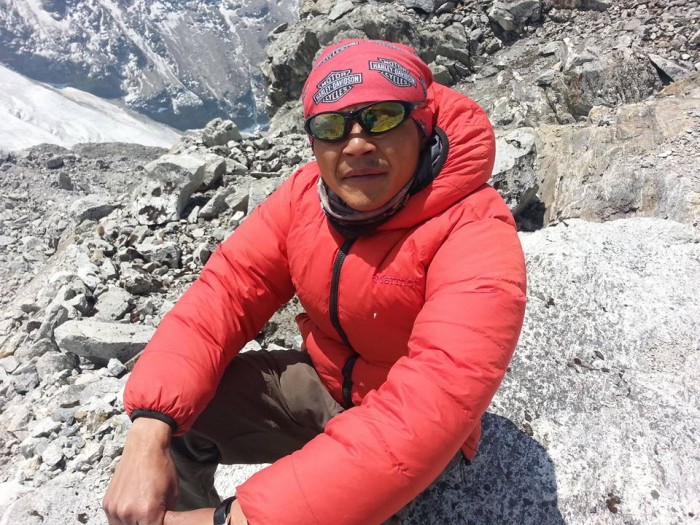
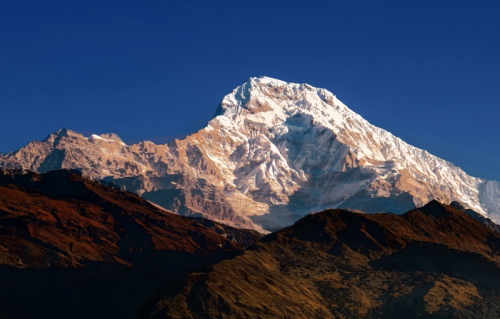
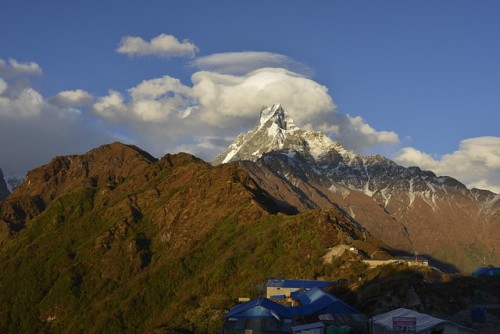
The Annapurna Circuit Trek is one of the world's most iconic trekking adventures, attracting thousands of trekkers every year to the breathtaking Himalayas of Nepal. Famous for its spectacular mountain scenery, diverse landscapes, ancient villages, and rich cultural heritage, this legendary trek circles the magnificent Annapurna Massif and offers an unforgettable journey through some of Nepal's most beautiful regions.
Unlike many trekking routes that focus only on mountain views, the Annapurna Circuit Trek combines adventure, culture, nature, spirituality, and history into one remarkable experience. During the trek, you will walk through lush subtropical forests, cascading waterfalls, deep river valleys, terraced farmlands, alpine meadows, barren high-altitude deserts, and finally cross the famous Thorong La Pass (5,416 meters)—one of the highest trekking passes in the world.
At Himalayan Adventure Intl Treks, we organize professionally guided Annapurna Circuit Trek packages with experienced local guides, comfortable teahouse accommodation, flexible itineraries, and personalized service to ensure every traveler enjoys a safe, memorable, and authentic Himalayan adventure.
Whether you are planning a classic 14-day trek, an extended 18 to 21-day expedition, or a customized Annapurna Circuit combined with Tilicho Lake or Annapurna Base Camp, our expert team is ready to make your dream journey a reality.
The Annapurna Circuit is consistently ranked among the world's greatest trekking routes because of its incredible diversity. Few trekking destinations offer such dramatic changes in scenery within a single journey.
During the trek, you will experience:
Every day offers something completely different, making the Annapurna Circuit one of Nepal's most rewarding trekking adventures.
The Annapurna Circuit circles the northern side of the Annapurna Mountain Range in central Nepal.
The journey traditionally starts from Besisahar in Lamjung District, although many trekkers now begin from Dharapani or Chame after driving further into the mountains.
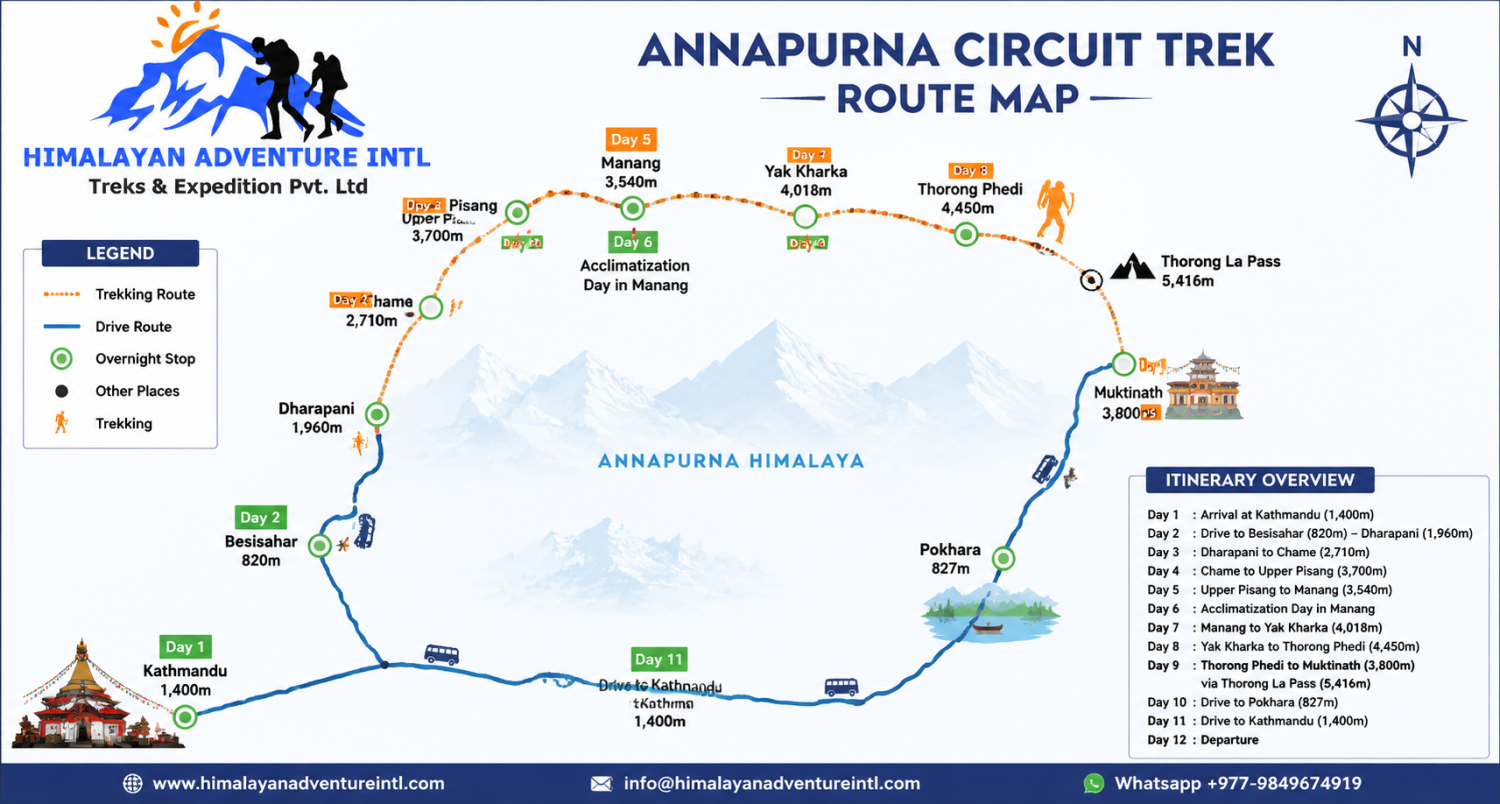
The trek follows the Marsyangdi River Valley before gradually climbing toward the spectacular Manang Valley. After proper acclimatization, trekkers continue to Yak Kharka and Thorong Phedi before crossing the challenging Thorong La Pass at 5,416 meters.
After reaching the summit of the pass, the trail descends to the holy pilgrimage site of Muktinath, continues through the beautiful Kali Gandaki Valley, and ends at Jomsom before returning to Pokhara.
| Trek Information | Details |
|---|---|
| Trek Duration | 12–21 Days |
| Maximum Elevation | 5,416 m |
| Trek Distance | 160–230 km |
| Trek Difficulty | Moderate to Challenging |
| Best Seasons | Spring & Autumn |
| Accommodation | Teahouses |
| Starting Point | Besisahar / Dharapani / Chame |
| Ending Point | Jomsom / Pokhara |
| Highest Pass | Thorong La Pass |
| Region | Annapurna Conservation Area |
The classic trekking route follows this path:
Kathmandu → Besisahar → Dharapani → Chame → Upper Pisang → Ngawal → Manang → Yak Kharka → Thorong Phedi → Thorong La Pass → Muktinath → Kagbeni → Jomsom → Tatopani (optional) → Pokhara.
Trekkers may also include:
Each variation adds extra adventure and incredible scenery.
The greatest achievement of the Annapurna Circuit is reaching Thorong La Pass.
Standing at 5,416 meters above sea level, this breathtaking mountain pass offers panoramic views of:
Watching sunrise from Thorong La is a once-in-a-lifetime experience.
Manang is one of Nepal's most beautiful Himalayan villages.
Surrounded by towering snow-covered peaks, this charming settlement offers:
Trekkers usually spend one extra day here for acclimatization.
Muktinath is one of Nepal's most sacred pilgrimage destinations.
Both Hindus and Buddhists visit this holy temple throughout the year.
Highlights include:
One of the most fascinating parts of the Annapurna Circuit is the opportunity to meet different ethnic communities.
You will pass through villages inhabited by:
Each community has its own traditions, architecture, cuisine, festivals, and way of life.
The Annapurna Circuit offers some of Nepal's finest mountain panoramas.
Major peaks visible include:
Photography enthusiasts will enjoy countless opportunities for spectacular images.
Choosing the right trekking company can make all the difference in your Himalayan experience. At Himalayan Adventure Intl Treks, we are committed to delivering safe, enjoyable, and authentic adventures with a strong focus on personalized service.
Our licensed trekking guides have years of experience leading groups across the Annapurna region. They are trained in mountain safety, altitude awareness, and first aid while sharing local knowledge about culture, history, and nature.
Every traveler has different goals. We offer customized itineraries ranging from 12 to 21 days, with optional side trips to Tilicho Lake, Ice Lake, or even Annapurna Base Camp.
We keep our groups small whenever possible, allowing for a more relaxed pace, better interaction with guides, and a more personalized trekking experience.
We carefully select comfortable teahouses and lodges throughout the trek, ensuring clean rooms, warm hospitality, and nutritious meals to support your journey.
We believe in sustainable travel that benefits local communities and protects the fragile Himalayan environment. Our team encourages eco-friendly practices and supports local businesses along the trekking route.
Our packages are designed with clear inclusions and no hidden charges. Whether you choose a budget, standard, or premium package, you'll know exactly what is included before you book.
Upon arrival at Tribhuvan International Airport, our representative from Himalayan Adventure Intl Treks will warmly welcome you and transfer you to your hotel. After check-in, you will receive a detailed trek briefing, equipment check, and final preparation for your adventure.
Accommodation: Hotel in Kathmandu
After breakfast, travel by road through scenic hills, rivers, and traditional villages. Passing Besisahar and Dharapani, you arrive in Chame, the district headquarters of Manang. Along the way, enjoy views of waterfalls, forests, and the Marsyangdi River.
Driving Time: 8–10 hours
Accommodation: Teahouse
Today's trail winds through fragrant pine forests and crosses suspension bridges before reaching Upper Pisang. Along the way, you'll enjoy stunning views of Annapurna II and the dramatic Paungda Danda rock face.
Walking Time: 5–6 hours
Take the scenic high route through Ghyaru, which offers breathtaking panoramic views of Annapurna, Pisang Peak, and the Manang Valley. Visit ancient monasteries and traditional Tibetan-style villages before reaching Ngawal.
Walking Time: 5–6 hours
A relatively short walk brings you to Manang, passing prayer wheels, mani walls, and cultivated fields. The village is a cultural center of the region and a perfect place to relax before ascending to higher elevations.
Walking Time: 4–5 hours
To reduce the risk of altitude sickness, spend the day exploring the surrounding area. Popular hikes include Gangapurna Lake, Ice Lake, and nearby viewpoints with spectacular Himalayan panoramas. Return to Manang for the night.
The landscape becomes more rugged as you climb above the tree line. Passing yak pastures and alpine meadows, you'll notice the dramatic transition from green valleys to high-altitude terrain.
Walking Time: 4–5 hours
Today's shorter trek prepares you for the highest point of the journey. After reaching Thorong Phedi, rest, hydrate, and prepare for the early morning ascent to Thorong La Pass.
Walking Time: 3–4 hours
Today is the most exciting and challenging day of the Annapurna Circuit Trek. You will begin your hike before sunrise, usually around 3:00–4:00 AM, to avoid strong afternoon winds at Thorong La Pass.
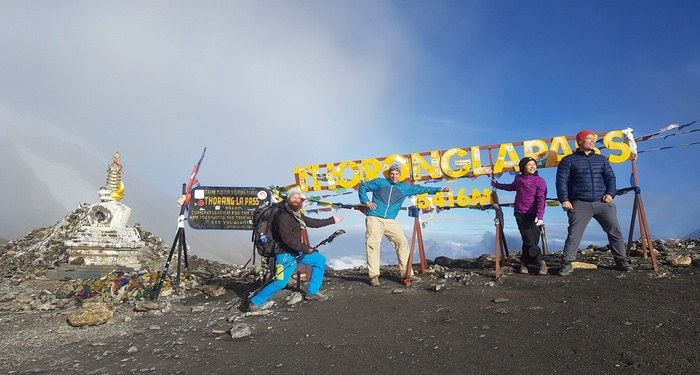
The ascent is gradual but demanding due to the high altitude. After several hours of climbing, colorful prayer flags signal your arrival at Thorong La Pass (5,416m)—the highest point of the trek. Standing here is an unforgettable achievement, with breathtaking panoramic views of the Annapurna and Dhaulagiri ranges, surrounding glaciers, and rugged Himalayan landscapes.
After celebrating and taking photos, descend carefully to the sacred village of Muktinath, an important pilgrimage site for both Hindus and Buddhists. The descent is long but rewarding, with dramatic scenery throughout.
Walking Time: 8–10 hours
Accommodation: Teahouse
After breakfast, descend into the Kali Gandaki Valley, enjoying magnificent views of Nilgiri and Dhaulagiri. Arrive in the ancient village of Kagbeni, known for its narrow stone alleys, traditional Tibetan architecture, and historic monastery. Kagbeni is also the gateway to the restricted Upper Mustang region.
Walking Time: 4–5 hours
Continue along the wide Kali Gandaki River valley to Jomsom, the administrative center of Mustang District. The route passes apple orchards, windswept landscapes, and traditional Thakali villages.
Jomsom is famous for its fresh apples, apple pie, apple cider, and spectacular mountain scenery.
Walking Time: 3–4 hours
Choose either a scenic mountain flight or a comfortable jeep/bus journey to Pokhara. After arriving, relax beside beautiful Phewa Lake, explore Lakeside, or enjoy a celebratory dinner.
Accommodation: Hotel in Pokhara
Return to Kathmandu by tourist bus, private vehicle, or domestic flight. The remainder of the day is free for sightseeing or shopping for souvenirs.
Accommodation: Hotel
After breakfast, Himalayan Adventure Intl Treks will transfer you to Tribhuvan International Airport for your onward journey.
The Annapurna Circuit Trek cost depends on trek duration, group size, transportation, accommodation, and the services included.
Estimated Cost: US$600–900 per person
Includes:
Ideal for budget-conscious travelers.
Estimated Cost: US$900–1,800 per person
Includes:
This is the most popular option among international trekkers.
Estimated Cost: US$2,000–3,500+ per person
Includes:
Perfect for travelers seeking maximum comfort.
Every trekker must obtain the necessary permits before entering the Annapurna Conservation Area.
Current trekking regulations in Nepal require trekkers to travel with a licensed guide. Depending on the latest local procedures, trekkers may need local municipality registration or TIMS-related documentation arranged through their trekking agency.
Himalayan Adventure Intl Treks handles all required permit arrangements for our clients.
Hiring a licensed trekking guide is strongly recommended and is required on many trekking routes under current regulations.
Includes:
A porter allows you to enjoy your trek without carrying a heavy backpack.
One porter usually carries luggage for two trekkers, up to approximately 20–25 kg total.
Tourist Bus:
Shared Jeep:
Private Jeep:
Flight:
Shared Jeep:
Private Jeep:
Meals become more expensive as altitude increases because supplies are transported by porters, mules, or vehicles.
Average prices:
Popular meals include:
Dal Bhat remains the favorite choice because it is nutritious and often comes with free refills.
Teahouses provide comfortable but simple lodging.
Typical room prices:
Facilities generally include:
Private bathrooms are available only in some lower-altitude lodges.
Budget for personal expenses such as:
The complete Annapurna Circuit covers approximately:
Average daily walking distance:
Average trekking time:
| Location | Elevation |
|---|---|
| Kathmandu | 1,350m |
| Chame | 2,670m |
| Upper Pisang | 3,300m |
| Manang | 3,540m |
| Yak Kharka | 4,050m |
| Thorong Phedi | 4,540m |
| Thorong La Pass | 5,416m |
| Muktinath | 3,760m |
| Kagbeni | 2,800m |
| Jomsom | 2,720m |
Spring is one of the most popular trekking seasons.
Highlights:
Autumn offers excellent visibility and comfortable trekking conditions.
Highlights:
Winter trekking is possible for experienced trekkers, but heavy snowfall may temporarily close Thorong La Pass.
The lower sections of the trail receive heavy rain, making trails muddy and increasing the risk of landslides. However, the rain-shadow areas around Manang and Mustang are often drier than other regions of Nepal.
The Annapurna Circuit Trek is considered moderately difficult to challenging.
Main challenges include:
Good physical fitness and proper acclimatization greatly improve your experience.
To reduce the risk of Acute Mountain Sickness (AMS):
Recommended items include:
Himalayan Adventure Intl Treks is a trusted local trekking company dedicated to providing safe, enjoyable, and personalized Himalayan adventures.
We offer:
Our goal is to ensure every traveler enjoys an authentic and memorable Annapurna Circuit experience.
The Annapurna Circuit Trek is much more than a mountain trek—it is a journey through Nepal's extraordinary landscapes, vibrant cultures, and timeless Himalayan traditions. From the lush river valleys of Lamjung to the windswept heights of Thorong La Pass, every day offers new scenery, new friendships, and unforgettable memories.
Whether you're seeking dramatic mountain views, cultural immersion, spiritual experiences at Muktinath, or the satisfaction of completing one of the world's greatest trekking routes, the Annapurna Circuit delivers an adventure unlike any other.
With professional planning, experienced local guides, and personalized service, Himalayan Adventure Intl Treks is ready to help you explore this legendary trail with confidence. Contact us today to customize your itinerary and begin your unforgettable Himalayan journey.
Welcome to Nepal!
Upon your arrival at Tribhuvan International Airport, our friendly representative from Himalayan Adventure Intl Treks will warmly welcome you and transfer you to your hotel in Kathmandu.
After checking into your hotel, you can relax after your international flight or explore the vibrant streets of Thamel, Nepal's famous tourist district. Here you will find trekking gear shops, restaurants, cafés, handicraft stores, and traditional Nepalese culture.
In the evening, our trekking guide conducts a detailed trek briefing covering:
If any trekking equipment is missing, Kathmandu offers excellent opportunities to rent or purchase quality gear.
Accommodation: Tourist Standard Hotel
Driving Time: 9–10 Hours
After breakfast, your Annapurna Circuit adventure officially begins.
The scenic highway leaves Kathmandu and follows the Trishuli River before reaching Dumre. The road continues toward Besisahar, the traditional gateway to the Annapurna Circuit.
From Besisahar, a rugged mountain road takes you deeper into the Marsyangdi Valley by local jeep. The journey passes through:
As the road climbs higher, the landscape changes dramatically with towering cliffs, waterfalls, suspension bridges, dense forests, and roaring rivers.
By evening you arrive at Dharapani, a beautiful village influenced by Tibetan culture.
The first spectacular Himalayan scenery appears here, preparing trekkers for the incredible days ahead.
Meals: Breakfast, Lunch & Dinner
Accommodation: Mountain Tea House
Walking Time: 6 Hours
After breakfast, the trekking trail follows the Marsyangdi River through pine and fir forests.
Today's route passes:
The climb toward Timang rewards trekkers with magnificent views of Manaslu, Lamjung Himal, and surrounding snow-covered peaks.
Traditional stone villages, Buddhist prayer wheels, colorful monasteries, and local yak caravans create an authentic Himalayan atmosphere.
Crossing several suspension bridges and beautiful forests, you finally reach Chame, the headquarters of Manang District.
Chame offers excellent mountain views, natural hot springs nearby, and a peaceful mountain environment.
Visible peaks include:
Meals: Breakfast, Lunch & Dinner
Accommodation: Tea House
Walking Time: 6 Hours
Today's trek enters one of the most scenic sections of the Annapurna Circuit.
Leaving Chame, the trail passes through beautiful pine forests before reaching the impressive Paungda Danda, a massive curved rock face rising nearly 1,500 meters above the valley floor.
The route crosses the Marsyangdi River several times while offering breathtaking panoramas of:
Upon reaching Pisang village, you continue uphill to Upper Pisang, a traditional Tibetan-style settlement.
Upper Pisang is famous for:
The higher route also provides better acclimatization for the coming days.
Meals: Breakfast, Lunch & Dinner
Accommodation: Tea House
Walking Time: 6 Hours
Today's trail follows the famous upper route of the Annapurna Circuit, considered one of the most scenic trekking days.
The trail passes through:
Steep climbs are rewarded with uninterrupted views of:
The villages along today's trail showcase authentic Tibetan architecture, ancient monasteries, prayer flags, mani walls, and local yak pastures.
Before reaching Manang, many trekkers visit the centuries-old Braga Monastery, one of the oldest Buddhist monasteries in the Himalayas.
Finally, you arrive at Manang, a beautiful Himalayan village surrounded by snow-capped mountains.
The afternoon is ideal for a short walk around the village and staying hydrated to prepare for higher elevations.
Meals: Breakfast, Lunch & Dinner
Accommodation: Tea House
Proper acclimatization is essential before crossing Thorong La Pass.
Instead of resting all day, the best strategy is to "climb high and sleep low."
Several excellent hiking options include:
A beautiful turquoise glacial lake located beneath Gangapurna Glacier.
Provides breathtaking panoramic views of:
Experienced trekkers can hike toward Ice Lake for even higher altitude adaptation.
During the day, your guide also discusses:
The afternoon is spent relaxing in Manang while enjoying local bakeries and cafés.
Meals: Breakfast, Lunch & Dinner
Accommodation: Tea House
Walking Time: 5 Hours
Today's trek gradually climbs into the alpine zone.
Vegetation becomes sparse while yaks and blue sheep can often be seen grazing on mountain slopes.
The trail crosses:
Beautiful panoramic views accompany the journey throughout the day.
Visible mountains include:
Upon arrival at Yak Kharka, the peaceful mountain surroundings provide an ideal place to continue acclimatization.
Walking slowly, drinking plenty of water, and eating nutritious meals are strongly recommended.
Meals: Breakfast, Lunch & Dinner
Accommodation: Tea House
Walking Time: 4 Hours
Although today's walking distance is relatively short, altitude makes the trek more demanding.
The trail climbs gently through rocky landscapes before crossing suspension bridges and narrow mountain paths.
Gradually, you reach Thorong Phedi, which literally means "base of the hill."
This small settlement serves as the final overnight stop before crossing Thorong La Pass.
After lunch, trekkers usually rest, hydrate, and prepare their equipment for the early morning departure.
Your guide checks everyone's health condition and explains the next day's challenging ascent.
Early dinner and sufficient sleep are highly recommended.
Meals: Breakfast, Lunch & Dinner
Accommodation: Tea House
Walking Time: 7–8 Hours
Today is the highlight of the Annapurna Circuit Trek.
The journey begins before sunrise, usually around 4:00 AM, allowing trekkers to cross the pass before afternoon winds become strong.
The gradual climb requires patience and a steady pace.
As dawn breaks, the surrounding Himalayan peaks glow with golden light.
After several hours of climbing, you finally reach the legendary Thorong La Pass (5,416m).
Standing atop one of the world's highest trekking passes is an unforgettable achievement.
The summit offers spectacular views of:
Trekkers celebrate with photographs beside colorful prayer flags before beginning the long descent.
The trail descends carefully toward Muktinath, one of Nepal's most sacred pilgrimage destinations for both Hindus and Buddhists.
Here you may visit:
After a memorable day, enjoy a well-deserved overnight stay.
Meals: Breakfast, Lunch & Dinner
Accommodation: Tea House
Driving Time: 6–7 Hours
Following breakfast, begin a scenic drive through the spectacular Kali Gandaki Valley.
The journey passes:
Along the route you'll witness dramatic landscapes, apple orchards, deep gorges, waterfalls, and distant views of Dhaulagiri and Nilgiri.
Upon arrival in Pokhara, check into your hotel and enjoy the comforts of the beautiful lakeside city.
You may spend the evening strolling around Phewa Lake, enjoying cafés, shopping, or relaxing after completing the high mountain section of the trek.
Meals: Breakfast & Lunch
Accommodation: Hotel
Driving Time: Approximately 7 Hours
After breakfast, return to Kathmandu along the scenic Prithvi Highway.
The drive follows the Trishuli River through picturesque hills, farming villages, and terraced landscapes.
Upon arrival, transfer to your hotel.
The remainder of the day is free for:
In the evening, Himalayan Adventure Intl Treks hosts a farewell dinner where you can share memories from your incredible Himalayan journey.
Meals: Breakfast
Accommodation: Hotel
Your unforgettable Annapurna Circuit Trek concludes today.
Depending on your international flight schedule, a representative from Himalayan Adventure Intl Treks will transfer you to Tribhuvan International Airport approximately three hours before departure.
As you leave Nepal, you will carry unforgettable memories of majestic Himalayan mountains, welcoming local communities, colorful monasteries, high mountain passes, and one of the world's greatest trekking adventures.
We sincerely thank you for choosing Himalayan Adventure Intl Treks and look forward to welcoming you again for another incredible journey in Nepal, including Everest Base Camp Trek, Manaslu Circuit Trek, Upper Mustang Trek, Langtang Valley Trek, Annapurna Base Camp Trek, Kanchenjunga Trek, Dolpo Trek, or many other exciting Himalayan adventures.
End of Services
Airport Pick-up and Drops: We'll be there to greet you upon your arrival in Nepal and ensure a smooth transition to your accommodation. Likewise, we'll arrange for your departure transportation, ensuring a hassle-free journey back home.
Meals: Indulge in delicious and nourishing meals throughout your trek, with three meals a day (Breakfast, Lunch, and Dinner) accompanied by a refreshing cup of tea or coffee, providing you with the energy needed for your adventure.
Accommodation: Rest easy in cozy guesthouses (Lodges) during your trekking journey, and enjoy comfortable stays with all necessary amenities provided.
Hotel Stays: Enjoy the warmth of Nepali hospitality with three nights in Kathmandu and one night in Pokhara, where you'll be accommodated with a Bed and Breakfast plan, ensuring a comfortable stay before and after your trek.
Transportation: Travel to Pokhara and Kathmandu in comfort and style, with transportation arrangements made via public Jeep/Bus and tourist Bus respectively, offering you convenience and reliability.
Experienced Guides and Porters: Our team of experienced English-speaking guides and porters will accompany you throughout your journey, providing valuable insights, assistance, and ensuring your safety every step of the way. With a ratio of one guide for every six guests and one porter for every two guests, you can trek with peace of mind.
Government and Local Taxes: We take care of all necessary permits and fees, including National Park Fees and the Trekkers Information Management System (TIMS), so you can focus on enjoying the trekking experience.
Medical Kit and Insurance: Your safety is our priority, which is why we provide a comprehensive medical kit box and insurance coverage for our guides and porters during the trek, along with additional services as per your requirements.
The Annapurna Circuit Trek is one of the world's greatest trekking routes, circling the Annapurna mountain range in central Nepal. The trek combines beautiful forests, waterfalls, alpine valleys, Tibetan-influenced villages, glaciers, and the famous Thorong La Pass at 5,416 meters. It is suitable for adventurous trekkers seeking both natural beauty and cultural experiences.
The trek follows a circular route around the Annapurna Himalaya rather than going to a single destination and returning the same way. Trekkers travel through the Marsyangdi Valley, cross Thorong La Pass, descend into Mustang, and continue through the Kali Gandaki Valley, completing a full circuit around the Annapurna massif.
The Annapurna Circuit Trek is considered a moderately challenging to strenuous trek. Daily walking usually ranges from 5 to 8 hours. The highest point, Thorong La Pass (5,416m), requires good physical fitness, proper acclimatization, and a slow walking pace. Previous trekking experience is helpful but not essential.
The classic Annapurna Circuit Trek usually takes 12–18 days, depending on your itinerary. Shorter itineraries include jeep transportation, while longer itineraries allow more acclimatization and visits to additional attractions such as Tilicho Lake or Ice Lake.
The best trekking seasons are:
Spring (March–May):
Autumn (September–November):
Winter (December–February) is possible but colder, while the monsoon season (June–August) brings rain, slippery trails, and occasional landslides.
rekkers need an Annapurna Conservation Area Permit (ACAP).
Permit regulations may change according to Nepal Tourism Board and Nepal Government rules, so Himalayan Adventure Intl Treks always arranges the latest required permits before your trek.
Hiring a professional licensed guide is highly recommended for safety, navigation, and cultural interpretation.
Guide Cost:
The guide fee generally includes the guide's salary, meals, accommodation, insurance, and government taxes unless otherwise stated in your package.
Hiring a porter allows you to enjoy your trek without carrying a heavy backpack.
Porter Cost:
A porter usually carries up to 20–25 kg, shared between two trekkers whenever possible.
A porter-guide performs both guiding and porter duties on easier trekking routes.
Porter-Guide Cost:
This option is ideal for budget-conscious trekkers who need basic guidance while reducing overall trekking costs.
Yes. Himalayan Adventure Intl Treks provides experienced, government-licensed female trekking guides for solo women, couples, families, and groups.
Female Guide Cost:
Many female travelers prefer trekking with female guides for comfort, cultural understanding, and personal preference.
Absolutely.
Himalayan Adventure Intl Treks provides experienced guides speaking:
Language Guide Cost:
The price depends on the language and guide availability.
Yes.
Because Thorong La Pass reaches 5,416 meters, altitude sickness (AMS) is one of the most important considerations.
Common symptoms include:
Your guide monitors your health daily and follows proper acclimatization procedures to minimize risks.
Good prevention includes:
Proper acclimatization greatly increases the chances of safely crossing Thorong La Pass.
Most trekkers stay in comfortable mountain tea houses.
Rooms generally include:
Higher elevations offer more basic facilities, but the hospitality remains warm and welcoming.
Tea houses provide a surprisingly wide variety of meals.
Popular choices include:
Dal Bhat is highly recommended because it provides unlimited refills in many lodges and excellent energy for trekking.
Yes.
Trekkers can obtain drinking water by:
Using reusable bottles helps reduce plastic waste and protects the fragile Himalayan environment.
Typical transportation includes:
Most itineraries begin with a drive from Kathmandu to Besisahar and continue by jeep to Dharapani. After completing the trek, travelers usually drive from Muktinath or Jomsom to Pokhara before returning to Kathmandu.
Yes.
Comprehensive travel insurance is strongly recommended.
Your policy should cover:
Insurance provides peace of mind during your Himalayan adventure.
A good packing list includes:
Clothing
Footwear
Equipment
Packing light while carrying all essential gear will make your trek more comfortable and enjoyable.
Yes. Beginners with good physical fitness and determination can successfully complete the Annapurna Circuit Trek. We recommend preparing with regular walking, hiking, jogging, cycling, or stair climbing for at least 6–8 weeks before your trip. Himalayan Adventure Intl Treks designs itineraries with proper acclimatization to help first-time trekkers safely enjoy the adventure.
Yes. Solo travelers are welcome to join our scheduled departures or book a private trek. Since Nepal now requires foreign trekkers in many trekking areas to trek with a licensed guide, hiring a professional guide is the safest and most convenient option. Joining a group also reduces transportation costs and allows you to meet fellow trekkers from around the world.
The highest point is Thorong La Pass (5,416m / 17,769 ft). It is one of the highest trekking passes in the world. Most trekkers begin the ascent before sunrise to enjoy stable weather and avoid strong afternoon winds. Reaching the summit is one of the greatest achievements of the trek.
Thorong La Pass is physically demanding because of the high altitude, but it is not a technical climb. The trail is well-established and can be completed safely by trekkers who are properly acclimatized, walk at a steady pace, and follow their guide's instructions.
Yes. Many trekkers choose to include Tilicho Lake (4,919m), one of the world's highest alpine lakes. Adding Tilicho Lake usually requires an additional 2–3 trekking days and offers spectacular scenery, making the adventure even more rewarding.
Yes. Many tea houses offer Wi-Fi services, especially in larger villages such as Chame, Manang, and Muktinath. Internet speed varies depending on the location and weather. Some lodges charge a small fee for internet access.
Yes. Most tea houses provide charging facilities. At lower elevations charging is often free, while higher villages may charge a small fee because electricity is supplied by solar power or small hydroelectric systems. Carrying a power bank is highly recommended.
ATMs are available in Kathmandu, Pokhara, and Besisahar. After entering the higher mountain region, reliable ATM services become very limited. It is best to withdraw enough Nepalese Rupees before starting the trek to cover personal expenses.
Weather varies with season and altitude.
Checking the latest weather forecast before departure is always recommended.
The Annapurna Conservation Area is rich in biodiversity. Trekkers may encounter:
If you're lucky, you may even spot the elusive snow leopard from a distance, although sightings are extremely rare.
The Annapurna Circuit passes through villages inhabited by Gurung, Manangi, and Thakali communities. Along the route you will experience:
These cultural encounters are one of the highlights of the trek.
Your guide is trained to monitor your health and respond to emergencies. If severe altitude sickness or another medical problem occurs, the guide will arrange the safest descent and, if necessary, organize helicopter evacuation through your travel insurance provider. Comprehensive insurance covering high-altitude rescue is strongly recommended.
Yes. Families with active teenagers and children who enjoy hiking can complete the trek with proper preparation. A slower itinerary, additional acclimatization days, and experienced guides make the journey safer and more enjoyable for families.
Absolutely. Many trekkers in their 50s, 60s, and even 70s successfully complete the Annapurna Circuit each year. Good physical health, adequate training, and a carefully planned itinerary are more important than age. Himalayan Adventure Intl Treks can customize the pace to suit your fitness level.
Personal expenses vary, but many trekkers budget around USD 10–12 per day for drinks, snacks, Wi-Fi, charging, hot showers, souvenirs, and other personal purchases. Carrying enough cash is important because digital payment facilities are limited in the mountains.
Tipping is not compulsory, but it is a respected tradition in Nepal and a meaningful way to thank your trekking team for their hard work. The amount depends on your satisfaction, group size, and trip duration.
Himalayan Adventure Intl Treks offers:
Our goal is to provide safe, memorable, and authentic Himalayan adventures for every traveler.
We organize a wide range of services, including:
We can also tailor itineraries to match your schedule, budget, and interests.
Booking with Himalayan Adventure Intl Treks is simple. Contact our team with your preferred travel dates, group size, and trekking requirements. We will provide a detailed itinerary, quotation, packing information, permit guidance, and pre-departure support. Once your booking is confirmed, our experienced team will handle all logistics so you can focus on enjoying your Himalayan adventure.
Whether you are looking for a budget trek, a private guided tour, a luxury trekking experience, or a customized Round Annapurna itinerary, Himalayan Adventure Intl Treks is ready to help you create unforgettable memories in the Himalayas.
| Service | Cost |
|---|---|
| Licensed Trekking Guide | USD 30 per day |
| Female Trekking Guide | USD 30 per day |
| Porter | USD 20 per day |
| Porter Cum Guide | USD 25 per day |
| Language Speaking Guide | USD 50–90 per day |
| Annapurna Conservation Area Permit (ACAP) | Rs 3000 per person Asian Rs 1000 |
The Annapurna Circuit Trek remains one of the finest trekking experiences on Earth, combining dramatic mountain scenery, rich Himalayan culture, and the unforgettable challenge of crossing Thorong La Pass (5,416m). With experienced guides, reliable logistics, and personalized service, Himalayan Adventure Intl Treks is committed to making your journey safe, enjoyable, and memorable from arrival in Nepal to your final departure.
Thorong La Pass is a major highlight of the Annapurna Circuit, offering breathtaking views and a significant achievement for trekkers crossing one of the highest passes in the world.
Yes, you can extend your trek by adding extra days at various points or taking detours to explore additional areas. Discuss your plans with your guide or agency.
Comprehensive travel insurance covering trekking at high altitudes, medical emergencies, and evacuation is highly recommended for the Annapurna Circuit Trek.
Acclimatize by ascending gradually, taking rest days, and staying hydrated. Proper acclimatization helps minimize the risk of altitude sickness.
Respect local customs by dressing modestly, asking for permission before taking photos, and following local practices. Show respect to religious sites and traditions.
Yes, gear can be rented in Kathmandu or Pokhara. It’s important to ensure the gear is of good quality and suitable for the trek’s conditions.
Sturdy, well-fitted trekking boots with ankle support and good grip are ideal for the Annapurna Circuit. Waterproof and breathable boots are also recommended.
Trekking with children requires careful planning, ensuring they are physically prepared and acclimatized. Shorter daily distances and frequent rest breaks are advisable.
Wildlife includes various bird species, Himalayan tahr, and sometimes snow leopards in the higher regions. Respect wildlife and observe from a distance.
Follow Leave No Trace principles, dispose of waste properly, avoid disturbing wildlife, and support eco-friendly practices in local teahouses and lodges.
The trek provides economic benefits to local communities through tourism, supporting local businesses and providing jobs. It also fosters cultural exchange between trekkers and locals.
Emergency evacuation services are available, often through helicopter rescue. Ensure your travel insurance covers emergency evacuation and medical expenses.
A guide assists with navigation, provides cultural insights, ensures safety, and helps with acclimatization. They enhance the overall trekking experience and address any issues that arise.
Yes, you can combine the Annapurna Circuit with other treks like the Annapurna Base Camp or Gosaikunda Trek. Discuss your plans with a trekking agency for a customized itinerary.
Health and hygiene conditions vary. Basic facilities are available in teahouses, but it’s essential to maintain personal hygiene and use purified water to avoid illness.
Prepare for unexpected weather by packing versatile clothing, including waterproof and windproof layers. Stay informed about weather conditions and be ready to adapt.
Average altitude gain varies but generally ranges from 300-800 meters (1,000-2,600 feet) per day, with gradual ascents to allow for acclimatization.
If experiencing altitude sickness, descend to a lower altitude, rest, stay hydrated, and seek medical attention if necessary. Inform your guide immediately.
Yes, notable sites include monasteries in Manang and Braga, Hindu and Buddhist temples, and traditional village landmarks reflecting the region's cultural heritage.
Accommodation ranges from basic teahouses to more comfortable lodges. Rooms typically have basic amenities, with higher-end options available in some areas.
Charging facilities are available in most teahouses, but bring a portable power bank as backup. Be aware that power availability might be limited at higher altitudes.
Common issues include altitude sickness, digestive problems, and cold-related ailments. Proper preparation and acclimatization can help mitigate these risks.
The best seasons are spring (March to May) and autumn (September to November) when weather conditions are generally stable and visibility is clear.
Common options include domestic flights to Pokhara or a bus ride from Kathmandu. From Pokhara, you can reach the starting point via a short drive or jeep ride.
Yes, trekking on a budget is possible by staying in basic teahouses, eating local food, and using public transportation. Plan and budget accordingly for a cost-effective trek.
Yes, follow regulations like waste disposal practices, respecting wildlife, and supporting local conservation efforts to minimize environmental impact.
Daily trekking durations range from 5 to 7 hours, depending on the stage of the trek and the distance to be covered.
Essential items include layered clothing, trekking boots, a sleeping bag, a rain jacket, a hat, gloves, sunscreen, a first aid kit, and a water bottle.
Gradual ascent, proper acclimatization, hydration, and listening to your body’s signals are crucial in avoiding altitude sickness.
Basic medical facilities are available in some villages, with more comprehensive services in major towns like Manang. For severe issues, evacuation may be necessary.
Tourism has both positive and negative impacts, including economic benefits and environmental stress. Sustainable practices and supporting local communities help mitigate negative effects.
Yes, visiting local villages is part of the trek. It provides opportunities to experience traditional lifestyles, customs, and hospitality of the local communities.
Treatment includes descending to a lower altitude, rest, hydration, medication (like Diamox), and seeking medical attention if symptoms persist or worsen.
Yes, private treks can be arranged with trekking agencies, offering customized itineraries, personal guides, and specific dates according to your preferences.
Risks include altitude sickness, unpredictable weather, and challenging terrain. Proper preparation, acclimatization, and safety measures help manage these risks.
Yes, but it’s important to inform your guide or trek organizer in advance to ensure suitable food arrangements are made to accommodate your dietary needs.
Drink plenty of water and use purification tablets or filters. Refill your water bottle at teahouses along the route and monitor your hydration levels regularly.
Yes, you need an Annapurna Conservation Area Permit (ACAP) and a Trekkers' Information Management System (TIMS) card. These can be obtained in Kathmandu or Pokhara.
Descend to a lower altitude, rest, stay hydrated, and use altitude sickness medication if necessary. Consult a medical professional if symptoms are severe.
Yes, the trek offers numerous opportunities for cultural exchange with local communities, allowing you to learn about their traditions, lifestyles, and languages.
Recommended vaccinations include Hepatitis A and B, Typhoid, and Tetanus. Consult a travel health clinic for personalized advice based on your medical history and current health.
Credit cards are not widely accepted on the trek, so carry cash for transactions. Ensure you have enough cash for teahouse stays, food, and any other expenses.
Adjust to the local time zone gradually, stay hydrated, and get plenty of rest before starting the trek. Allow a day or two in Kathmandu or Pokhara to acclimate.
Prepare mentally by setting realistic goals, researching the trek, and visualizing the experience. Developing a positive mindset and resilience is key to handling challenges.
Previous trekking experience is beneficial, especially if you’ve trekked at high altitudes. However, all trekkers should prepare adequately for the Annapurna Circuit’s demands.
Options include domestic flights to Pokhara followed by a drive or jeep to the trek starting point. Buses and private vehicles are also available for the journey.
Recommended guides include "Trekking in Nepal: A Traveler's Guide" by Brad & Jenny Brown and "The Trekker’s Guide to the Annapurna Circuit" by Philip Baines.
Essential items include thermal clothing, a good quality sleeping bag, insulated gloves, a warm hat, and proper waterproof gear. Be prepared for snow and cold temperatures.
Yes, solo trekking is possible but requires careful planning. Consider hiring a guide or joining a group trek for safety and logistical support.
Wildlife sightings may include the Himalayan tahr, blue sheep, and various bird species. Keep an eye out for these animals as you trek through the region.
Typical food includes Nepali dishes like dal bhat, momo, and Tibetan specialties such as thukpa. Western options may also be available in some teahouses.
Yes, additional permits may be required for trekking beyond the Annapurna Circuit, such as in the Manaslu or Upper Mustang regions. Check specific requirements with your trek organizer.
Notable viewpoints include Thorong La Pass, Poon Hill, and the villages of Manang and Braga, offering spectacular views of the Annapurna and Dhaulagiri ranges.
The Annapurna Circuit is renowned for its diverse landscapes and cultural experiences, offering a more varied trek compared to other routes like Everest Base Camp or Langtang Valley.
A guide provides local knowledge, navigational assistance, safety, and cultural insights, enhancing your trekking experience and helping to manage logistics and emergencies.
Challenges include high altitude, variable weather, and demanding terrain. Adequate preparation and acclimatization are crucial for a successful trek.
Support local communities by staying in teahouses, eating local food, and purchasing handicrafts. Respect cultural practices and contribute to local conservation efforts.
English is commonly spoken in teahouses and by guides. However, learning a few basic Nepali phrases can enhance interactions with locals and enrich your experience.
The trek typically lasts 12 to 18 days, depending on the itinerary, pace, and any additional side treks or acclimatization days included.
Prepare physically with regular cardio and strength training, focusing on endurance and leg strength. Gradual acclimatization and pacing yourself during the trek are also important.
Key safety tips include acclimatizing properly, monitoring weather conditions, carrying a first aid kit, staying hydrated, and following local advice on safety and health.
The Annapurna Circuit Trek is one of the world's greatest trekking adventures, offering an unforgettable journey through diverse landscapes, ancient villages, lush forests, alpine meadows, and the spectacular Thorong La Pass (5,416m). This legendary trek circles the Annapurna Massif, allowing trekkers to experience Nepal's rich culture, breathtaking Himalayan scenery, and unique biodiversity.
Unlike many other trekking routes, the Annapurna Circuit passes through subtropical forests, waterfalls, deep river valleys, apple orchards, Buddhist monasteries, Tibetan-influenced villages, and high Himalayan deserts before descending into the sacred pilgrimage town of Muktinath.
Whether you are an experienced hiker or a first-time trekker looking for an adventurous challenge, Himalayan Adventure Intl Treks offers flexible trekking packages designed for solo travelers, couples, families, students, researchers, photographers, bird watchers, and large groups.
The Annapurna Circuit remains Nepal's most famous trekking route because it offers an incredible combination of adventure, culture, scenery, wildlife, and local hospitality.
Unlike Everest Base Camp, this trek changes dramatically every day. You begin in green river valleys and gradually enter high alpine landscapes before crossing one of the world's highest trekking passes.
Trekkers also enjoy comfortable teahouse accommodation, delicious local meals, and excellent trekking infrastructure, making the journey enjoyable without requiring camping.
Himalayan Adventure Intl Treks carefully plans each itinerary with enough acclimatization days to reduce the risk of altitude sickness while allowing you to enjoy every destination.
A typical Annapurna Circuit Trek starts with a drive from Kathmandu to Besisahar and then continues by local jeep to Dharapani or Chame.
Popular trekking route:
Some trekkers also include Tilicho Lake, extending the trek by 3–4 days.
Every foreign trekker must obtain trekking permits before entering the Annapurna Conservation Area.
Your permit allows entry into the Annapurna Conservation Area and supports conservation projects, trail maintenance, and local communities.
Himalayan Adventure Intl Treks arranges all permits before your trek begins.
Hiring an experienced guide makes your trek safer, easier, and more enjoyable.
Guide Cost: $30 per day
Guide services include:
Professional guides also explain local culture, Buddhist traditions, Himalayan wildlife, and village history.
Many solo women and families prefer trekking with female guides.
$30 per day
Our female trekking guides are licensed, experienced, friendly, and highly trained in mountain safety and first aid.
Female guides provide the same professional service as male guides while offering additional comfort for female travelers.
Hiring a porter allows you to enjoy the trek without carrying a heavy backpack.
$20 per day
One porter can comfortably carry luggage for two trekkers up to approximately 20 kg.
Porters are fully insured, experienced, and equipped for high-altitude trekking.
For budget travelers, a porter-guide is an excellent option.
$25 per day
Services include:
This option is ideal for experienced trekkers seeking an economical trekking experience.
Himalayan Adventure Intl Treks provides professional multilingual trekking guides.
$50–90 per day
Languages available include:
These guides enhance your trekking experience by offering detailed cultural and historical insights in your preferred language.
Transportation depends on your comfort level and budget.
Public Bus
Comfortable tourist or local buses depart daily.
Ideal for families, photographers, and private groups.
Benefits include:
Road conditions vary according to the season.
Private jeeps are recommended during the monsoon season and for families or luxury trekking groups.
The Annapurna Circuit offers excellent teahouse accommodation throughout the route.
Daily food and accommodation cost:
$35–45 per person
This usually includes:
Breakfast
Lunch
Dinner
Comfortable room
Tea houses become more basic at higher elevations, but they remain clean, warm, and welcoming.
Typical meals include:
Trekkers should budget for small extra expenses.
Average additional cost:
Approximately $5 per day
Includes:
These services become more expensive at higher elevations because electricity is generated by solar power or transported fuel.
Most villages provide comfortable mountain lodges with:
Higher villages have more basic facilities but spectacular mountain scenery.
Choosing a reliable trekking company makes a significant difference to your Himalayan adventure.
Our services include:
Our experienced team prioritizes your safety, comfort, and satisfaction from arrival in Kathmandu until your departure from Nepal.
The Annapurna Circuit Trek is open throughout the year, but each season offers a different experience. Choosing the right season depends on your preferences for weather, scenery, and trekking conditions.
Spring is considered one of the best times to trek the Annapurna Circuit. The weather is stable, temperatures are pleasant, and the mountain views are exceptionally clear. Rhododendron forests bloom with vibrant red, pink, and white flowers, creating colorful landscapes.
Advantages of Spring:
Spring is highly recommended for first-time trekkers, families, and photographers.
Autumn is the most popular trekking season in Nepal. After the monsoon rains, the skies become clear, the air is fresh, and visibility is outstanding.
Why Choose Autumn?
Autumn is perfect for solo travelers, couples, and organized groups.
Winter transforms the Annapurna region into a snowy wonderland. The trails are quieter, offering a peaceful trekking experience.
Winter Advantages
Trekkers should be prepared for freezing temperatures, particularly near Thorong La Pass. Warm clothing and proper equipment are essential.
Although monsoon brings regular rainfall to lower elevations, the upper Manang and Mustang regions remain relatively dry because they lie in the Himalayan rain shadow.
Monsoon Highlights
Transportation may occasionally be affected by road conditions, but experienced guides can adjust the itinerary as needed.
Himalayan Adventure Intl Treks offers flexible packages suitable for every type of traveler.
Traveling alone does not mean trekking alone. Our private guide service ensures safety, flexibility, and personalized attention.
Package Includes
This package is ideal for independent travelers seeking a safe and rewarding adventure.
Already planning your own accommodation and transportation? Choose our Guide and Permit Package.
Package Includes
This is an affordable option for experienced trekkers who want professional guidance without a full-service package.
Budget-conscious trekkers often choose a porter-guide who carries luggage while providing basic navigation and local assistance.
Cost
Best For
Joining a group is one of the most economical ways to experience the Annapurna Circuit.
Our fixed departure groups include trekkers from around the world, creating opportunities to make new friends while reducing overall costs.
Benefits
Couples enjoy a more personalized experience with flexible itineraries and private services.
Package Features
This package is perfect for honeymooners, anniversaries, or couples seeking an unforgettable Himalayan adventure.
Educational institutions frequently organize trekking trips for learning and adventure.
Our student packages include:
Student groups receive special pricing based on group size.
Researchers studying geology, climate, biodiversity, anthropology, ecology, or Himalayan culture can benefit from customized expedition support.
Our services include:
Himalayan Adventure Intl Treks has experience assisting academic institutions, universities, and scientific research teams.
Small groups of 4–10 trekkers enjoy personalized service while sharing transportation and guide costs.
Advantages
Large groups receive professional logistical support throughout the journey.
Our large-group services include:
Ideal for:
The Annapurna Conservation Area is Nepal's largest protected area and a paradise for bird enthusiasts.
More than 450 bird species have been recorded in the region.
Common birds include:
Spring and autumn are the best seasons for bird watching.
Experienced nature guides can be arranged upon request.
The Annapurna region is equally famous for its rich plant diversity.
Trekkers encounter:
Spring is the ideal season for botanical enthusiasts because thousands of flowering plants bloom across the hillsides.
Botanical tours can be customized for universities, researchers, photographers, and nature lovers.
As the trek reaches elevations above 5,000 meters, proper acclimatization is essential.
Our guides are trained in first aid and mountain rescue procedures and monitor trekkers carefully throughout the journey.
Essential items include:
Packing light while bringing quality gear will make your trek more comfortable.
Himalayan Adventure Intl Treks is committed to delivering safe, enjoyable, and professionally organized trekking experiences.
Whether you are planning a solo adventure, a romantic trek for two, a university research expedition, or a large group journey, our experienced team ensures every detail is handled with professionalism and care.
The Annapurna Circuit Trek remains one of Nepal's most iconic trekking adventures, combining dramatic mountain scenery, diverse landscapes, rich Himalayan culture, and unforgettable experiences. From the lush valleys of Besisahar to the challenging crossing of Thorong La Pass (5,416m) and the sacred pilgrimage site of Muktinath, every day offers something new to discover.
With flexible packages for solo trekkers, couples, students, families, researchers, bird watchers, botanists, and large groups, Himalayan Adventure Intl Treks provides reliable services tailored to every travel style and budget. Our licensed guides, experienced porters, transparent pricing, and commitment to safety ensure you can focus on enjoying the journey.
Book your Annapurna Circuit Trek with Himalayan Adventure Intl Treks and experience the beauty, culture, and adventure of the Himalayas with a trusted local trekking company dedicated to making your trip safe, memorable, and truly exceptional.