
Have Questions? Talk to Expert (Binod)

Khopra Danda Trek in Winter is one of Nepal's most rewarding off-the-beaten-path Himalayan adventures. Located in the Annapurna region, the trek combines peaceful mountain trails, traditional villages, beautiful forests, spectacular sunrise and sunset views, and magnificent panoramas of the Annapurna and Dhaulagiri mountain ranges.
While the popular Annapurna Base Camp and Annapurna Circuit trails can become busy during the trekking seasons, Khopra Danda in winter offers a quieter and more peaceful Himalayan experience. From December to February, the mountain scenery is often exceptionally clear, with brilliant blue skies, fresh snow, and outstanding views of high peaks.
The winter season also makes the trek more demanding. Temperatures can fall well below freezing at higher elevations, snow and ice may cover sections of the trail, and daylight hours are shorter. Proper clothing, a suitable sleeping bag, good footwear, experienced local guides, and careful planning are therefore essential.
At Himalayan Adventure Intl Treks, we organize customized Khopra Danda and Khayar Lake winter trekking packages with experienced guides, porters, transportation, accommodation, permits, and other necessary arrangements. Travelers can choose from Budget, Deluxe, and Luxury packages depending on their comfort level and travel preferences.
Winter is a particularly attractive time to visit Khopra Danda for travelers who prefer peaceful trails and dramatic mountain scenery.
From December through February, the atmosphere is generally dry and clear. On good-weather days, the visibility can be excellent, allowing trekkers to see the snow-covered Himalayan peaks stretching across the horizon.
The biggest advantages of a winter Khopra Danda trek include:
The winter landscape transforms the Annapurna region. Rhododendron forests become quiet and sometimes snow-covered, mountain ridges appear dramatically white, and the high Himalayan peaks stand against deep blue skies.
For photographers and nature lovers, winter can be one of the most beautiful periods of the year.
Understanding winter weather is one of the most important parts of planning this trek.
At lower elevations, sunny daytime temperatures can be relatively comfortable, generally around 5°C to 10°C, depending on altitude, weather, and exposure to the sun.
At higher elevations, however, the temperature can remain close to freezing even during the daytime.
Temperatures fall considerably after sunset. Around Khopra Danda and other higher sections, nighttime temperatures may reach approximately -15°C to -18°C or lower during particularly cold periods.
A quality four-season sleeping bag is therefore highly recommended.
Lower trails may initially be dry, dusty, or firm. As the trek reaches higher elevations, especially around viewpoints and ridges, trekkers may encounter:
Conditions vary considerably from one year to another. Local guides assess trail conditions and help determine whether additional equipment such as microspikes or light crampons is required.
Winter days are shorter. Sunset can be around 5:15 PM, so trekkers should avoid starting long walking days late.
At Himalayan Adventure Intl Treks, we recommend starting trekking days early, normally around 7:00 AM, so that walking can be completed before darkness and the coldest evening conditions.
The exact itinerary can be customized according to the trekker's available time, physical condition, weather, and whether Khayar Lake is included.
A typical Khopra Danda adventure begins in Kathmandu and continues by road to Pokhara. From Pokhara, transportation takes trekkers toward the trailhead.
The trek then passes through traditional villages, forests, terraced hillsides, and high Himalayan landscapes before reaching Khopra Ridge.
A typical route can include:
Kathmandu → Pokhara → Trek Starting Point → Ghandruk/nearby villages → Chistibung → Khopra Danda → Khayar Lake optional → Khopra Danda → Swanta/Sikha area → Tatopani → Pokhara → Kathmandu
The exact route can be modified according to trail conditions and accommodation availability.
Khopra Danda, also known as Khopra Ridge, is the major highlight of the trek.
From the ridge, trekkers can enjoy impressive views of some of the most famous mountains in the Annapurna and Dhaulagiri regions.
Depending on weather and visibility, the panorama may include:
Standing on Khopra Ridge during winter, with snow-covered mountains rising dramatically across the horizon, is an unforgettable Himalayan experience.
Sunrise and sunset are particularly beautiful here. Early morning light gradually illuminates the Himalayan peaks, while evening sunlight creates changing colors across the snowy mountains.
For adventurous trekkers, the Khopra Danda itinerary can be extended toward Khayar Lake, one of the region's fascinating high-altitude destinations.
Khayar Lake lies at a significantly higher elevation than Khopra Danda. During winter, the trail can become challenging because of snow and ice.
The journey requires careful planning and should only be undertaken when weather and trail conditions are considered safe by the local trekking team.
Winter Khayar Lake offers:
Because conditions can change quickly at high elevations, the decision to continue toward Khayar Lake should be based on the actual weather, snow conditions, trekker fitness, and advice from the experienced guide.
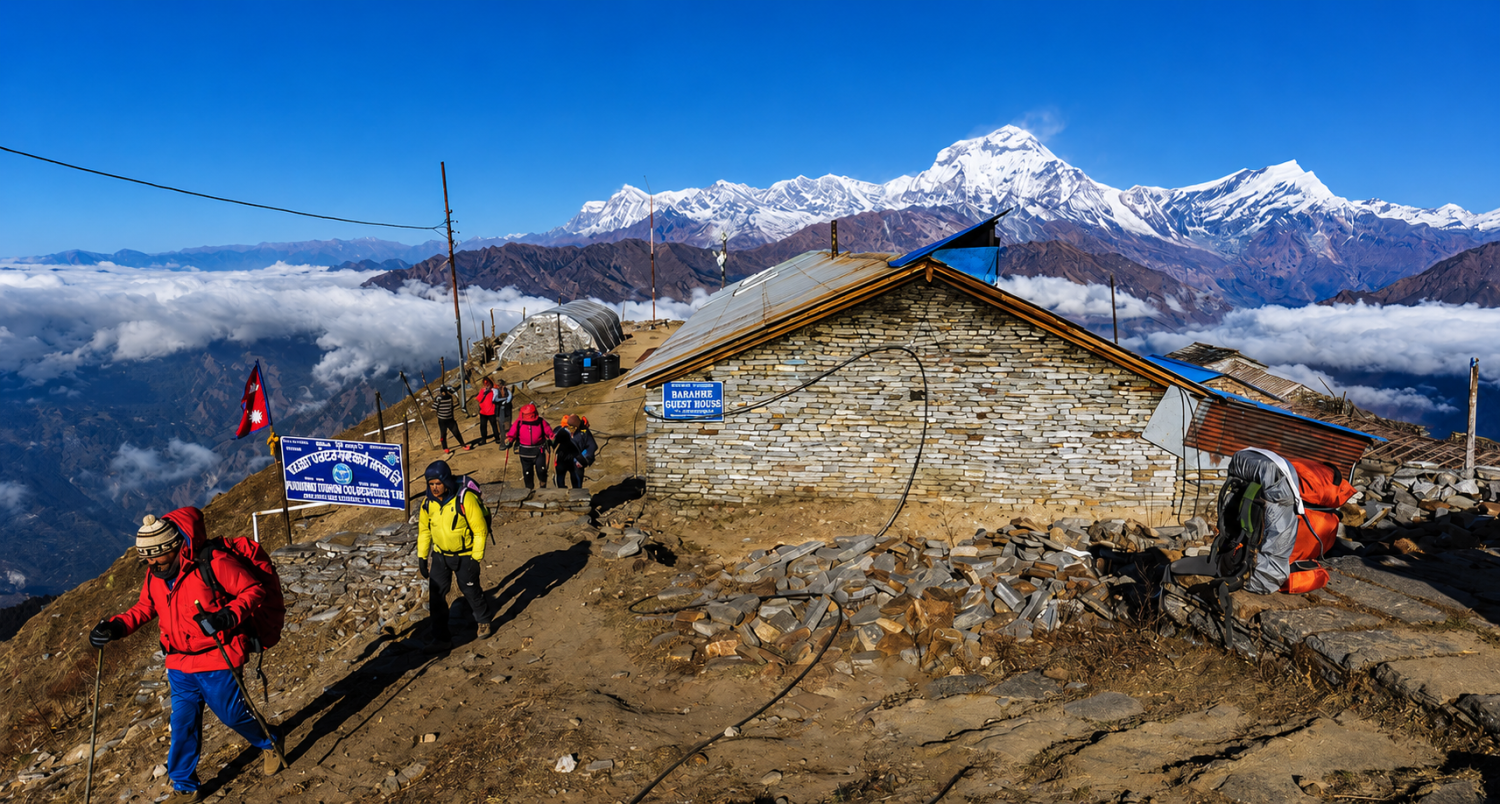
The Khopra Danda Trek is generally considered a moderate to challenging Himalayan trek, particularly in winter.
The difficulty increases because of:
Trekkers should have reasonable cardiovascular fitness and be comfortable walking for several hours on consecutive days.
Previous trekking experience is helpful but not always essential. Beginners with good fitness can also undertake the trek with an experienced guide and a properly planned itinerary.
Altitude should always be taken seriously in the Himalayas.
Even physically fit trekkers can experience altitude-related problems. Symptoms can include headache, tiredness, dizziness, nausea, reduced appetite, or difficulty sleeping.
The best approach is prevention.
Our trekking team recommends:
A guide should never encourage a trekker to continue upward when significant altitude symptoms are present.
The Himalayan Adventure Intl Treks team monitors trekkers throughout the journey and adjusts the itinerary when necessary.
Packing correctly is particularly important for a winter trek.
We recommend bringing:
Layering is better than carrying one extremely heavy garment because trekkers can adjust clothing according to changing temperatures.
A four-season down sleeping bag rated to approximately -20°C is strongly recommended for winter Khopra Danda.
Although teahouses generally provide blankets, a personal high-quality sleeping bag provides important additional warmth.
Good footwear is essential.
Bring:
The guide will advise whether traction equipment is necessary according to current trail conditions.
Bring:
Cold temperatures can reduce battery performance. Camera batteries and power banks should therefore be protected from extreme cold, especially overnight.
The trek uses local teahouses and mountain lodges.
Lower and middle-altitude villages generally have more accommodation choices. At higher elevations, facilities are simpler.
During winter, most main trekking lodges continue operating, although some high-altitude teahouses may close during particularly cold periods or late winter.
Accommodation generally includes:
Facilities become more basic as the altitude increases.
Travelers selecting a Deluxe or Luxury package can enjoy better hotel accommodation in Kathmandu and Pokhara and upgraded arrangements wherever practical during the trek.
Food is an important part of maintaining energy during a winter trek.
Teahouses normally serve traditional and international trekking meals such as:
Dal Bhat is particularly popular among trekkers because it provides carbohydrates, protein, and energy for long walking days.
During winter, warm soups, tea, and other hot meals are especially valuable.
The estimated food and accommodation cost during the trek is approximately US$35–40 per person per day, depending on the selected arrangements and package.
A professional local guide can make a significant difference on a winter Khopra Danda trek.
Our experienced guides assist with:
Our standard guide cost is approximately:
US$30 per day
A female trekking guide is available on request at approximately US$30 per day.
Female guides can be particularly appreciated by solo female travelers, families, and groups who prefer a female trekking professional.
For travelers who require a guide who speaks a particular international language, we can arrange a language-speaking guide.
Estimated cost:
US$50–70 per day
The exact price depends on the language and guide availability.
A porter allows trekkers to walk with a lighter daypack while the main luggage is carried between overnight stops.
Our porter service costs approximately:
US$20 per day
We recommend packing responsibly and keeping the total luggage weight within an appropriate porter load.
For travelers seeking a lower-cost option, we can also arrange a porter-cum-guide at approximately US$25 per day, subject to availability and itinerary requirements.
Transportation can be arranged according to the traveler's selected package.
Tourist bus transportation from Kathmandu to Pokhara generally costs approximately:
US$15–20 per person one way
Private transportation can also be arranged for travelers seeking greater comfort, privacy, or flexibility.
Transportation from Pokhara toward the trek starting point by public transport is approximately:
US$7–10 per person
Private vehicles can be arranged for Deluxe and Luxury travelers or groups that prefer greater convenience.
Khopra Danda lies within the Annapurna Conservation Area, so trekkers require the appropriate Annapurna Conservation Area Permit (ACAP).
As part of our current trekking arrangements, the ACAP permit cost is:
Permit requirements and government fees can change, so our team confirms the applicable requirements when arranging the trek.
Himalayan Adventure Intl Treks can arrange the required trekking permits on behalf of our guests so travelers do not have to deal with the administrative process themselves.
Many travelers combine their Khopra Danda Trek with sightseeing and relaxation before or after the trek.
Himalayan Adventure Intl Treks can arrange hotel reservations in:
We can provide accommodation according to the selected package and traveler's preference.
This allows travelers to organize their entire Nepal holiday through one trekking company rather than arranging each service separately.
At Himalayan Adventure Intl Treks, we understand that every traveler has different expectations regarding accommodation, transportation, and comfort.
We therefore organize Khopra Danda trips under different service categories.
The Budget package is designed for travelers who want an affordable Himalayan adventure.
It can include:
This is an excellent option for students, backpackers, and travelers focused on the trekking experience.
The Deluxe package provides greater comfort.
Possible services include:
The Luxury package is designed for travelers who prefer maximum comfort and personalized service.
Depending on availability, it can include:
Luxury services at high altitude remain subject to the facilities available in the trekking region.
For travelers who want to combine trekking with an aerial Himalayan experience, helicopter services can also be arranged.
A sharing helicopter flight from Pokhara to Annapurna Base Camp is available at approximately:
US$500 per person
Helicopter operations depend on weather, visibility, aviation regulations, and operational availability.
Travelers can discuss helicopter options with our team when planning their Nepal adventure.
Not every traveler has enough time for a long Himalayan trek. For those who want to experience the mountains from the air, Himalayan Adventure Intl Treks can also arrange a Mountain Flight Sightseeing Tour.
The approximate cost is:
US$290 per person
Mountain flights provide an opportunity to view the Himalayan range from the aircraft without undertaking a high-altitude trek.
This can also be added to a longer Nepal holiday before or after the Khopra Danda adventure.
Because winter daylight is limited, an early start is strongly recommended.
We generally advise trekkers to begin walking around 7:00 AM whenever possible.
An early start helps travelers:
Trekkers should not judge winter conditions only by the weather in Kathmandu or Pokhara. Mountain conditions can be dramatically different at higher elevations.
The winter season generally covers:
December can provide excellent visibility and relatively stable weather. Snow may begin accumulating at higher elevations.
January is generally the coldest part of winter. Nights at high altitude can become extremely cold, and snow and ice can make some sections challenging.
February can offer excellent clear-sky conditions while temperatures gradually begin to improve later in the month. Snow may still remain on higher trails.
All three months can be excellent for experienced winter trekkers, provided the itinerary is planned according to current conditions.
This trek is particularly suitable for:
Travelers should understand that winter trekking is more demanding than trekking during spring or autumn.
Safety is our highest priority.
Our guides regularly assess:
If conditions become unsafe, the itinerary may be modified.
Responsible trekking also means respecting the local communities and natural environment.
Travelers should:
Himalayan Adventure Intl Treks is a Nepal-based trekking and adventure company providing customized Himalayan travel experiences.
Our team can arrange the complete Khopra Danda winter adventure, including:
Our objective is to make the journey comfortable, safe, organized, and memorable while allowing travelers to experience the authentic Himalayan environment.
Travelers interested in a more challenging winter Himalayan experience can also consider our Winter Everest Base Camp Trek.
The Everest region offers spectacular winter mountain scenery, although winter conditions can be considerably colder and more demanding.
Himalayan Adventure Intl Treks organizes both Khopra Danda Winter Trek and Winter Everest Base Camp Trek, allowing travelers to select an adventure according to their available time, experience, and preferred difficulty.
Absolutely.
The Khopra Danda Trek in winter is ideal for travelers who want to experience the Himalayas away from the crowds.
The combination of clear blue skies, snow-covered mountains, peaceful trails, traditional villages, spectacular viewpoints, and the possibility of reaching Khayar Lake creates an extraordinary winter adventure.
However, winter should never be underestimated. Temperatures around the higher sections can fall to approximately -15°C to -18°C, snow and ice can make trails difficult, and daylight is limited.
With the right equipment, sensible pacing, experienced local guides, suitable accommodation, and careful weather planning, winter can be an exceptional time to explore Khopra Ridge.
From a comfortable Budget adventure to a more personalized Deluxe or Luxury experience, Himalayan Adventure Intl Treks can organize the necessary arrangements for your Khopra Danda winter journey.
If you are planning your trip, the ideal preparation starts by deciding:
Which month would you like to travel — December, January, or February?
What is your current hiking or trekking experience?
Would you prefer a private guide and porter or a more economical arrangement?
Based on these details, we can prepare a suitable Khopra Danda or Khayar Lake winter trekking itinerary and package for you.
Khopra Danda in winter is not simply a trek—it is an opportunity to experience the quiet, snowy and spectacular side of the Nepal Himalayas.
Your Khopra Ridge Winter Trek begins with your arrival at Tribhuvan International Airport in Kathmandu, situated at approximately 1,350 meters above sea level.
Upon arrival, a representative from Himalayan Adventure Intl Treks will welcome you at the airport and assist with your transfer to your hotel. Depending on your arrival time, you can relax at the hotel or take a short walk around the surrounding area.
Kathmandu is Nepal's cultural and historical center, offering an interesting introduction to the country. The city is home to ancient temples, courtyards, traditional architecture, and lively markets.
Your guide or company representative will also provide a trek briefing, during which you can discuss the route, weather conditions, packing requirements, safety considerations, and the overall trekking plan.
Because winter conditions can be cold at higher elevations, your trekking equipment will be checked before departure. If you need additional trekking equipment, our team can help you arrange or rent suitable items.
Overnight: Hotel in Kathmandu
Elevation: 1,350m
Meals: Welcome/depending on arrival arrangement
After breakfast, you leave Kathmandu and travel toward Pokhara, Nepal's famous lakeside city.
The journey follows winding mountain highways and provides changing scenery throughout the day. You pass through river valleys, hills, farming settlements, forests, and numerous small communities.
The drive normally takes approximately 6–8 hours, depending on road and traffic conditions.
As you approach Pokhara, the scenery becomes increasingly mountainous. On clear days, you may catch glimpses of the Annapurna and Dhaulagiri ranges.
Pokhara is situated at approximately 827 meters and has a much warmer climate than the higher trekking areas. After checking into your hotel, you can relax or explore the Lakeside area.
If weather permits, the evening can be spent enjoying the peaceful atmosphere around Phewa Lake.
Your guide will make final preparations for the trekking section, including checking equipment and confirming transportation for the following morning.
Overnight: Hotel in Pokhara
Elevation: 827m
Driving: Approximately 6–7 hours
Meals: Breakfast
Today marks the beginning of the actual trek.
After breakfast, you drive from Pokhara toward Ghandruk, one of the most famous traditional Gurung settlements in the Annapurna region.
The road gradually climbs through green hills and mountain communities before reaching Ghandruk. The village is known for its traditional stone houses, terraced fields, Gurung culture, and spectacular mountain surroundings.
After exploring the village and having lunch or a short rest, you begin trekking toward Tadapani.
The trail passes through forests dominated by rhododendron, oak, and other Himalayan vegetation. In winter, the higher sections can become snowy, creating a beautiful atmosphere beneath the forest canopy.
Tadapani is situated at approximately 2,721 meters and is famous for its mountain views. Depending on weather conditions, you may see Annapurna South, Hiunchuli, Machhapuchhre, and surrounding peaks.
Winter evenings at Tadapani can be cold, so it is important to keep warm and stay hydrated.
Overnight: Lodge in Tadapani
Elevation: 2,721m
Trekking: Approximately 6–7 hours
Meals: Breakfast, lunch and dinner
Today you leave Tadapani and enter a quieter section of the Khopra Ridge trekking route.
The trail gradually climbs through beautiful Himalayan forests. Winter transforms this landscape, particularly when fresh snow covers the forest floor and branches.
As you gain elevation, the vegetation becomes thinner and the surrounding mountain landscape becomes increasingly visible.
Dobato is located at approximately 3,460 meters, making this an important stage of the trek because you are gradually gaining altitude.
The trail is generally peaceful compared with popular Annapurna routes. Depending on the weather, you may encounter snow along parts of the trail during winter.
After reaching Dobato, you can relax at the lodge and enjoy the mountain atmosphere.
One of the major attractions of Dobato is Muldai Viewpoint, a spectacular nearby viewpoint that can offer panoramic views of the Annapurna and Dhaulagiri ranges. If conditions and the trekking schedule permit, your guide can organize a viewpoint visit.
Overnight: Lodge in Dobato
Elevation: 3,460m
Trekking: Approximately 5–6 hours
Meals: Breakfast, lunch and dinner
After breakfast, you continue toward Chhistibung.
Today's trail is particularly enjoyable because it passes through peaceful forests and open mountain terrain. Unlike the previous day, the overall elevation decreases toward Chhistibung, allowing you to enjoy a relatively comfortable trekking day.
The trail passes through forested landscapes and remote grazing areas. During winter, sections of the route may be covered with snow, depending on recent weather conditions.
Chhistibung is situated at approximately 3,100 meters and provides a quiet overnight stop before the major ascent to Khopra Danda.
Your guide will monitor weather conditions and your physical condition, particularly because the next day involves a significant elevation gain.
A warm meal and good rest are important preparations for the following day's trek.
Overnight: Lodge in Chhistibung
Elevation: 3,100m
Trekking: Approximately 5–6 hours
Meals: Breakfast, lunch and dinner
Today is one of the most exciting and important days of the Khopra Ridge Winter Trek.
After breakfast, you begin the ascent from Chhistibung toward Khopra Danda, located at approximately 4,020 meters.
The trail climbs steadily through forests before opening into higher alpine landscapes. As you gain altitude, the views become progressively more impressive.
Winter conditions can make this section challenging. Snow and ice may cover parts of the trail, and temperatures can fall significantly, especially toward the ridge. Your guide will maintain a comfortable pace and monitor weather and trail conditions.
As you approach Khopra Ridge, the surrounding mountains begin to dominate the horizon.
Finally, you reach Khopra Danda, one of the great viewpoints of the Annapurna region.
From the ridge, you can enjoy spectacular Himalayan scenery, including views toward Dhaulagiri, Annapurna South, Fang, Nilgiri, and other peaks.
The enormous mountain panorama is particularly impressive during winter when clear skies often create excellent visibility.
After checking into the lodge, take time to rest and enjoy the surroundings.
Overnight: Lodge at Khopra Danda
Elevation: 4,020m
Trekking: Approximately 5–6 hours
Meals: Breakfast, lunch and dinner
After enjoying the mountain scenery, you begin the long descent from Khopra Ridge toward Tatopani.
This is a major change in landscape and elevation.
The trail gradually descends from the alpine environment toward lower forests and villages. As you lose elevation, temperatures become warmer and vegetation becomes increasingly lush.
The descent can be demanding on the knees, so maintaining a controlled pace is important. Your guide will help you manage the trail safely, particularly where snow, ice, mud, or slippery sections are present.
Eventually, you reach Tatopani, located at approximately 1,190 meters.
Tatopani is famous for its natural hot springs. After several days in cold Himalayan conditions, relaxing in the hot springs can be a wonderful way to recover.
The combination of mountain trekking, cultural experiences, and natural hot springs makes Tatopani a rewarding conclusion to the trekking section.
Overnight: Lodge/Hotel in Tatopani
Elevation: 1,190m
Trekking: Approximately 6–8 hours
Meals: Breakfast, lunch and dinner
After breakfast, you leave Tatopani and drive back toward Pokhara.
The route follows mountain roads through valleys, villages, terraced farmland, and forested hills.
After several days of trekking, the drive provides an opportunity to relax and enjoy the scenery without walking.
Upon arrival in Pokhara, you check into your hotel.
The remainder of the day is free for relaxation. You can explore Lakeside, walk around Phewa Lake, enjoy local restaurants, or simply rest at your hotel.
Pokhara is an ideal place to recover after the trek.
Overnight: Hotel in Pokhara
Elevation: 827m
Driving: Approximately 5 hours
Meals: Breakfast
After breakfast, you begin the scenic drive back to Kathmandu.
The journey follows the same general highway corridor through Nepal's middle hills, with views of rivers, villages, terraced farmland, and mountain landscapes.
The drive normally takes approximately 6–8 hours, depending on traffic and road conditions.
Upon reaching Kathmandu, you check into your hotel and have free time to relax.
If you have time, you can explore Kathmandu's local markets and purchase souvenirs before your international departure.
Your Himalayan Adventure Intl Treks representative will confirm your airport transfer arrangements and departure schedule.
Overnight: Hotel in Kathmandu
Elevation: 1,350m
Driving: Approximately 6–7 hours
Meals: Breakfast
Your Khopra Ridge Winter Trek officially comes to an end today.
Depending on your flight schedule, our representative will arrange your transfer to Tribhuvan International Airport.
We recommend arriving at the airport with sufficient time for international check-in and security procedures.
Your journey through Nepal may be ending, but the memories of snow-covered trails, traditional villages, Himalayan sunrises, and the spectacular Khopra Ridge will remain long after you leave.
Meals: Breakfast
Airport transfer: Included according to your package