
Have Questions? Talk to Expert (Binod)
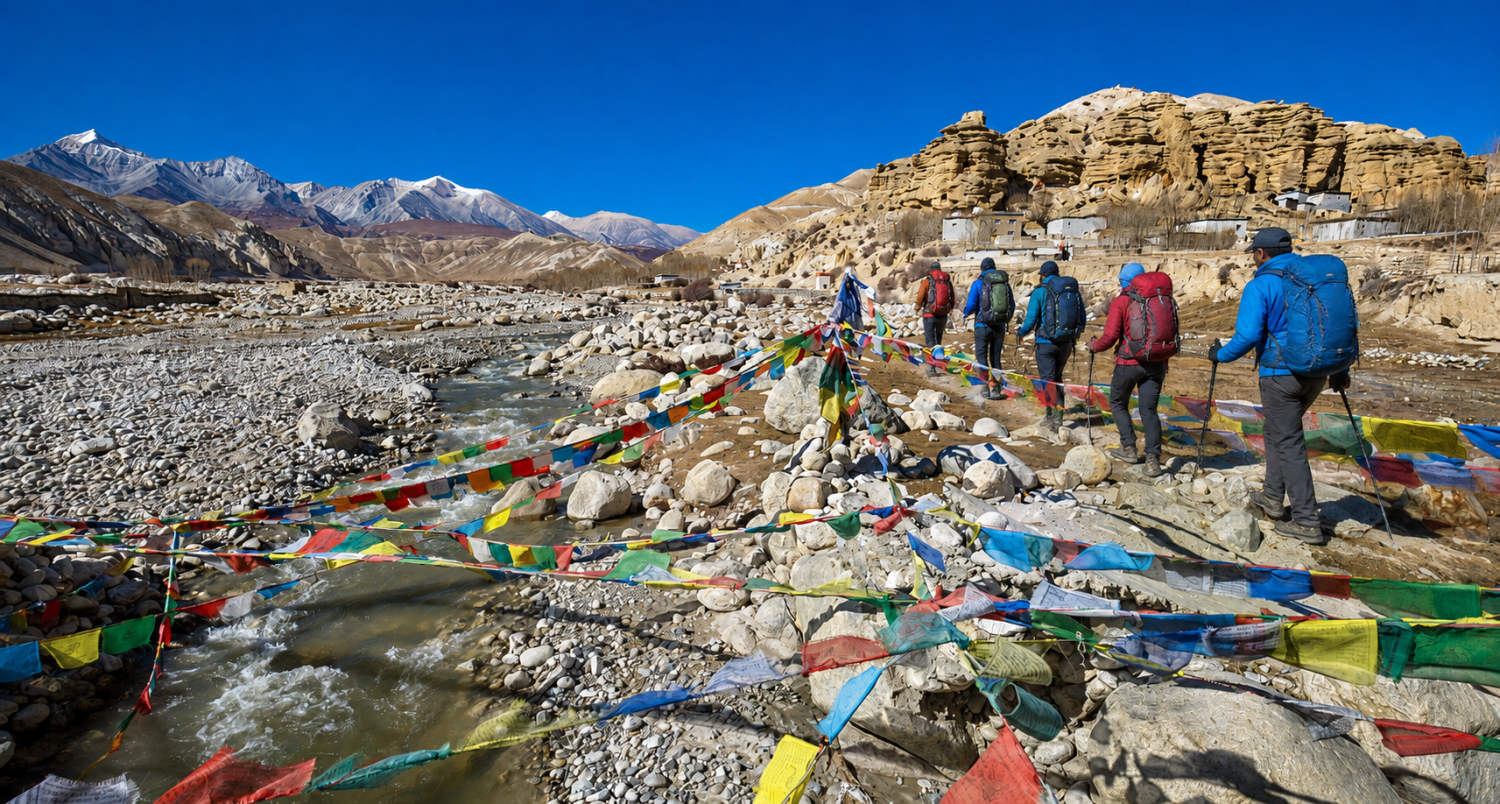
The Upper Mustang Monsoon Trek is one of Nepal’s most distinctive high-altitude journeys, taking travelers into a dramatic trans-Himalayan landscape of red cliffs, barren valleys, ancient monasteries, whitewashed villages, medieval architecture, and centuries-old Tibetan Buddhist traditions. Often described as the “Last Forbidden Kingdom” or “Mini Tibet,” Upper Mustang feels dramatically different from the green valleys of southern Nepal.
What makes Upper Mustang particularly special is its position in the rain shadow of the Annapurna and Dhaulagiri mountain ranges. While much of Nepal receives heavy monsoon rainfall from June to September, Upper Mustang remains comparatively dry. This makes it one of the country's most attractive trekking destinations during the monsoon season. The region can also be explored in spring, autumn, and winter, although weather, road conditions, accommodation availability, and flight schedules vary considerably.
For travelers looking for a journey combining Himalayan scenery, ancient culture, adventure, history, spirituality, and remote mountain life, the Upper Mustang Trek is an exceptional choice.
Himalayan Adventure Intl Treks organizes Upper Mustang adventures throughout the year and can arrange trekking permits, transportation, licensed guides, porters, accommodation, meals, cultural experiences, and customized itineraries.
Important permit update: Upper Mustang requires a special restricted-area trekking permit in addition to the Annapurna Conservation Area entry permit. Nepal’s Department of Immigration currently lists the Upper Mustang restricted-area permit at USD 50 per person per day for the applicable Upper Mustang area. The Annapurna Conservation Area entry permit is currently NRs. 3,000 for foreigners and NRs. 1,000 for SAARC nationals.
Upper Mustang is not simply another Himalayan trekking route. It is an opportunity to enter a landscape shaped by the Himalayas, Tibetan Buddhism, ancient trade routes, wind, erosion, and centuries of isolation.
The journey reveals a remarkable contrast. Below Jomsom, the Kali Gandaki Valley contains green fields, orchards, villages, and mountain forests. As you travel north toward Kagbeni, Chele, Ghami, Tsarang, and Lo Manthang, the landscape gradually becomes more arid. Huge cliffs rise above the trail, while caves and ancient settlements appear in seemingly impossible locations.
The region also offers spectacular views toward the Annapurna, Dhaulagiri, Nilgiri, and other Himalayan peaks. Yet the mountains are only part of the attraction. The real character of Upper Mustang lies in its people, monasteries, traditional homes, chortens, mani walls, prayer flags, festivals, and historic villages.
The area was closed to foreign travelers until 1992, and controlled tourism continues to help preserve its distinctive cultural and environmental character.
Many trekkers assume that Nepal cannot be visited during the monsoon. That is not true for Upper Mustang.
Because the region lies north of the main Himalayan barrier, much of the moisture carried by the summer monsoon is blocked before it reaches the Mustang plateau. As a result, Upper Mustang is significantly drier than many trekking regions farther south.
This makes June, July, August and early September particularly interesting for travelers who want to explore Nepal during the monsoon.
Monsoon Upper Mustang offers:
However, monsoon does not mean completely weatherproof travel. Flights between Pokhara and Jomsom can be affected by cloud, wind, visibility, or operational conditions, while roads can experience delays. A good itinerary should therefore include flexibility.
Spring, generally March to May, is another excellent season.
Temperatures gradually become warmer, mountain scenery is impressive, and the landscape begins to change after winter. Depending on the altitude and location, spring can bring a combination of cool mornings, pleasant daytime conditions, and cold evenings.
Spring is especially attractive for travelers interested in:
Spring is also one of the traditional high seasons for trekking in Nepal.
September to November is widely considered one of the strongest periods for Himalayan travel.
The atmosphere is generally crisp, the mountain landscape is impressive, and the post-monsoon environment can provide excellent visibility. Autumn is particularly suitable for trekkers who want a classic Upper Mustang experience.
The season is ideal for:
Autumn can also be busy compared with monsoon and winter, so travelers seeking quieter trails may prefer a less conventional departure period.
Upper Mustang can also be explored during December, January, and February, but winter requires more preparation.
Temperatures can become very cold, especially overnight and at higher elevations. Snow, freezing temperatures, strong winds, road conditions, and reduced accommodation availability may affect the itinerary.
Winter is best suited to travelers who are prepared for cold mountain conditions and who have a flexible schedule.
Himalayan Adventure Intl Treks can customize winter arrangements according to current weather, road conditions, accommodation availability, and transportation options.
Transportation is an important part of planning the Upper Mustang journey.
Travelers can choose from several options:
Tourist bus: approximately USD 20–25 per person
Flight: approximately USD 145 per person
Private vehicle: approximately USD 180 for a vehicle carrying 5–7 people
The best option depends on the group's size, budget, preferred comfort level, and itinerary.
The next stage is transportation toward Jomsom.
Flight: approximately USD 195 per person
Public bus: approximately USD 15–20 per person
Private vehicle: approximately USD 180 for 5–7 people
Flight schedules are particularly dependent on weather and operational conditions. For this reason, travelers should avoid planning critical international connections immediately after a domestic mountain flight.
Himalayan Adventure Intl Treks can monitor transportation arrangements and help reorganize the itinerary when necessary.
Upper Mustang is a restricted trekking area, so travelers should understand that there is more than one permit requirement.
The current ACAP entry fee is:
The current NTNC permit system confirms these rates, including tax.
The Department of Immigration currently lists:
for the applicable Upper Mustang restricted area.
This is separate from the ACAP entry fee.
Because government fees and regulations can change, travelers should confirm the applicable fee for their exact itinerary and travel dates before departure. Himalayan Adventure Intl Treks can arrange the required permit services on request.
Upper Mustang is best experienced with knowledgeable local support.
USD 30 per day
A professional guide can help with navigation, local culture, accommodation arrangements, communication, permits, and emergency coordination.
USD 22 per day
A porter can carry trekking baggage, allowing travelers to walk with a lighter daypack.
USD 50–70 per day
Language-speaking guides can be arranged according to availability and the required language.
USD 35 per day
Female guides can be arranged on request, subject to availability.
USD 28 per day
A porter-guide can be a practical option for travelers seeking a more economical arrangement.
A general estimate for food and accommodation is USD 35–40 per person per day, depending on the itinerary, lodge category, location, and services included.
Accommodation ranges from simple local guesthouses to more comfortable lodges and selected luxury properties.
Upper Mustang is remote, so travelers should not expect the same range of facilities found in Kathmandu or Pokhara. The limited infrastructure is part of the region's character, but it also means advance planning is important.
Meals generally include familiar trekking foods such as:
Travelers with special dietary requirements should inform Himalayan Adventure Intl Treks before departure.
Himalayan Adventure Intl Treks can organize several levels of Upper Mustang travel.
Designed for travelers who want to experience Upper Mustang economically while maintaining essential trekking support.
A balanced option combining professional guiding, comfortable accommodation, transportation, meals, and essential services.
Designed for travelers who prefer upgraded accommodation, private transportation, additional comfort, and personalized arrangements.
A premium Upper Mustang experience emphasizing high-quality accommodation, private transportation, personalized guiding, cultural experiences, and carefully planned logistics.
The exact package price depends on group size, duration, accommodation, transportation, permit costs, guide requirements, and selected services.
A classic itinerary can be organized around the following route:
Kathmandu → Pokhara → Jomsom → Kagbeni → Chele → Syangboche → Ghami → Tsarang → Lo Manthang → Exploration → Return toward Jomsom → Pokhara → Kathmandu
One popular itinerary takes approximately two weeks, although Himalayan Adventure Intl Treks can extend or shorten the program according to fitness, interests, transportation, and available vacation time.
Kagbeni is the traditional gateway toward Upper Mustang and an atmospheric settlement near the Kali Gandaki River. Its narrow lanes, traditional buildings, monasteries, and mountain setting create an immediate sense that the journey is entering a different cultural world.
Chele marks an important transition into the Upper Mustang landscape. The terrain becomes increasingly dry and dramatic, with cliffs and high passes surrounding the trail.
Syangboche is surrounded by rugged Himalayan scenery and is commonly included on trekking routes toward Lo Manthang.
Ghami is known for its traditional architecture, Buddhist heritage, and impressive landscape. Its long mani wall is among the cultural highlights of the route.
Tsarang, also known as Charang, is an important historic settlement with monasteries, traditional homes, and dramatic views across the Mustang landscape.
Lo Manthang is the cultural heart of Upper Mustang.
The walled settlement contains historic buildings, monasteries, narrow streets, traditional houses, and an extraordinary atmosphere shaped by centuries of Himalayan history.
Exploration days around Lo Manthang allow travelers to visit monasteries, villages, viewpoints, caves, and cultural sites without carrying trekking baggage.
One of Upper Mustang's greatest mysteries is its extensive network of caves.
Caves have been carved into the high cliffs throughout the region. Some are associated with ancient habitation, meditation, religious practice, burial traditions, and storage.
The caves demonstrate how communities adapted to the harsh environment. Their existence also raises fascinating questions about the early history of settlements in the Mustang region.
Some cave sites are protected or difficult to access, and travelers should visit only locations where access is permitted. A knowledgeable local guide is invaluable for understanding their cultural and historical context.
Upper Mustang has preserved a strong Tibetan-influenced Buddhist culture.
Visitors may encounter:
Buddhist monasteries are not simply tourist attractions. They remain living religious institutions. Travelers should therefore dress respectfully, ask before photographing ceremonies or people, and follow local instructions.
The Nepal Tourism Board describes the Tiji Festival as a sacred celebration rooted in Vajrayana Buddhist traditions and associated with Vajrakila.
The Tiji Festival, also called Tenchi, is one of Upper Mustang's most important cultural celebrations.
It takes place annually in Lo Manthang according to the Tibetan lunar calendar. The festival features sacred masked dances, religious rituals, traditional performances, and community celebrations.
The festival has a long history and is connected with Vajrakila practices. According to the Nepal Tourism Board, the tradition dates back to the early 15th century and was later revived through important religious and royal figures.
A Tiji Festival Trek offers more than sightseeing. It allows visitors to witness an important living cultural tradition.
Because festival dates change according to the Tibetan calendar, travelers should plan well in advance.
Upper Mustang lies close to the Tibetan Plateau and has historically maintained strong cultural, religious, and commercial connections with Tibet.
The landscape reflects this trans-Himalayan relationship through architecture, language, religion, trade traditions, food, clothing, and settlement patterns.
Travelers should understand that the Nepal–China/Tibet border is a sensitive frontier and that visiting border areas is subject to local regulations and permissions. A normal Upper Mustang trekking permit does not automatically authorize travel wherever one wishes near the international boundary.
Mustang's history is deeply connected with trans-Himalayan trade.
For centuries, the region served as a corridor between the southern Himalayas and the Tibetan plateau. Traders, pilgrims, monks, and local communities moved through the Kali Gandaki region.
The Kingdom of Lo developed a distinctive cultural and political identity. Lo Manthang became an important center of the region, surrounded by fortified architecture, monasteries, agricultural settlements, and trade routes.
The area remained relatively isolated for generations. Modern tourism opened gradually, with foreign travelers first receiving access to Upper Mustang in 1992. This history of controlled access is one reason the region retains such a strong sense of identity.
The Upper Mustang Trek is generally considered moderate to challenging, depending on the itinerary.
The difficulty comes from several factors:
The trek does not require technical climbing, but good preparation is important.
Travelers should gradually acclimatize and avoid trying to cover excessive distances too quickly.
Altitude sickness is one of the most important health concerns during an Upper Mustang adventure.
Symptoms can include headache, dizziness, unusual tiredness, nausea, reduced appetite, and difficulty sleeping. More serious altitude illness requires immediate attention.
Prevention begins with a sensible itinerary.
Himalayan Adventure Intl Treks can design itineraries with appropriate acclimatization and provide experienced guides familiar with high-altitude trekking.
A good packing list should be adapted to the season.
Moisture-wic