
Have Questions? Talk to Expert (Binod)
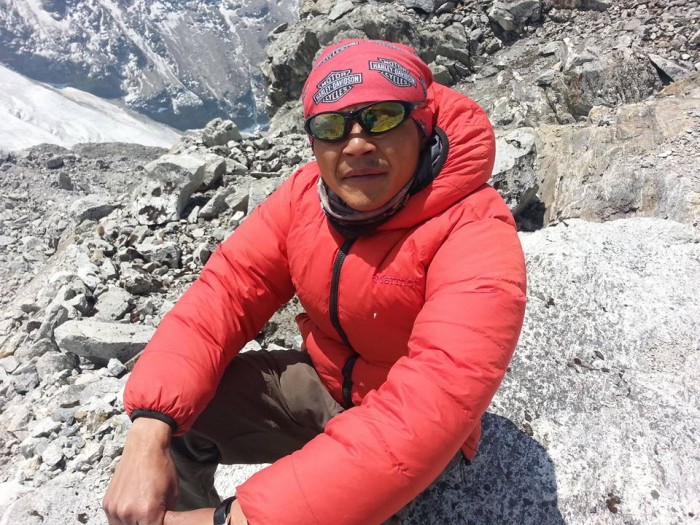
The Dhaulagiri Circuit Trek is one of Nepal's most spectacular and demanding high-altitude adventures, taking trekkers around the mighty Mount Dhaulagiri (8,167m), the world's seventh-highest mountain. Unlike the crowded trekking routes of Everest and Annapurna, the Dhaulagiri Circuit remains a remote Himalayan expedition where trekkers experience untouched wilderness, massive glaciers, towering icefalls, alpine meadows, high mountain passes, traditional Magar and Thakali villages, and breathtaking Himalayan panoramas.
Himalayan Adventure Intl Treks proudly offers a professionally organized Half Camping and Half Homestay Dhaulagiri Circuit Trek, combining the excitement of expedition-style camping with the warmth of authentic Nepali village hospitality. This unique combination provides greater comfort in lower villages while maintaining safety and flexibility in the remote alpine regions where no lodges exist.
This incredible trek crosses two famous Himalayan passes:
Along the journey, trekkers visit:
For trekkers looking for one of Nepal's greatest wilderness adventures, the Dhaulagiri Circuit Trek is truly unforgettable.
The Dhaulagiri region remains one of Nepal's least explored trekking destinations. Unlike commercial trekking routes, this journey offers genuine Himalayan isolation and adventure.
The trek usually takes 14–16 days, although many trekkers extend it to 18 or 20 days for better acclimatization. The journey begins in Kathmandu before traveling to Pokhara and then driving to Darbang, where trekking starts.
Initially, the trail follows rivers, terraced farms, forests, and traditional villages. Gradually the scenery transforms into alpine meadows, glaciers, rocky moraines, snowfields, and towering Himalayan peaks.
Camping becomes necessary after leaving the villages because there are no permanent tea houses beyond Italian Base Camp.
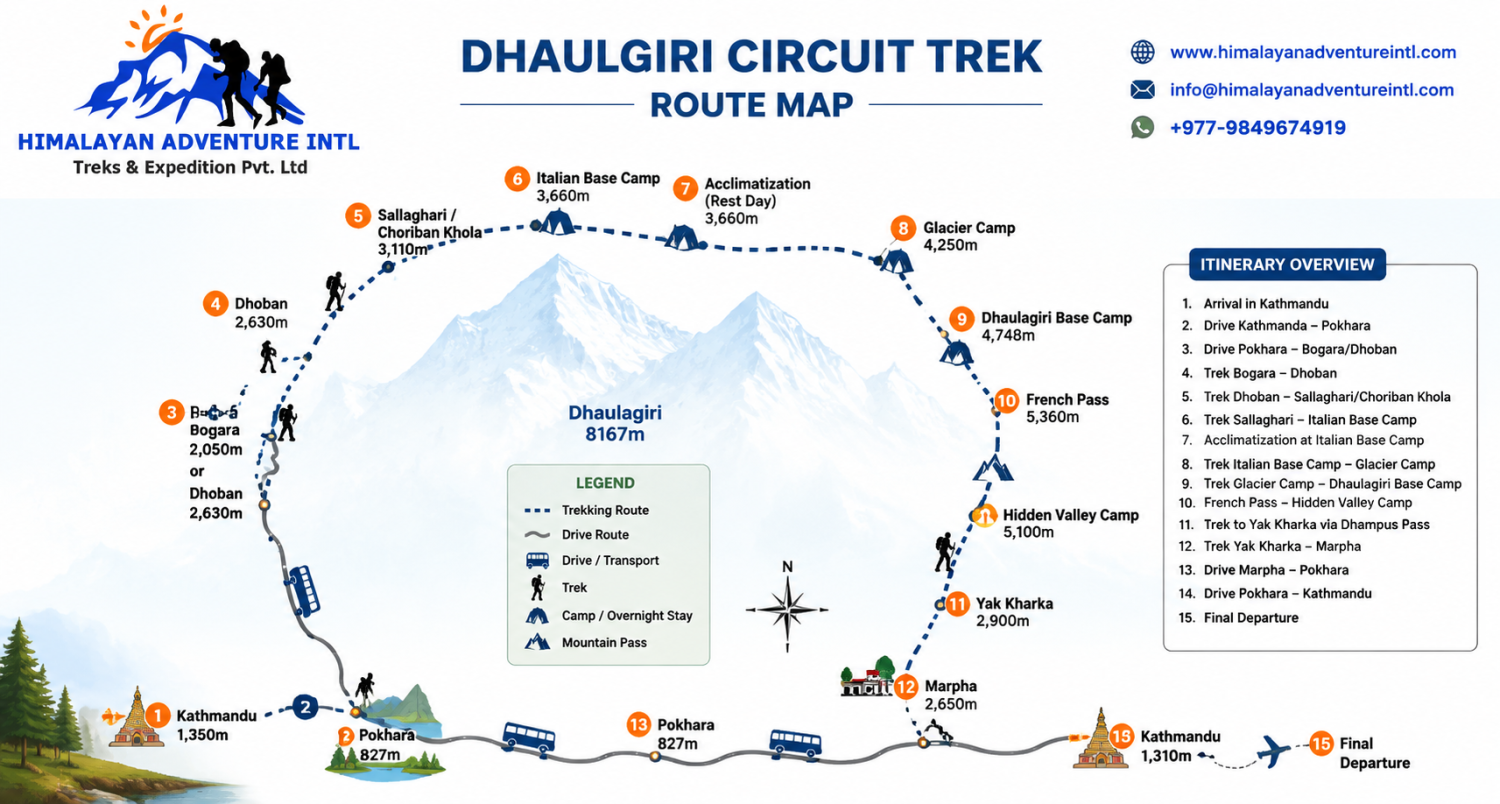
The expedition eventually reaches Dhaulagiri Base Camp before crossing French Pass into Hidden Valley and later traversing Dhampus Pass before descending to beautiful Marpha.
Choosing the right season is one of the most important factors for a successful Dhaulagiri Circuit Trek.
Spring is considered the best season.
Advantages include:
Temperature
Autumn is equally popular.
Advantages
Temperature
Possible but challenging.
Heavy snowfall often blocks:
Suitable only for experienced winter trekkers.
Generally not recommended.
Challenges include:
The Dhaulagiri Circuit Trek is considered one of Nepal's most difficult trekking adventures.
Reasons include:
Trekkers should have:
Unlike many fully camping expeditions, Himalayan Adventure Intl Treks offers a combination of camping and local accommodation.
Lower villages include:
Guests enjoy:
Camping begins after reaching remote alpine terrain.
Our camping services include:
Fresh meals are prepared every day even above 5,000 meters.
Trekkers require two permits.
Not always required for organized groups under the current regulations, but requirements may change. Himalayan Adventure Intl Treks arranges all necessary permits before departure.
The trek begins from Kathmandu.
$15 per person
Comfortable tourist bus with:
$18 per person
Shared jeep transportation through beautiful mountain roads.
$180 per jeep
Ideal for groups wanting to shorten the first trekking days.
Shared Jeep
$25 per person
Private Jeep
$180 per jeep
Pokhara–Kathmandu flights are available for travelers wanting to save time after completing the trek.
Food is an important part of a successful expedition.
Villages provide fresh local food including:
Our experienced kitchen team prepares nutritious meals.
Breakfast
Lunch
Dinner
Snacks
Boiled drinking water is available during camping.
Independent trekkers should budget approximately:
Total:
$30–40 per person per day
Camping costs are included in organized trekking packages.
Hiring a professional guide is essential for Dhaulagiri.
Guide services include:
Experienced Trekking Guide Cost
$30 per day
The guide's salary, meals, accommodation, insurance, and equipment are included in organized packages.
Porters make the journey safer and more enjoyable.
One porter normally carries luggage for two trekkers.
Maximum load:
20–25 kg
Strong Porter Cost
$28 per day
Includes:
Because the trek exceeds 5,300 meters, altitude sickness is a serious consideration.
Our guides carefully monitor every trekker.
Safety recommendations include:
Emergency evacuation can be arranged if necessary.
The trek passes through authentic villages where visitors experience:
Local hospitality remains one of the trek's greatest memories.
The Dhaulagiri Conservation Area protects:
The trek offers close views of:
Average distance:
10–15 km daily
Walking time:
6–8 hours
High-pass days:
8–10 hours
Suitable for:
Not recommended for:
Himalayan Adventure Intl Treks specializes in remote Himalayan expeditions with a strong focus on safety, personalized service, and responsible tourism.
Our services include:
Whether you choose a standard, deluxe, or customized itinerary, our team ensures a safe and memorable journey through one of Nepal's most remote mountain regions.
The overall cost depends on group size, duration, service level, and transportation preferences.
Typical package prices are:
These packages generally include permits, professional guides, porters, camping equipment, meals during the trek, accommodation, transportation, and logistical support.
The Dhaulagiri Circuit Trek is one of Nepal's last true wilderness adventures, offering an unforgettable combination of glacier travel, remote mountain passes, pristine alpine landscapes, and authentic Himalayan culture. Crossing French Pass (5,360m) and Dhampus Pass (5,240m) while camping beneath the towering Dhaulagiri massif is an experience reserved for adventurous trekkers seeking more than a typical Himalayan holiday.
With Himalayan Adventure Intl Treks, you benefit from an expertly managed half camping and half homestay experience, experienced guides, strong porters, reliable transportation, carefully planned acclimatization, quality camping equipment, and dedicated support throughout the journey. From the scenic Kathmandu to Pokhara tourist bus ($15) and Pokhara to Darbang shared jeep ($18) to the Darbang–Bhogara/Dhoban private jeep ($180) and Marpha to Pokhara shared jeep ($25) or private jeep ($180), every detail is arranged to ensure a smooth, safe, and rewarding expedition.
If you are searching for one of the most challenging and rewarding trekking adventures in the Himalayas, the Dhaulagiri Circuit Trek stands among Nepal's finest expeditions, delivering breathtaking scenery, cultural immersion, and the satisfaction of completing one of the country's most legendary mountain circuits.
Welcome to Nepal!
Upon your arrival at Tribhuvan International Airport (TIA), a friendly representative from Himalayan Adventure Intl Treks will warmly welcome you and transfer you to your comfortable hotel in the heart of Kathmandu. During the drive, you will experience your first glimpse of Nepal's colorful streets, ancient temples, bustling markets, and vibrant local culture.
After checking into your hotel, enjoy some time to relax after your international flight. In the evening, our trekking guide will conduct a comprehensive trip briefing covering the trekking itinerary, safety measures, equipment checklist, altitude awareness, weather conditions, and camping logistics.
If time permits, you may explore the nearby tourist district of Thamel, famous for its trekking shops, restaurants, cafes, and cultural atmosphere.
Accommodation: Hotel
Meals: Welcome Dinner
After breakfast, begin a scenic journey to Pokhara aboard a comfortable tourist bus. The highway follows the beautiful Trishuli and Marsyangdi Rivers, passing picturesque villages, lush green hills, terraced farmlands, waterfalls, and traditional settlements.
Several refreshment stops are made along the route for meals, tea, and photographs.
Pokhara is Nepal's adventure capital, situated beside the beautiful Phewa Lake beneath the stunning Annapurna and Machhapuchhre mountain ranges.
After checking into your hotel, enjoy an evening stroll around Lakeside, visit local restaurants, or simply relax while enjoying reflections of the Himalayas in the peaceful lake.
Driving Distance: Approximately 200 km
Accommodation: Hotel
Meals: Breakfast
After breakfast, begin an adventurous jeep drive towards the remote Myagdi region. The road winds through beautiful villages, dense forests, terraced hillsides, and deep river valleys.
The journey passes Beni before continuing along rough mountain roads following the Myagdi Khola. Depending upon road conditions and seasonal accessibility, the drive reaches either Bogara or Dhoban.
This exciting drive offers magnificent views of waterfalls, pine forests, traditional Magar villages, suspension bridges, and distant snow-capped peaks.
Tonight marks your final stay before entering the completely remote wilderness of the Dhaulagiri region.
Accommodation: Local Lodge or Tent Camp
Meals: Breakfast, Lunch, Dinner
Today begins the actual trekking adventure.
The trail gradually enters beautiful forests filled with rhododendron, pine, bamboo, and oak trees. Along the route, trekkers cross numerous wooden bridges, cascading streams, rocky trails, and narrow mountain paths carved into cliffs.
The valley becomes increasingly narrow as towering cliffs rise above both sides of the trail. Colorful birds, Himalayan wildlife, and beautiful wildflowers decorate the route during spring.
Eventually, reach Dhoban, a peaceful riverside campsite surrounded by dense forest and impressive mountain scenery.
Walking Time: 6 Hours
Accommodation: Tent Camp
Meals: Breakfast, Lunch, Dinner
After breakfast, continue deeper into the isolated Dhaulagiri wilderness.
The trail steadily climbs through beautiful alpine forests alongside the Myagdi River. As elevation increases, the vegetation gradually changes from dense forests to alpine shrubs.
You will pass several landslide sections requiring careful walking while enjoying magnificent views of surrounding peaks.
Sallaghari or Choriban Khola provides an excellent camping location surrounded by peaceful forests and dramatic mountain landscapes.
As you gain altitude, the temperature becomes noticeably cooler.
Walking Time: 5 Hours
Accommodation: Tent Camp
Meals: Breakfast, Lunch, Dinner
Today's trail climbs steadily toward the spectacular Italian Base Camp.
Leaving the forests behind, the landscape transforms into alpine meadows surrounded by enormous Himalayan cliffs. Massive waterfalls descend from hanging glaciers while colorful alpine flowers bloom during spring and summer.
Upon reaching Italian Base Camp, breathtaking panoramic views unfold before you.
Marvel at towering peaks including:
Italian Base Camp is considered one of Nepal's finest panoramic camping locations.
Walking Time: 4 Hours
Accommodation: Tent Camp
Meals: Breakfast, Lunch, Dinner
Proper acclimatization is essential before ascending to higher elevations.
Today is reserved for rest and altitude adaptation. Rather than remaining inactive, the guide leads a short acclimatization hike to nearby viewpoints before returning to camp.
This gradual exposure helps your body adjust to thinner mountain air while reducing the risk of Acute Mountain Sickness (AMS).
Spend the afternoon relaxing, photographing the magnificent glaciers, or simply enjoying the incredible Himalayan panorama.
Our experienced guide will continuously monitor everyone's health and oxygen adaptation.
Accommodation: Tent Camp
Meals: Breakfast, Lunch, Dinner
Today's adventure becomes increasingly exciting.
The trail traverses glacial moraines, rocky ridges, icy terrain, and unstable boulder fields. Trekking poles become especially helpful on today's route.
Surrounded by giant glaciers and towering Himalayan walls, trekkers experience one of Nepal's most dramatic mountain landscapes.
After carefully crossing sections of the Chhonbardan Glacier, reach Glacier Camp, situated amidst spectacular ice formations.
Sunset transforms the surrounding snow-covered peaks into brilliant shades of gold and orange.
Walking Time: 5 Hours
Accommodation: Tent Camp
Meals: Breakfast, Lunch, Dinner
Today is one of the highlights of the expedition.
The route continues over glacial terrain beneath towering icefalls and impressive hanging glaciers.
Upon reaching Dhaulagiri Base Camp, enjoy extraordinary close-up views of:
Standing directly beneath one of the world's highest mountains is an unforgettable experience.
The peaceful surroundings provide exceptional opportunities for mountain photography.
Walking Time: 5 Hours
Accommodation: Tent Camp
Meals: Breakfast, Lunch, Dinner
This is the most challenging and rewarding day of the trek.
Before sunrise, begin a gradual climb toward French Pass, one of Nepal's highest trekking passes.
The ascent offers breathtaking panoramic views of:
Reaching French Pass is a remarkable achievement.
After celebrating the crossing with photographs, descend into the beautiful Hidden Valley, a spectacular high-altitude alpine basin surrounded by towering snow-covered mountains.
The valley remains one of Nepal's least-visited Himalayan destinations.
Highest Elevation: 5,360m
Accommodation: Tent Camp
Meals: Breakfast, Lunch, Dinner
Another exciting day begins with the ascent toward Dhampus Pass.
From the summit, enjoy one final panoramic view of the Dhaulagiri and Annapurna Himalayan ranges before beginning the long descent.
The trail gradually leaves snowfields behind, descending through rocky landscapes into alpine meadows where yaks often graze during summer.
Eventually arrive at Yak Kharka, a peaceful grazing area surrounded by beautiful mountain scenery.
Crossing both French Pass and Dhampus Pass makes this trek one of Nepal's greatest Himalayan adventures.
Walking Time: 7 Hours
Accommodation: Tent Camp or Lodge
Meals: Breakfast, Lunch, Dinner
Today's descent becomes easier as you enter the famous Kali Gandaki Valley.
The landscape changes dramatically from alpine wilderness to traditional villages and cultivated farmland.
Arrive at Marpha, one of Nepal's most beautiful Thakali villages, renowned for its whitewashed houses, narrow stone-paved streets, apple orchards, Buddhist monasteries, and warm hospitality.
Visitors can sample fresh apple products including juice, pie, dried apples, and the village's famous apple brandy.
Take time to explore the monastery and local handicraft shops.
Walking Time: 4 Hours
Accommodation: Lodge
Meals: Breakfast, Lunch, Dinne
Following breakfast, board a jeep or local vehicle for the scenic drive back to Pokhara.
The route follows the Kali Gandaki Gorge—the deepest gorge in the world—passing Jomsom, Tatopani, Beni, waterfalls, suspension bridges, rivers, and charming villages.
Upon arrival in Pokhara, check into your hotel and enjoy a hot shower, comfortable accommodation, and a relaxing evening by Phewa Lake.
Many trekkers celebrate the successful completion of the Dhaulagiri Circuit with a farewell dinner overlooking the lake.
Accommodation: Hotel
Meals: Breakfast
After breakfast, return to Kathmandu via a comfortable tourist bus.
Enjoy the scenic countryside one final time while reflecting on your incredible Himalayan expedition.
Upon arrival, transfer to your hotel. The remainder of the day is free for shopping, visiting UNESCO World Heritage Sites, purchasing souvenirs, or relaxing before your international departure.
In the evening, Himalayan Adventure Intl Treks hosts a special farewell dinner featuring authentic Nepali cuisine and a cultural performance to celebrate your successful Dhaulagiri Circuit Trek.
Accommodation: Hotel
Meals: Breakfast, Farewell Dinner
Your unforgettable Dhaulagiri Circuit Trek comes to an end today.
Depending on your international flight schedule, a representative from Himalayan Adventure Intl Treks will transfer you to Tribhuvan International Airport approximately three hours before departure.
As you leave Nepal, you take with you unforgettable memories of remote Himalayan wilderness, breathtaking glaciers, towering mountain passes, authentic local culture, lifelong friendships, and one of the greatest trekking adventures in the world.
We sincerely thank you for choosing Himalayan Adventure Intl Treks and look forward to welcoming you again for your next adventure in Nepal, Bhutan, Tibet, or India.
Meals: Breakfast (depending on flight schedule)
The Dhaulagiri Circuit Trek is a challenging trek that circles the seventh-highest mountain in the world, Dhaulagiri (8,167m). It offers a remote and rugged experience, with spectacular views of the Dhaulagiri massif and surrounding peaks.
The Dhaulagiri Circuit Trek is considered one of the most difficult treks in Nepal, requiring a high level of physical fitness, trekking experience, and the ability to handle high altitudes and challenging terrain.
The best time to do the Dhaulagiri Circuit Trek is during the pre-monsoon (April to June) and post-monsoon (September to November) seasons, when the weather is stable and the views are clear.
The Dhaulagiri Circuit Trek typically takes about 18 to 22 days to complete, depending on the specific itinerary and the pace of the group.
The main highlights include crossing the French Pass (5,360m), the Hidden Valley, the Dhampus Pass (5,200m), and reaching Dhaulagiri Base Camp (4,740m), along with breathtaking views of Dhaulagiri and other Himalayan peaks.
Accommodation on the Dhaulagiri Circuit Trek is primarily in tents due to the remoteness of the area. Some basic teahouses are available in lower regions, but camping is required at higher altitudes.
Yes, due to the challenging and remote nature of the trek, it is highly recommended to hire an experienced guide and a support team. Navigating the trail can be difficult, especially in bad weather.
Trekkers need the Annapurna Conservation Area Permit (ACAP) and the Trekker’s Information Management System (TIMS) card to undertake the Dhaulagiri Circuit Trek.
Physical preparation should include cardiovascular exercises, strength training, and endurance activities like hiking with a backpack. Altitude training is also beneficial.
Essential items include a good-quality sleeping bag, trekking boots, warm clothing, a first aid kit, a water purification system, and a high-altitude tent. Packing light but with all necessary gear is crucial.
The trek typically starts from Beni, which can be reached by a 9-hour drive from Kathmandu. Alternatively, a flight to Pokhara followed by a drive to Beni is an option.
Food is basic and consists mainly of dal bhat (rice and lentils), noodles, soups, and tea. In higher altitudes, meals are prepared by the trekking crew as there are no teahouses.
Yes, altitude sickness is a significant concern due to the high elevations reached on this trek. Proper acclimatization, hydration, and monitoring for symptoms are essential.
The highest point on the Dhaulagiri Circuit Trek is the French Pass at 5,360 meters (17,585 feet).
The Dhaulagiri Circuit Trek is not suitable for beginners due to its difficulty and altitude. It is recommended for experienced trekkers with prior high-altitude trekking experience.
Wildlife such as Himalayan tahr, snow leopards (rarely), musk deer, and various species of birds can be seen during the trek.
Rescue services are available, but due to the remote nature of the trek, helicopter evacuations are the most reliable option in case of emergencies.
The Dhaulagiri Circuit Trek is extremely remote, with limited access to villages, communication, and facilities. It offers a true wilderness experience.
Gradual acclimatization, staying hydrated, eating a high-calorie diet, and avoiding alcohol and smoking are essential steps for preparing for high altitude on this trek
A high level of physical fitness is required, including cardiovascular endurance, leg strength, and the ability to trek for long hours over difficult terrain.
Risks include altitude sickness, extreme weather conditions, avalanches, crevasses, and the physical challenges of the terrain.
Acclimatization should be gradual, with rest days at key points such as Italian Base Camp and Dhaulagiri Base Camp. Following the "climb high, sleep low" principle is important.
Dhaulagiri is considered a sacred mountain in Nepal and holds significant cultural and spiritual importance for local communities. It is also revered by mountaineers worldwide.
To avoid altitude sickness, ascend slowly, stay hydrated, eat well, and avoid alcohol and smoking. Medications like Diamox can be taken as a preventive measure.
The Dhampus Pass (5,200m) is a high mountain pass crossed on the Dhaulagiri Circuit Trek. It offers stunning views of the Annapurna and Dhaulagiri ranges and is one of the trek's most challenging sections.
Temperatures can drop significantly, especially at night and at higher altitudes. It can reach as low as -20°C (-4°F) in places like the Hidden Valley.
Mobile network coverage is very limited or nonexistent on most parts of the Dhaulagiri Circuit Trek due to its remote location.
The French Pass (5,360m) is the highest point of the Dhaulagiri Circuit Trek and offers panoramic views of Dhaulagiri I and surrounding peaks.
Symptoms of altitude sickness include headaches, nausea, dizziness, fatigue, and shortness of breath. Severe cases can lead to High Altitude Pulmonary Edema (HAPE) or High Altitude Cerebral Edema (HACE).
Safety can be ensured by hiring an experienced guide, having proper acclimatization, carrying necessary equipment, being aware of weather conditions, and having a well-planned itinerary.
You need comprehensive travel insurance that covers high-altitude trekking, emergency evacuations, and medical expenses specific to remote trekking areas.
While it is possible, it is highly discouraged due to the trek's difficulty and remoteness. A guide and support team are strongly recommended.
The Hidden Valley is a remote, high-altitude valley located beyond the French Pass, known for its stark beauty and isolation. It serves as a campsite on the trek.
Essential gear includes a warm sleeping bag, down jacket, high-quality trekking boots, crampons, trekking poles, and a durable tent. Proper layering for varying weather conditions is also necessary.
The major passes are the French Pass (5,360m) and the Dhampus Pass (5,200m), both of which are challenging and offer stunning views.
Training should include cardiovascular exercises, strength training, altitude training, and long hikes with a backpack to build endurance and leg strength.
Yes, the Dhaulagiri Circuit Trek offers stunning views of Dhaulagiri I (8,167m) and the surrounding peaks from various points along the route.
The ACAP is a permit required to enter the Annapurna Conservation Area, which includes parts of the Dhaulagiri Circuit Trek. It helps fund conservation efforts and local development.
The main challenges include high altitudes, steep ascents and descents, extreme weather conditions, and the need for self-sufficiency in remote areas.
The cost can vary widely depending on the services chosen, but it generally ranges from $2,500 to USD 4,000, including permits, guide services, food, and accommodation.
Important medical supplies include altitude sickness medication, pain relievers, antiseptic creams, bandages, blister treatment, and personal prescription medications.
Yes, rest days are planned at the Italian Base Camp and Dhaulagiri Base Camp to aid acclimatization and recovery.
The trek route typically follows Beni, Darbang, Muri, Boghara, Dobang, Italian Base Camp, Dhaulagiri Base Camp, French Pass, Hidden Valley, Dhampus Pass, and Jomsom.
Common health risks include altitude sickness, hypothermia, dehydration, sunburn, and gastrointestinal issues.
It is possible, but not recommended due to the challenging nature of the terrain and the difficulty in acclimatization when doing the trek in reverse.
The Italian Base Camp (3,660m) is a key acclimatization stop on the Dhaulagiri Circuit Trek, offering stunning views of Dhaulagiri and the surrounding peaks.
The trek can be booked through trekking agencies in Nepal, which offer various packages that include guides, permits, and logistics.
Water sources include rivers, streams, and occasional springs. It's essential to purify water using tablets or filters.
Preparation includes spending time at altitude before the trek, ascending slowly, staying hydrated, and considering preventive medication like Diamox.
Yes, respect local customs and traditions, seek permission before taking photographs of people, and be aware of cultural sensitivities, especially in remote villages.
The best time to cross the French Pass is early in the morning to avoid the risk of bad weather and strong winds.
Charging facilities are limited or nonexistent on the trek, so carrying a portable solar charger or extra batteries is recommended.
The Dhaulagiri Circuit Trek became popular with adventurers in the 1950s, following the successful ascents of Dhaulagiri I, and has since been a challenging and remote trekking route.
A guide ensures safety, navigates the route, arranges logistics, assists with acclimatization, and provides local knowledge about the terrain and culture.
Acclimatization is achieved by following a gradual ascent, taking rest days at higher altitudes, staying hydrated, and listening to your body’s needs.
The nearest town to the starting point of the Dhaulagiri Circuit Trek is Beni, which is accessible by road from Pokhara.
Trekkers are encouraged to carry out all non-biodegradable waste and use eco-friendly products. Following Leave No Trace principles is essential.
The best time to visit Hidden Valley is during the spring (April-May) and autumn (October-November) seasons, when the weather is more stable.
The trek typically takes 18 to 21 days, depending on acclimatization needs and weather conditions.
The region is home to wildlife like snow leopards and Himalayan black bears, but encounters are rare. Trekkers should still be cautious.
Major landmarks include Dhaulagiri Base Camp, French Pass, Dhampus Pass, Hidden Valley, and the Kali Gandaki River.
Permits required include the Annapurna Conservation Area Permit (ACAP) and the TIMS card (Trekkers' Information Management System).
Yes, it can be combined with treks like the Annapurna Circuit or the Upper Mustang for an extended adventure.
Packing essentials include warm clothing, waterproof gear, trekking poles, crampons, a sleeping bag rated for cold weather, and a reliable backpack.
The highest point is the French Pass at 5,360 meters (17,585 feet), which offers spectacular views of Dhaulagiri and surrounding peaks.
Wildlife includes Himalayan tahrs, blue sheep, snow leopards, and various bird species such as the Himalayan monal.
The region is predominantly inhabited by the Magar and Gurung ethnic groups, with a rich culture of festivals, traditional music, and unique architecture.
Staying warm involves dressing in layers, using a high-quality down jacket and sleeping bag, and staying dry. It’s also important to keep moving and avoid sitting still for long periods.
Dangers include avalanches, crevasses, altitude sickness, and extreme weather conditions. Trekkers should be well-prepared and aware of these risks.
Sunrise and sunset times vary depending on the season, but generally, the sun rises between 5:30-6:30 AM and sets between 5:00-6:00 PM during the trekking season.
Yes, trekking equipment can be purchased or rented in Kathmandu or Pokhara, including sleeping bags, down jackets, trekking poles, and more.
The food is basic but hearty, often including rice, lentils (dal bhat), noodles, and vegetables. Meat is rare at higher altitudes, and trekkers should be cautious about hygiene.
Carry extra batteries and memory cards, protect your equipment from cold, and take advantage of the golden hour (sunrise and sunset) for the best lighting.
A four-season sleeping bag rated for -20°C (-4°F) or lower is recommended due to the cold temperatures at high altitudes.
Physical training should include cardiovascular exercises, strength training, hiking with a backpack, and gradually increasing the intensity as the trek approaches.
While it’s possible to trek solo, it’s not recommended due to the remote and challenging nature of the trek. A guide or group provides safety and support.
The most challenging part is crossing the French Pass and Dhampus Pass due to the high altitude, cold, and potentially difficult weather conditions.
Travel insurance should be obtained from a reputable provider, ensuring it covers high-altitude trekking, medical evacuation, and adventure activities.
Sturdy, waterproof trekking boots with good ankle support are recommended. Ensure they are well broken in before the trek to avoid blisters.
Communication options are limited, but satellite phones or devices like Garmin inReach can be used for emergency communication.
Altitude sickness can affect anyone, regardless of fitness level. Symptoms include headache, nausea, and dizziness. Immediate descent is necessary if symptoms worsen.
Staying hydrated involves drinking plenty of water, avoiding alcohol, and using hydration salts to replenish lost electrolytes.
The average group size ranges from 4 to 12 trekkers, allowing for a more manageable and safe trekking experience.
Transportation options include taking a bus or jeep from Pokhara to Beni, the starting point of the trek.
Handling emergencies involves having a first aid kit, knowing basic first aid, carrying travel insurance, and having a communication device for rescue operations.
A tourist visa is required to enter Nepal, which can be obtained on arrival at the airport or online before travel.
Yes, but it’s important to inform your guide or trekking agency in advance to accommodate dietary needs, though options may be limited at higher altitudes.
The weather can vary greatly, with cold temperatures, strong winds, and potential snowfall at high altitudes. Being prepared for all conditions is essential.
Choose a reputable trekking agency with good reviews, experienced guides, and clear communication. Ensure they are registered with the Nepal Tourism Board.
Avoid raw or undercooked foods, unfiltered water, and food from unhygienic sources to prevent illness.
Environmental impacts include littering, trail erosion, and pollution. Trekkers should minimize their footprint by following eco-friendly practices.
The average altitude gain is about 500 to 800 meters per day, with some days requiring careful acclimatization.
Dealing with headaches involves resting, hydrating, descending if necessary, and taking pain relievers or altitude medication if symptoms persist.
The monsoon season is not ideal due to heavy rainfall, slippery trails, and leeches. However, with proper preparation, it is possible.
Avoid blisters by wearing well-fitted, broken-in boots, using moisture-wicking socks, and applying blister prevention products like moleskin or tape.
Porters carry heavy loads, allowing trekkers to focus on the hike. They also contribute to the local economy and should be treated with respect.
Trekking in snow requires proper gear like crampons, trekking poles, and insulated clothing. It’s also important to be aware of avalanche risks.
Top spots include Dhaulagiri Base Camp, French Pass, Hidden Valley, and the views of the Dhaulagiri and Annapurna ranges.
Maintain energy by eating high-calorie snacks, staying hydrated, taking regular breaks, and ensuring adequate sleep each night.
Post-trek recovery includes rest, hydration, gentle stretching, massage, and gradually resuming physical activities. Reflecting on the experience and sharing it with others can also aid in mental recovery.
The Dhaulagiri Circuit Trek is one of Nepal's most spectacular and demanding trekking adventures. Located in the remote western Himalayas, this incredible journey circles Mount Dhaulagiri (8,167 meters), the seventh-highest mountain in the world. Unlike the popular Everest Base Camp Trek or Annapurna Circuit Trek, the Dhaulagiri Circuit offers genuine wilderness, untouched landscapes, massive glaciers, hidden valleys, traditional villages, and breathtaking Himalayan scenery.
Organized by Himalayan Adventure Intl Treks, this adventure is specially designed for experienced trekkers seeking a true Himalayan expedition. The trek combines comfortable village homestays in the lower region with fully supported camping in the high alpine section where no permanent lodges exist. This half-homestay and half-camping style provides the perfect balance between authentic local culture and remote mountain exploration.
Crossing the spectacular French Pass (5,360m) and Dhampus Pass (5,240m) while walking beneath towering ice walls and giant glaciers makes this one of the most rewarding trekking experiences in Nepal.
Whether you dream of reaching Dhaulagiri Base Camp, exploring Hidden Valley, or adding the exciting Dhampus Peak (Thapa Peak 6,012m) climbing extension, this trek promises an unforgettable Himalayan adventure.
The Dhaulagiri Circuit Trek is perfect for trekkers who want to escape crowded trekking routes and experience the raw beauty of the Nepal Himalayas.
Mount Dhaulagiri lies in western Nepal inside the Annapurna Conservation Area. The name Dhaulagiri comes from Sanskrit:
Meaning "The White Mountain."
The Dhaulagiri massif stretches over 120 kilometers and includes several magnificent peaks above 7,000 meters. The region is famous for its enormous glaciers, dramatic cliffs, alpine meadows, remote valleys, and high mountain passes.
Upon arrival at Tribhuvan International Airport, our representative welcomes you and transfers you to your hotel. During the evening, meet your trekking guide for a detailed trek briefing and equipment check.
Accommodation: Hotel
Travel by comfortable tourist bus through scenic hills, rivers, villages, and terraced farmland.
Accommodation: Hotel
After breakfast, drive by local jeep from Pokhara to Darbang before continuing by private jeep to Bhogara or Dhoban.
Transportation Cost:
Accommodation: Local Homestay
Walk through beautiful forests, waterfalls and suspension bridges while following the Myagdi River.
Walking: 6–7 Hours
Accommodation: Camping
Today's trail gradually climbs through dense pine, bamboo and rhododendron forests.
Walking: 6 Hours
Camping Overnight.
One of the most scenic days of the trek. Enjoy magnificent panoramic views of Dhaulagiri, Tukuche Peak and the surrounding glaciers.
Walking: 6–7 Hours
Camping.
Spend the day exploring Italian Base Camp.
Short hikes help your body adapt to the increasing altitude while enjoying incredible glacier views.
Camping.
Today's trail becomes more technical as you cross glacial moraine and rocky terrain.
Walking: 6 Hours
Camping.
Reach the spectacular Dhaulagiri Base Camp surrounded by giant icefalls and glaciers.
This is one of Nepal's most dramatic mountain camps.
Camping.
One of the biggest highlights.
Cross French Pass before descending into Hidden Valley.
Walking: 7–8 Hours
Camping.
Optional early morning climb of Dhampus Peak before crossing Dhampus Pass.
Continue descending to Yak Kharka.
Camping.
Descend into the beautiful apple-growing village of Marpha.
Accommodation: Lodge
Transportation:
Accommodation: Hotel
Tourist Bus
Cost: $15 per person
Accommodation: Hotel
Extra day for weather or transportation delays.
Transfer to Kathmandu Airport.
Approximate trekking distance:
170–180 Kilometers
Average walking:
Unlike popular trekking routes, Dhaulagiri has limited tea houses.
Himalayan Adventure Intl Treks operates this trek using a combination of:
Available in lower villages:
Homestays provide:
Camping begins after entering the higher wilderness where permanent accommodation is unavailable.
Camping facilities include:
Nutritious meals are essential for high-altitude trekking.
Our professional kitchen staff prepares fresh meals daily.
Breakfast
Lunch
Dinner
Drinking Water
Average food and accommodation cost if trekking independently:
$30–40 per person per day
| Transportation | Cost |
|---|---|
| Kathmandu to Pokhara Tourist Bus | $15 |
| Pokhara to Darbang Shared Jeep | $18 |
| Darbang to Bhogara/Dhoban Private Jeep | $180 per jeep |
| Marpha to Pokhara Shared Jeep | $25 |
| Marpha to Pokhara Private Jeep | $180 |
Trekkers require:
Spring
Autumn
Total Trek Permit
Without Peak:
Approximately $50
With Peak Climbing:
Approximately $175–300
Typical package prices with Himalayan Adventure Intl Treks:
Budget Group Package: $1,500–$1,700 per person
Standard Private Package: $2,200–$2,500 per person
Dhaulagiri Circuit + Dhampus Peak Climbing: $2,200–$2,500+ depending on group size and services.
Prices generally include:
The best season.
Advantages:
Also highly recommended.
Advantages:
Possible but extremely cold.
Heavy snow may close French Pass.
Not recommended due to:
Because of glaciers and technical terrain, hiring an experienced guide is essential.
Himalayan Adventure Intl Treks provides:
Altitude sickness can occur above 3,000 meters.
Our guides are trained to recognize and respond to AMS and carry essential first-aid equipment.
Adventure seekers can extend the trek with a climb of Dhampus Peak (Thapa Peak, 6,012m).
Highlights include:
While both routes are exceptional, the Dhaulagiri Circuit is more remote and expedition-like. It involves more camping, glacier travel, and higher passes, making it ideal for trekkers seeking a greater wilderness challenge. The Manaslu Circuit, on the other hand, offers more teahouses and easier logistics while still providing outstanding Himalayan scenery.
Himalayan Adventure Intl Treks has extensive experience leading remote trekking expeditions across Nepal. Our team focuses on safety, local expertise, and personalized service to ensure every client enjoys a memorable adventure.
With us you receive:
Whether you choose the classic Dhaulagiri Circuit or combine it with Dhampus Peak climbing, our experienced team will help you safely explore one of Nepal's last great Himalayan wilderness areas.
The Dhaulagiri Circuit Trek is widely regarded as one of Nepal's finest trekking adventures. Towering Himalayan peaks, immense glaciers, secluded valleys, authentic mountain villages, and thrilling high-pass crossings combine to create an unforgettable expedition. It is a journey for determined trekkers who want more than a standard trekking holiday—it is an opportunity to experience the true spirit of the Himalayas.
If you are looking for a challenging, scenic, and less-crowded Himalayan adventure for 2026/2027, the Dhaulagiri Circuit Trek with Himalayan Adventure Intl Treks is an outstanding choice. Our knowledgeable guides, experienced camping crew, and commitment to safety will help you complete this remarkable journey with confidence while creating memories that will last a lifetime.

Celia C
5th Feb, 2019
Joining the Dhaulagiri Circuit Trek with Himalayan Adventure Intl Treks was a dream come true. From the first interaction, their team impressed with warmth, guidance, and thorough planning. The trek itself was spectacular, offering panoramic views of towering Himalayan peaks, glacial streams, and serene alpine landscapes. Our guides combined expert trekking knowledge with genuine care, helping every trekker navigate challenges confidently. What made this experience truly special was the immersio... See moren in local culture: interacting with villagers, tasting homemade delicacies, and learning about their traditions created a meaningful connection to the region. Logistics were flawless—from comfortable lodges to nutritious meals—making even the most demanding sections manageable. The journey tested my endurance, rewarded me with stunning vistas, and left me with a profound sense of achievement. Himalayan Adventure Intl Treks exceeded all expectations, blending adventure, safety, and cultural authenticity. I now carry memories of camaraderie, mountain magic, and heartfelt gratitude. For anyone seeking an unforgettable Himalayan adventure, this trek is the ultimate choice.See less...